

The derived REKS energy expression is based on a number of assumptions, of
which the most severe is perhaps the assumption that the coupling strength dependent occupation numbers n
α
i in (16) can be replaced by their median values n i in
(17) to avoid the need to carry out their integration with respect to α. Although the
coupling strength integration of the ensemble weighting factors for partially
interacting Hamiltonians was attempted by Fromager et al. when deriving the
generalized adiabatic connection for ensemble DFT [32], to keep the formalism
simple we prefer to stick to the above assumption and to verify whether it is
sufficiently accurate by comparing the results obtained using the REKS method
with the reference (exact) data. In the following, an example is presented that
illustrates the validity of the above assumptions.
The H 2 + H 2 reaction studied by Schipper et al. [26] is perhaps the simplest
example of a 2+2 symmetry forbidden cycloaddition reaction [78–80]. This reaction was investigated using the MRCI/cc-pV5Z method and the ensemble KS
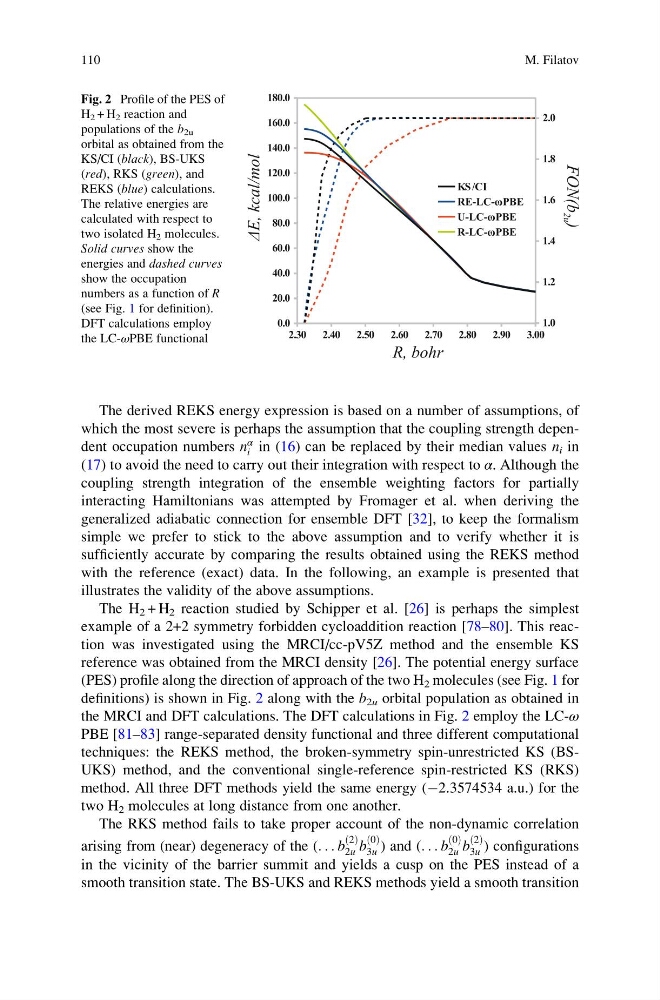
reference was obtained from the MRCI density [26]. The potential energy surface
(PES) profile along the direction of approach of the two H 2 molecules (see Fig. 1 for
definitions) is shown in Fig. 2 along with the b 2u orbital population as obtained in
the MRCI and DFT calculations. The DFT calculations in Fig. 2 employ the LC-ω
PBE [81–83] range-separated density functional and three different computational
techniques: the REKS method, the broken-symmetry spin-unrestricted KS (BSUKS) method, and the conventional single-reference spin-restricted KS (RKS)
method. All three DFT methods yield the same energy (À2.3574534 a.u.) for the
two H 2 molecules at long distance from one another.
The RKS method fails to take proper account of the non-dynamic correlation
arising from (near) degeneracy of the (. . . b
ð2Þ
2u b
ð0Þ
3u ) and (. . . b
ð0Þ
2u b
ð2Þ
3u ) configurations
in the vicinity of the barrier summit and yields a cusp on the PES instead of a
smooth transition state. The BS-UKS and REKS methods yield a smooth transition
Fig. 2 Profile of the PES of
H 2 + H 2 reaction and
populations of the b 2u
orbital as obtained from the
KS/CI (black), BS-UKS
(red), RKS (green), and
REKS (blue) calculations.
The relative energies are
calculated with respect to
two isolated H 2 molecules.
Solid curves show the
energies and dashed curves
show the occupation
numbers as a function of R
(see Fig. 1 for definition).
DFT calculations employ
the LC-ωPBE functional
110
M. Filatov
which the most severe is perhaps the assumption that the coupling strength dependent occupation numbers n
α
i in (16) can be replaced by their median values n i in
(17) to avoid the need to carry out their integration with respect to α. Although the
coupling strength integration of the ensemble weighting factors for partially
interacting Hamiltonians was attempted by Fromager et al. when deriving the
generalized adiabatic connection for ensemble DFT [32], to keep the formalism
simple we prefer to stick to the above assumption and to verify whether it is
sufficiently accurate by comparing the results obtained using the REKS method
with the reference (exact) data. In the following, an example is presented that
illustrates the validity of the above assumptions.
The H 2 + H 2 reaction studied by Schipper et al. [26] is perhaps the simplest
example of a 2+2 symmetry forbidden cycloaddition reaction [78–80]. This reaction was investigated using the MRCI/cc-pV5Z method and the ensemble KS
reference was obtained from the MRCI density [26]. The potential energy surface
(PES) profile along the direction of approach of the two H 2 molecules (see Fig. 1 for
definitions) is shown in Fig. 2 along with the b 2u orbital population as obtained in
the MRCI and DFT calculations. The DFT calculations in Fig. 2 employ the LC-ω
PBE [81–83] range-separated density functional and three different computational
techniques: the REKS method, the broken-symmetry spin-unrestricted KS (BSUKS) method, and the conventional single-reference spin-restricted KS (RKS)
method. All three DFT methods yield the same energy (À2.3574534 a.u.) for the
two H 2 molecules at long distance from one another.
The RKS method fails to take proper account of the non-dynamic correlation
arising from (near) degeneracy of the (. . . b
ð2Þ
2u b
ð0Þ
3u ) and (. . . b
ð0Þ
2u b
ð2Þ
3u ) configurations
in the vicinity of the barrier summit and yields a cusp on the PES instead of a
smooth transition state. The BS-UKS and REKS methods yield a smooth transition
Fig. 2 Profile of the PES of
H 2 + H 2 reaction and
populations of the b 2u
orbital as obtained from the
KS/CI (black), BS-UKS
(red), RKS (green), and
REKS (blue) calculations.
The relative energies are
calculated with respect to
two isolated H 2 molecules.
Solid curves show the
energies and dashed curves
show the occupation
numbers as a function of R
(see Fig. 1 for definition).
DFT calculations employ
the LC-ωPBE functional
110
M. Filatov