

character of the system subsides to a level commensurate with the pure-state
v-representability, the ensemble energy in (17) should collapse to the usual KS
DFT single-reference energy. Analyzing the dependence of the single-reference KS
DFT energy on the FONs of the frontier orbitals near, say, n a % 2 and n b % 0,
an expression similar to (17) can be obtained with the difference that the factor
(n a n b )
1/2 approaches (n a n b )
1 [71, 72]. It is thus plausible to introduce a function that
interpolates between the two asymptotes, the strong and the weak non-dynamic
correlation, and to cast (17) in the form of [35]
E
REKS 2;2
ð Þ
¼
n a
2
E DFT . . . ϕ a ϕ a
Â
à þ
n b
2
E DFT . . . ϕ b ϕ b
Â
Ã
þ f n a ; n b
ð
Þ E DFT . . . ϕ a ϕ b
½
ÀE DFT . . . ϕ a ϕ b
Â
à þ E DFT . . . ϕ a ϕ b
Â
à À E DFT . . . ϕ a ϕ b
Â
Ã
À
Á ;
ð23Þ
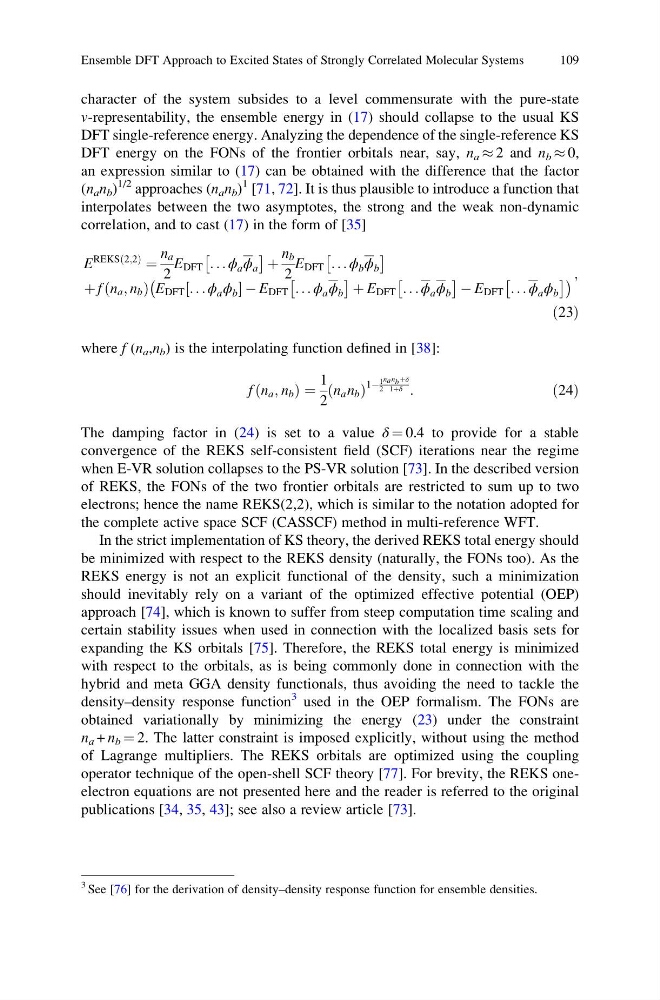
where f (n a ,n b ) is the interpolating function defined in [38]:
f n a ; n b
ð
Þ¼
1
2
n a n b
ð
Þ
1À
1
2
nan b þδ
1þδ :
ð24Þ
The damping factor in (24) is set to a value δ ¼ 0.4 to provide for a stable
convergence of the REKS self-consistent field (SCF) iterations near the regime
when E-VR solution collapses to the PS-VR solution [73]. In the described version
of REKS, the FONs of the two frontier orbitals are restricted to sum up to two
electrons; hence the name REKS(2,2), which is similar to the notation adopted for
the complete active space SCF (CASSCF) method in multi-reference WFT.
In the strict implementation of KS theory, the derived REKS total energy should
be minimized with respect to the REKS density (naturally, the FONs too). As the
REKS energy is not an explicit functional of the density, such a minimization
should inevitably rely on a variant of the optimized effective potential (OEP)
approach [74], which is known to suffer from steep computation time scaling and
certain stability issues when used in connection with the localized basis sets for
expanding the KS orbitals [75]. Therefore, the REKS total energy is minimized
with respect to the orbitals, as is being commonly done in connection with the
hybrid and meta GGA density functionals, thus avoiding the need to tackle the
density–density response function
3 used in the OEP formalism. The FONs are
obtained variationally by minimizing the energy (23) under the constraint
n a + n b ¼ 2. The latter constraint is imposed explicitly, without using the method
of Lagrange multipliers. The REKS orbitals are optimized using the coupling
operator technique of the open-shell SCF theory [77]. For brevity, the REKS oneelectron equations are not presented here and the reader is referred to the original
publications [34, 35, 43]; see also a review article [73].
3 See [76] for the derivation of density–density response function for ensemble densities.
Ensemble DFT Approach to Excited States of Strongly Correlated Molecular Systems
109
v-representability, the ensemble energy in (17) should collapse to the usual KS
DFT single-reference energy. Analyzing the dependence of the single-reference KS
DFT energy on the FONs of the frontier orbitals near, say, n a % 2 and n b % 0,
an expression similar to (17) can be obtained with the difference that the factor
(n a n b )
1/2 approaches (n a n b )
1 [71, 72]. It is thus plausible to introduce a function that
interpolates between the two asymptotes, the strong and the weak non-dynamic
correlation, and to cast (17) in the form of [35]
E
REKS 2;2
ð Þ
¼
n a
2
E DFT . . . ϕ a ϕ a
Â
à þ
n b
2
E DFT . . . ϕ b ϕ b
Â
Ã
þ f n a ; n b
ð
Þ E DFT . . . ϕ a ϕ b
½
ÀE DFT . . . ϕ a ϕ b
Â
à þ E DFT . . . ϕ a ϕ b
Â
à À E DFT . . . ϕ a ϕ b
Â
Ã
À
Á ;
ð23Þ
where f (n a ,n b ) is the interpolating function defined in [38]:
f n a ; n b
ð
Þ¼
1
2
n a n b
ð
Þ
1À
1
2
nan b þδ
1þδ :
ð24Þ
The damping factor in (24) is set to a value δ ¼ 0.4 to provide for a stable
convergence of the REKS self-consistent field (SCF) iterations near the regime
when E-VR solution collapses to the PS-VR solution [73]. In the described version
of REKS, the FONs of the two frontier orbitals are restricted to sum up to two
electrons; hence the name REKS(2,2), which is similar to the notation adopted for
the complete active space SCF (CASSCF) method in multi-reference WFT.
In the strict implementation of KS theory, the derived REKS total energy should
be minimized with respect to the REKS density (naturally, the FONs too). As the
REKS energy is not an explicit functional of the density, such a minimization
should inevitably rely on a variant of the optimized effective potential (OEP)
approach [74], which is known to suffer from steep computation time scaling and
certain stability issues when used in connection with the localized basis sets for
expanding the KS orbitals [75]. Therefore, the REKS total energy is minimized
with respect to the orbitals, as is being commonly done in connection with the
hybrid and meta GGA density functionals, thus avoiding the need to tackle the
density–density response function
3 used in the OEP formalism. The FONs are
obtained variationally by minimizing the energy (23) under the constraint
n a + n b ¼ 2. The latter constraint is imposed explicitly, without using the method
of Lagrange multipliers. The REKS orbitals are optimized using the coupling
operator technique of the open-shell SCF theory [77]. For brevity, the REKS oneelectron equations are not presented here and the reader is referred to the original
publications [34, 35, 43]; see also a review article [73].
3 See [76] for the derivation of density–density response function for ensemble densities.
Ensemble DFT Approach to Excited States of Strongly Correlated Molecular Systems
109