

E α . . . ϕ a ϕ a
Â
Ã
K
α
ab
K
α
ab
E α . . . ϕ b ϕ b
Â
Ã
¼
E 0 . . . ϕ a ϕ a
Â
Ã
0
0
E 0 . . . ϕ b ϕ b
Â
Ã
þ α
dE α . . . ϕ a ϕ a
Â
Ã
dα
dK
α
ab
dα
dK
α
ab
dα
dE α . . . ϕ b ϕ b
Â
Ã
dα
0
B
B
@
1
C
C
A
þ O α
2
À Á
;
ð20Þ
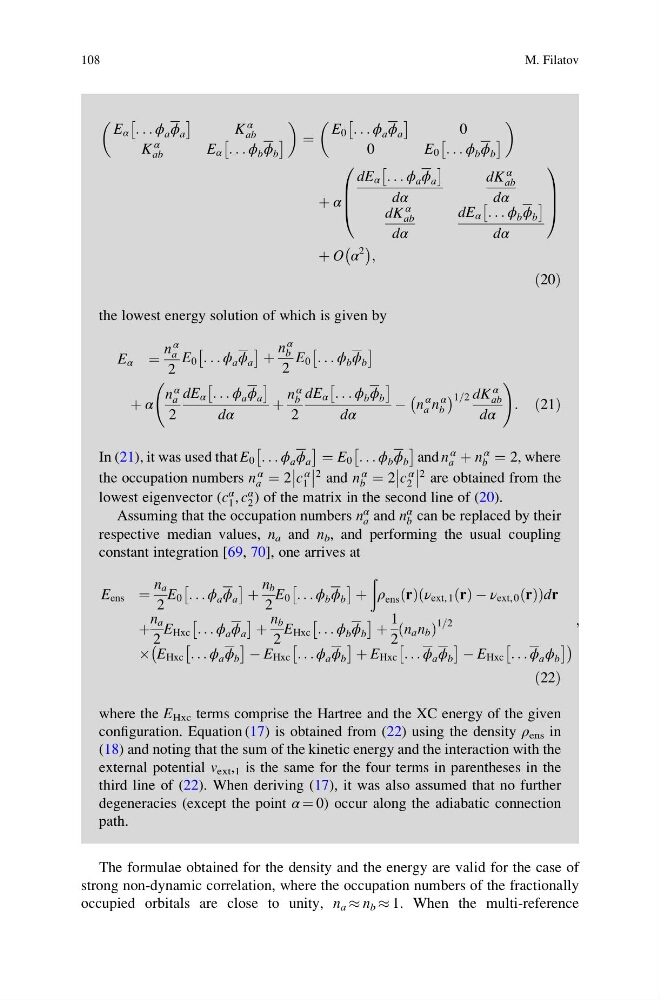
the lowest energy solution of which is given by
E α ¼
n
α
a
2
E 0 . . . ϕ a ϕ a
Â
à þ
n
α
b
2
E 0 . . . ϕ b ϕ b
Â
Ã
þ α
n
α
a
2
dE α . . . ϕ a ϕ a
Â
Ã
dα
þ
n
α
b
2
dE α . . . ϕ b ϕ b
Â
Ã
dα
À n
α
a n
α
b
À
Á 1=2 dK
α
ab
dα
!
: ð21Þ
In (21), it was used that E 0 . . . ϕ a ϕ a
Â
à ¼ E 0 . . . ϕ b ϕ b
Â
Ã
and n
α
a þ n
α
b ¼ 2, where
the occupation numbers n
α
a ¼ 2
c
α
1
2 and n
α
b ¼ 2
c
α
2
2 are obtained from the
lowest eigenvector (c
α
1 , c
α
2 ) of the matrix in the second line of (20).
Assuming that the occupation numbers n
α
a and n
α
b can be replaced by their
respective median values, n a and n b , and performing the usual coupling
constant integration [69, 70], one arrives at
E ens ¼
n a
2
E 0 . . . ϕ a ϕ a
Â
à þ
n b
2
E 0 . . . ϕ b ϕ b
Â
à þ
ð
ρ ens r
ð Þ ν ext, 1 r
ð Þ À ν ext, 0 r
ð Þ
ð
Þ dr
þ
n a
2
E Hxc . . . ϕ a ϕ a
Â
à þ
n b
2
E Hxc . . . ϕ b ϕ b
Â
à þ
1
2
n a n b
ð
Þ
1=2
 E Hxc . . . ϕ a ϕ b
Â
à À E Hxc . . . ϕ a ϕ b
Â
à þ E Hxc . . . ϕ a ϕ b
Â
à À E Hxc . . . ϕ a ϕ b
Â
Ã
À
Á
;
ð22Þ
where the E Hxc terms comprise the Hartree and the XC energy of the given
configuration. Equation (17) is obtained from (22) using the density ρ ens in
(18) and noting that the sum of the kinetic energy and the interaction with the
external potential v ext , 1 is the same for the four terms in parentheses in the
third line of (22). When deriving (17), it was also assumed that no further
degeneracies (except the point α ¼ 0) occur along the adiabatic connection
path.
The formulae obtained for the density and the energy are valid for the case of
strong non-dynamic correlation, where the occupation numbers of the fractionally
occupied orbitals are close to unity, n a % n b % 1. When the multi-reference
108
M. Filatov
Â
Ã
K
α
ab
K
α
ab
E α . . . ϕ b ϕ b
Â
Ã
¼
E 0 . . . ϕ a ϕ a
Â
Ã
0
0
E 0 . . . ϕ b ϕ b
Â
Ã
þ α
dE α . . . ϕ a ϕ a
Â
Ã
dα
dK
α
ab
dα
dK
α
ab
dα
dE α . . . ϕ b ϕ b
Â
Ã
dα
0
B
B
@
1
C
C
A
þ O α
2
À Á
;
ð20Þ
the lowest energy solution of which is given by
E α ¼
n
α
a
2
E 0 . . . ϕ a ϕ a
Â
à þ
n
α
b
2
E 0 . . . ϕ b ϕ b
Â
Ã
þ α
n
α
a
2
dE α . . . ϕ a ϕ a
Â
Ã
dα
þ
n
α
b
2
dE α . . . ϕ b ϕ b
Â
Ã
dα
À n
α
a n
α
b
À
Á 1=2 dK
α
ab
dα
!
: ð21Þ
In (21), it was used that E 0 . . . ϕ a ϕ a
Â
à ¼ E 0 . . . ϕ b ϕ b
Â
Ã
and n
α
a þ n
α
b ¼ 2, where
the occupation numbers n
α
a ¼ 2
c
α
1
2 and n
α
b ¼ 2
c
α
2
2 are obtained from the
lowest eigenvector (c
α
1 , c
α
2 ) of the matrix in the second line of (20).
Assuming that the occupation numbers n
α
a and n
α
b can be replaced by their
respective median values, n a and n b , and performing the usual coupling
constant integration [69, 70], one arrives at
E ens ¼
n a
2
E 0 . . . ϕ a ϕ a
Â
à þ
n b
2
E 0 . . . ϕ b ϕ b
Â
à þ
ð
ρ ens r
ð Þ ν ext, 1 r
ð Þ À ν ext, 0 r
ð Þ
ð
Þ dr
þ
n a
2
E Hxc . . . ϕ a ϕ a
Â
à þ
n b
2
E Hxc . . . ϕ b ϕ b
Â
à þ
1
2
n a n b
ð
Þ
1=2
 E Hxc . . . ϕ a ϕ b
Â
à À E Hxc . . . ϕ a ϕ b
Â
à þ E Hxc . . . ϕ a ϕ b
Â
à À E Hxc . . . ϕ a ϕ b
Â
Ã
À
Á
;
ð22Þ
where the E Hxc terms comprise the Hartree and the XC energy of the given
configuration. Equation (17) is obtained from (22) using the density ρ ens in
(18) and noting that the sum of the kinetic energy and the interaction with the
external potential v ext , 1 is the same for the four terms in parentheses in the
third line of (22). When deriving (17), it was also assumed that no further
degeneracies (except the point α ¼ 0) occur along the adiabatic connection
path.
The formulae obtained for the density and the energy are valid for the case of
strong non-dynamic correlation, where the occupation numbers of the fractionally
occupied orbitals are close to unity, n a % n b % 1. When the multi-reference
108
M. Filatov