

E ens ¼
n a
2
E DFT . . . ϕ a ϕ a
Â
à þ
n b
2
E DFT . . . ϕ b ϕ b
Â
à þ
1
2
n a n b
ð
Þ
1=2
 E DFT . . . ϕ a ϕ b
½
ÀE DFT . . . ϕ a ϕ b
Â
à þ E DFT . . . ϕ a ϕ b
Â
à À E DFT . . . ϕ a ϕ b
Â
Ã
À
Á ;
ð17Þ
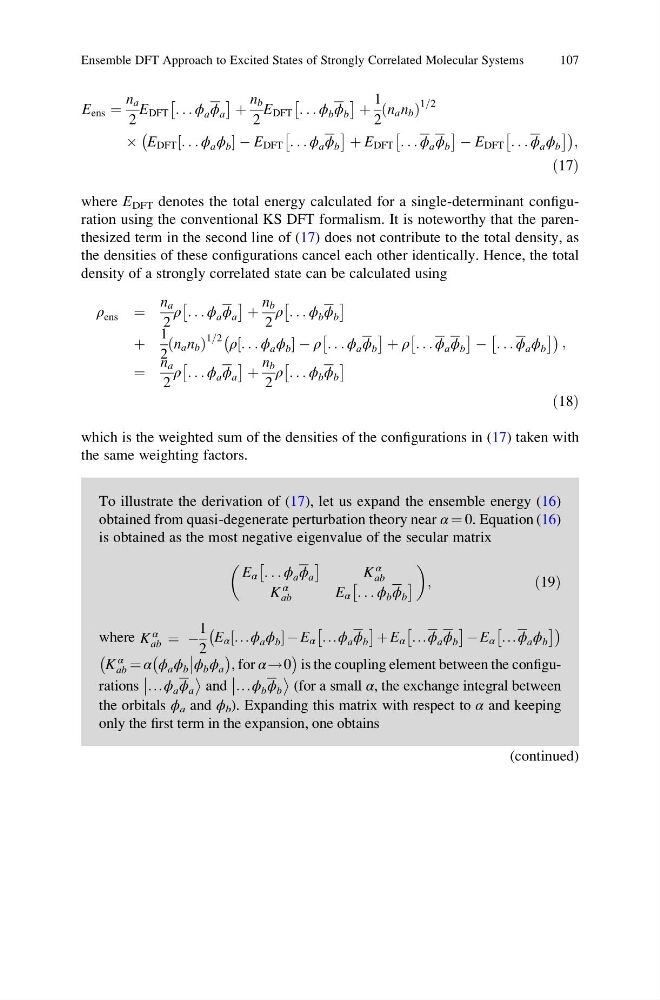
where E DFT denotes the total energy calculated for a single-determinant configuration using the conventional KS DFT formalism. It is noteworthy that the parenthesized term in the second line of (17) does not contribute to the total density, as
the densities of these configurations cancel each other identically. Hence, the total
density of a strongly correlated state can be calculated using
ρ ens ¼
n a
2
ρ . . . ϕ a ϕ a
Â
à þ
n b
2
ρ . . . ϕ b ϕ b
Â
Ã
þ
1
2
n a n b
ð
Þ
1=2 ρ . . . ϕ a ϕ b
½
Àρ . . . ϕ a ϕ b
Â
à þ ρ . . . ϕ a ϕ b
Â
à À . . . ϕ a ϕ b
Â
Ã
À
Á
¼
n a
2
ρ . . . ϕ a ϕ a
Â
à þ
n b
2
ρ . . . ϕ b ϕ b
Â
Ã
;
ð18Þ
which is the weighted sum of the densities of the configurations in (17) taken with
the same weighting factors.
To illustrate the derivation of (17), let us expand the ensemble energy (16)
obtained from quasi-degenerate perturbation theory near α ¼ 0. Equation (16)
is obtained as the most negative eigenvalue of the secular matrix
E α . . . ϕ a ϕ a
Â
Ã
K
α
ab
K
α
ab
E α . . . ϕ b ϕ b
Â
Ã
;
ð19Þ
where K
α
ab ¼ À
1
2
E α ...ϕ a ϕ b
½
ÀE α ...ϕ a ϕ b
Â
à þ E α ...ϕ a ϕ b
Â
à À E α ...ϕ a ϕ b
Â
Ã
À
Á
À
K
α
ab ¼ α ϕ a ϕ b
ϕ b ϕ a
À
Á
, for α!0
Á
is the coupling element between the configurations ...ϕ a ϕ a
and ...ϕ b ϕ b
(for a small α, the exchange integral between
the orbitals ϕ a and ϕ b ). Expanding this matrix with respect to α and keeping
only the first term in the expansion, one obtains
(continued)
Ensemble DFT Approach to Excited States of Strongly Correlated Molecular Systems
107
n a
2
E DFT . . . ϕ a ϕ a
Â
à þ
n b
2
E DFT . . . ϕ b ϕ b
Â
à þ
1
2
n a n b
ð
Þ
1=2
 E DFT . . . ϕ a ϕ b
½
ÀE DFT . . . ϕ a ϕ b
Â
à þ E DFT . . . ϕ a ϕ b
Â
à À E DFT . . . ϕ a ϕ b
Â
Ã
À
Á ;
ð17Þ
where E DFT denotes the total energy calculated for a single-determinant configuration using the conventional KS DFT formalism. It is noteworthy that the parenthesized term in the second line of (17) does not contribute to the total density, as
the densities of these configurations cancel each other identically. Hence, the total
density of a strongly correlated state can be calculated using
ρ ens ¼
n a
2
ρ . . . ϕ a ϕ a
Â
à þ
n b
2
ρ . . . ϕ b ϕ b
Â
Ã
þ
1
2
n a n b
ð
Þ
1=2 ρ . . . ϕ a ϕ b
½
Àρ . . . ϕ a ϕ b
Â
à þ ρ . . . ϕ a ϕ b
Â
à À . . . ϕ a ϕ b
Â
Ã
À
Á
¼
n a
2
ρ . . . ϕ a ϕ a
Â
à þ
n b
2
ρ . . . ϕ b ϕ b
Â
Ã
;
ð18Þ
which is the weighted sum of the densities of the configurations in (17) taken with
the same weighting factors.
To illustrate the derivation of (17), let us expand the ensemble energy (16)
obtained from quasi-degenerate perturbation theory near α ¼ 0. Equation (16)
is obtained as the most negative eigenvalue of the secular matrix
E α . . . ϕ a ϕ a
Â
Ã
K
α
ab
K
α
ab
E α . . . ϕ b ϕ b
Â
Ã
;
ð19Þ
where K
α
ab ¼ À
1
2
E α ...ϕ a ϕ b
½
ÀE α ...ϕ a ϕ b
Â
à þ E α ...ϕ a ϕ b
Â
à À E α ...ϕ a ϕ b
Â
Ã
À
Á
À
K
α
ab ¼ α ϕ a ϕ b
ϕ b ϕ a
À
Á
, for α!0
Á
is the coupling element between the configurations ...ϕ a ϕ a
and ...ϕ b ϕ b
(for a small α, the exchange integral between
the orbitals ϕ a and ϕ b ). Expanding this matrix with respect to α and keeping
only the first term in the expansion, one obtains
(continued)
Ensemble DFT Approach to Excited States of Strongly Correlated Molecular Systems
107