

The ensemble KS solution obtained which comprises the densities and energies
of two electronic configurations, where each is represented by a single KS determinant, corresponds to a system of non-interacting particles. To derive an energy
expression that would conform with the ensemble representation and would yield
the energy of a system of interacting electrons, let us make use of the adiabatic
connection formalism [69], i.e., let us gradually switch the electron–electron
interaction on and simultaneously modify the external potential in such a way
that the total density remains unchanged [70]; see the Hamiltonian
^
H α ¼
X
i
À
1
2
∇
2
i þ
X
i
v ext, α r i
ð Þ þ
X
i> j
α
r i j
;
ð15Þ
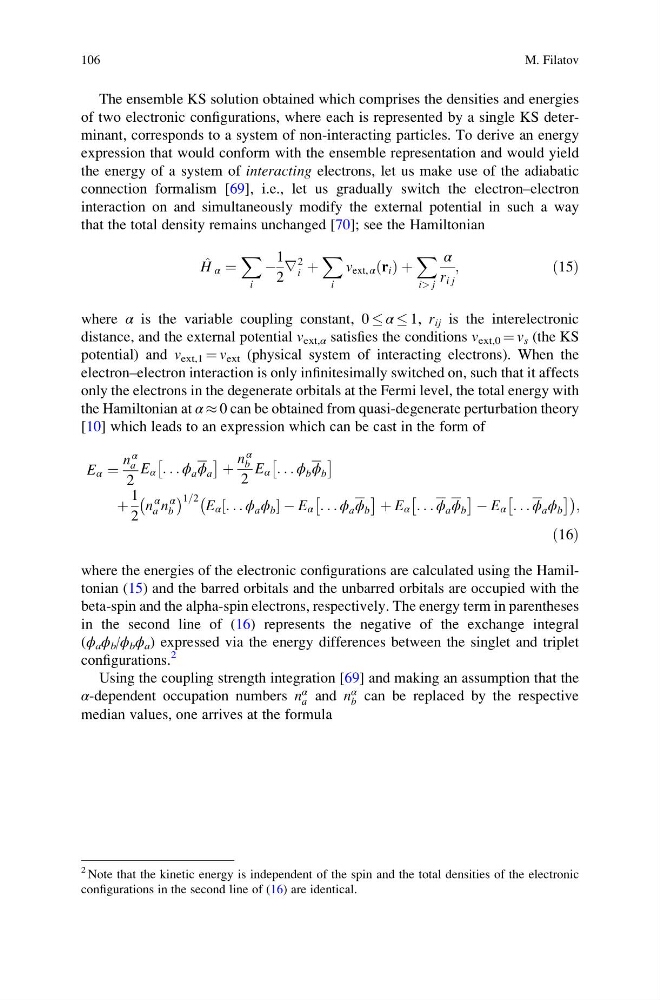
where α is the variable coupling constant, 0 α 1, r ij is the interelectronic
distance, and the external potential v ext,α satisfies the conditions v ext,0 ¼ v s (the KS
potential) and v ext,1 ¼ v ext (physical system of interacting electrons). When the
electron–electron interaction is only infinitesimally switched on, such that it affects
only the electrons in the degenerate orbitals at the Fermi level, the total energy with
the Hamiltonian at α % 0 can be obtained from quasi-degenerate perturbation theory
[10] which leads to an expression which can be cast in the form of
E α ¼
n
α
a
2
E α . . . ϕ a ϕ a
Â
à þ
n
α
b
2
E α . . . ϕ b ϕ b
Â
Ã
þ
1
2
n
α
a n
α
b
À
Á 1=2 E α . . . ϕ a ϕ b
½
ÀE α . . . ϕ a ϕ b
Â
à þ E α . . . ϕ a ϕ b
Â
à À E α . . . ϕ a ϕ b
Â
Ã
À
Á
;
ð16Þ
where the energies of the electronic configurations are calculated using the Hamiltonian (15) and the barred orbitals and the unbarred orbitals are occupied with the
beta-spin and the alpha-spin electrons, respectively. The energy term in parentheses
in the second line of (16) represents the negative of the exchange integral
(ϕ a ϕ b |ϕ b ϕ a ) expressed via the energy differences between the singlet and triplet
configurations.
2
Using the coupling strength integration [69] and making an assumption that the
α-dependent occupation numbers n
α
a and n
α
b can be replaced by the respective
median values, one arrives at the formula
2 Note that the kinetic energy is independent of the spin and the total densities of the electronic
configurations in the second line of (16) are identical.
106
M. Filatov
of two electronic configurations, where each is represented by a single KS determinant, corresponds to a system of non-interacting particles. To derive an energy
expression that would conform with the ensemble representation and would yield
the energy of a system of interacting electrons, let us make use of the adiabatic
connection formalism [69], i.e., let us gradually switch the electron–electron
interaction on and simultaneously modify the external potential in such a way
that the total density remains unchanged [70]; see the Hamiltonian
^
H α ¼
X
i
À
1
2
∇
2
i þ
X
i
v ext, α r i
ð Þ þ
X
i> j
α
r i j
;
ð15Þ
where α is the variable coupling constant, 0 α 1, r ij is the interelectronic
distance, and the external potential v ext,α satisfies the conditions v ext,0 ¼ v s (the KS
potential) and v ext,1 ¼ v ext (physical system of interacting electrons). When the
electron–electron interaction is only infinitesimally switched on, such that it affects
only the electrons in the degenerate orbitals at the Fermi level, the total energy with
the Hamiltonian at α % 0 can be obtained from quasi-degenerate perturbation theory
[10] which leads to an expression which can be cast in the form of
E α ¼
n
α
a
2
E α . . . ϕ a ϕ a
Â
à þ
n
α
b
2
E α . . . ϕ b ϕ b
Â
Ã
þ
1
2
n
α
a n
α
b
À
Á 1=2 E α . . . ϕ a ϕ b
½
ÀE α . . . ϕ a ϕ b
Â
à þ E α . . . ϕ a ϕ b
Â
à À E α . . . ϕ a ϕ b
Â
Ã
À
Á
;
ð16Þ
where the energies of the electronic configurations are calculated using the Hamiltonian (15) and the barred orbitals and the unbarred orbitals are occupied with the
beta-spin and the alpha-spin electrons, respectively. The energy term in parentheses
in the second line of (16) represents the negative of the exchange integral
(ϕ a ϕ b |ϕ b ϕ a ) expressed via the energy differences between the singlet and triplet
configurations.
2
Using the coupling strength integration [69] and making an assumption that the
α-dependent occupation numbers n
α
a and n
α
b can be replaced by the respective
median values, one arrives at the formula
2 Note that the kinetic energy is independent of the spin and the total densities of the electronic
configurations in the second line of (16) are identical.
106
M. Filatov