

occupations of the frontier orbitals to obtain the non-interacting KS reference
system and v s (r) corresponding to the criteria behind the KS method of DFT;
only the ensemble representation guaranteed the lowest-energy ground state of
the KS system; otherwise there occurred holes below the Fermi level (not a ground
state) and the resulting single determinant state lied at a somewhat higher energy
[26].
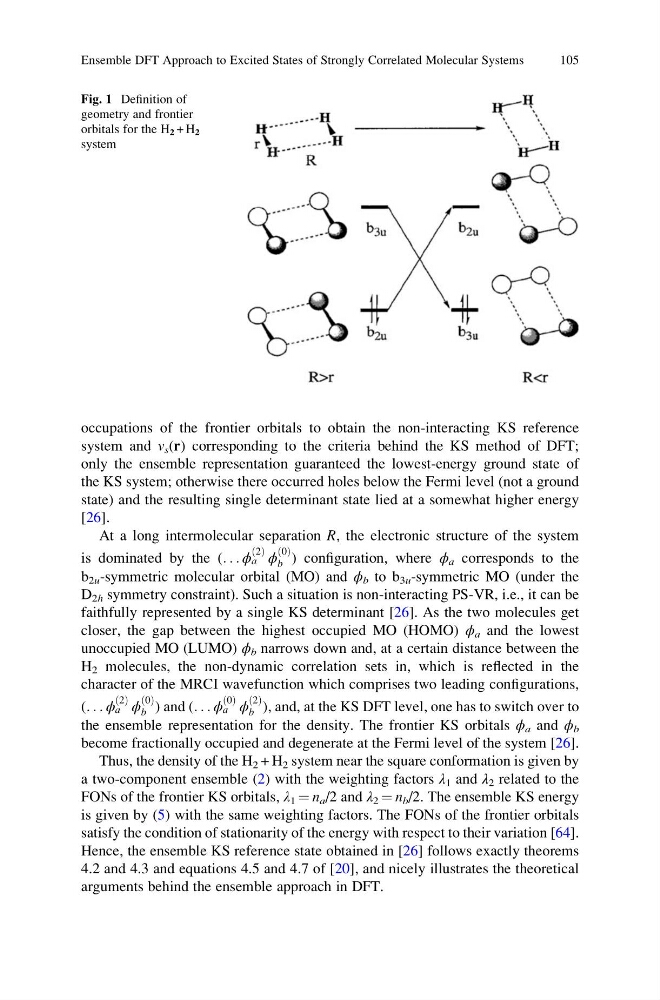
At a long intermolecular separation R, the electronic structure of the system
is dominated by the (. . . ϕ
ð2Þ
a ϕ
ð0Þ
b ) configuration, where ϕ a corresponds to the
b 2u -symmetric molecular orbital (MO) and ϕ b to b 3u -symmetric MO (under the
D 2h symmetry constraint). Such a situation is non-interacting PS-VR, i.e., it can be
faithfully represented by a single KS determinant [26]. As the two molecules get
closer, the gap between the highest occupied MO (HOMO) ϕ a and the lowest
unoccupied MO (LUMO) ϕ b narrows down and, at a certain distance between the
H 2 molecules, the non-dynamic correlation sets in, which is reflected in the
character of the MRCI wavefunction which comprises two leading configurations,
(. . . ϕ
ð2Þ
a ϕ
ð0Þ
b ) and (. . . ϕ
ð0Þ
a ϕ
ð2Þ
b ), and, at the KS DFT level, one has to switch over to
the ensemble representation for the density. The frontier KS orbitals ϕ a and ϕ b
become fractionally occupied and degenerate at the Fermi level of the system [26].
Thus, the density of the H 2 + H 2 system near the square conformation is given by
a two-component ensemble (2) with the weighting factors λ 1 and λ 2 related to the
FONs of the frontier KS orbitals, λ 1 ¼ n a /2 and λ 2 ¼ n b /2. The ensemble KS energy
is given by (5) with the same weighting factors. The FONs of the frontier orbitals
satisfy the condition of stationarity of the energy with respect to their variation [64].
Hence, the ensemble KS reference state obtained in [26] follows exactly theorems
4.2 and 4.3 and equations 4.5 and 4.7 of [20], and nicely illustrates the theoretical
arguments behind the ensemble approach in DFT.
Fig. 1 Definition of
geometry and frontier
orbitals for the H 2 + H 2
system
Ensemble DFT Approach to Excited States of Strongly Correlated Molecular Systems
105
system and v s (r) corresponding to the criteria behind the KS method of DFT;
only the ensemble representation guaranteed the lowest-energy ground state of
the KS system; otherwise there occurred holes below the Fermi level (not a ground
state) and the resulting single determinant state lied at a somewhat higher energy
[26].
At a long intermolecular separation R, the electronic structure of the system
is dominated by the (. . . ϕ
ð2Þ
a ϕ
ð0Þ
b ) configuration, where ϕ a corresponds to the
b 2u -symmetric molecular orbital (MO) and ϕ b to b 3u -symmetric MO (under the
D 2h symmetry constraint). Such a situation is non-interacting PS-VR, i.e., it can be
faithfully represented by a single KS determinant [26]. As the two molecules get
closer, the gap between the highest occupied MO (HOMO) ϕ a and the lowest
unoccupied MO (LUMO) ϕ b narrows down and, at a certain distance between the
H 2 molecules, the non-dynamic correlation sets in, which is reflected in the
character of the MRCI wavefunction which comprises two leading configurations,
(. . . ϕ
ð2Þ
a ϕ
ð0Þ
b ) and (. . . ϕ
ð0Þ
a ϕ
ð2Þ
b ), and, at the KS DFT level, one has to switch over to
the ensemble representation for the density. The frontier KS orbitals ϕ a and ϕ b
become fractionally occupied and degenerate at the Fermi level of the system [26].
Thus, the density of the H 2 + H 2 system near the square conformation is given by
a two-component ensemble (2) with the weighting factors λ 1 and λ 2 related to the
FONs of the frontier KS orbitals, λ 1 ¼ n a /2 and λ 2 ¼ n b /2. The ensemble KS energy
is given by (5) with the same weighting factors. The FONs of the frontier orbitals
satisfy the condition of stationarity of the energy with respect to their variation [64].
Hence, the ensemble KS reference state obtained in [26] follows exactly theorems
4.2 and 4.3 and equations 4.5 and 4.7 of [20], and nicely illustrates the theoretical
arguments behind the ensemble approach in DFT.
Fig. 1 Definition of
geometry and frontier
orbitals for the H 2 + H 2
system
Ensemble DFT Approach to Excited States of Strongly Correlated Molecular Systems
105