

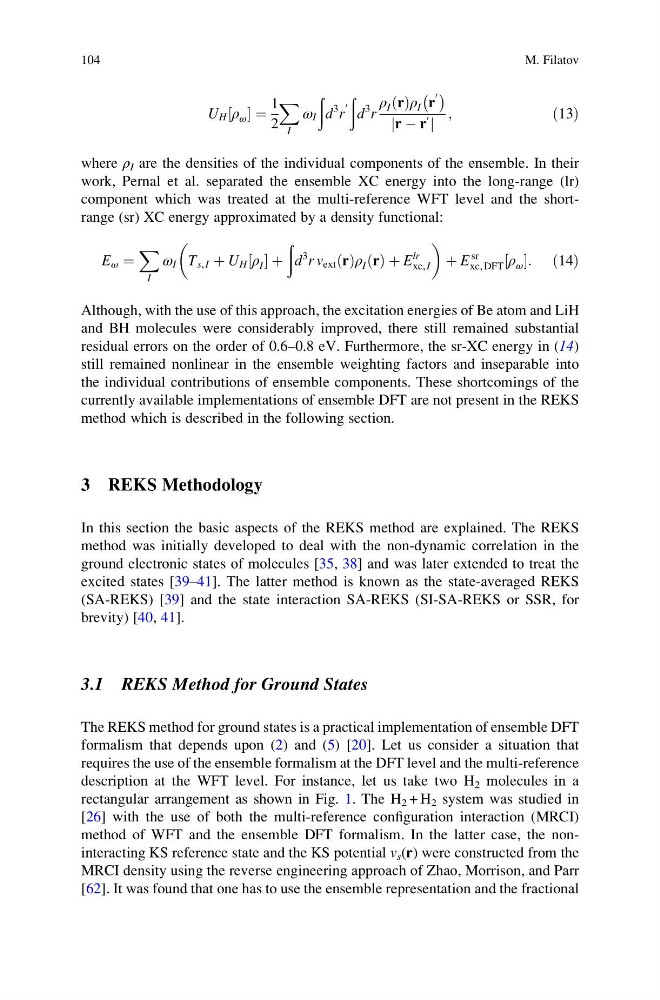
U H ρ ω
½ ¼
1
2
X
I
ω I
ð
d
3 r
0
ð
d
3 r
ρ I r
ð Þρ I r
0
À Á
r À r
0
j
j
;
ð13Þ
where ρ I are the densities of the individual components of the ensemble. In their
work, Pernal et al. separated the ensemble XC energy into the long-range (lr)
component which was treated at the multi-reference WFT level and the shortrange (sr) XC energy approximated by a density functional:
E ω ¼
X
I
ω I T s, I þ U H ρ I
½ þ
ð
d
3 r v ext r
ð Þρ I r
ð Þ þ E
lr
xc, I
þ E
sr
xc, DFT ρ ω
½ : ð14Þ
Although, with the use of this approach, the excitation energies of Be atom and LiH
and BH molecules were considerably improved, there still remained substantial
residual errors on the order of 0.6–0.8 eV. Furthermore, the sr-XC energy in (14)
still remained nonlinear in the ensemble weighting factors and inseparable into
the individual contributions of ensemble components. These shortcomings of the
currently available implementations of ensemble DFT are not present in the REKS
method which is described in the following section.
3 REKS Methodology
In this section the basic aspects of the REKS method are explained. The REKS
method was initially developed to deal with the non-dynamic correlation in the
ground electronic states of molecules [35, 38] and was later extended to treat the
excited states [39–41]. The latter method is known as the state-averaged REKS
(SA-REKS) [39] and the state interaction SA-REKS (SI-SA-REKS or SSR, for
brevity) [40, 41].
3.1 REKS Method for Ground States
The REKS method for ground states is a practical implementation of ensemble DFT
formalism that depends upon (2) and (5) [20]. Let us consider a situation that
requires the use of the ensemble formalism at the DFT level and the multi-reference
description at the WFT level. For instance, let us take two H 2 molecules in a
rectangular arrangement as shown in Fig. 1. The H 2 + H 2 system was studied in
[26] with the use of both the multi-reference configuration interaction (MRCI)
method of WFT and the ensemble DFT formalism. In the latter case, the noninteracting KS reference state and the KS potential v s (r) were constructed from the
MRCI density using the reverse engineering approach of Zhao, Morrison, and Parr
[62]. It was found that one has to use the ensemble representation and the fractional
104
M. Filatov
½ ¼
1
2
X
I
ω I
ð
d
3 r
0
ð
d
3 r
ρ I r
ð Þρ I r
0
À Á
r À r
0
j
j
;
ð13Þ
where ρ I are the densities of the individual components of the ensemble. In their
work, Pernal et al. separated the ensemble XC energy into the long-range (lr)
component which was treated at the multi-reference WFT level and the shortrange (sr) XC energy approximated by a density functional:
E ω ¼
X
I
ω I T s, I þ U H ρ I
½ þ
ð
d
3 r v ext r
ð Þρ I r
ð Þ þ E
lr
xc, I
þ E
sr
xc, DFT ρ ω
½ : ð14Þ
Although, with the use of this approach, the excitation energies of Be atom and LiH
and BH molecules were considerably improved, there still remained substantial
residual errors on the order of 0.6–0.8 eV. Furthermore, the sr-XC energy in (14)
still remained nonlinear in the ensemble weighting factors and inseparable into
the individual contributions of ensemble components. These shortcomings of the
currently available implementations of ensemble DFT are not present in the REKS
method which is described in the following section.
3 REKS Methodology
In this section the basic aspects of the REKS method are explained. The REKS
method was initially developed to deal with the non-dynamic correlation in the
ground electronic states of molecules [35, 38] and was later extended to treat the
excited states [39–41]. The latter method is known as the state-averaged REKS
(SA-REKS) [39] and the state interaction SA-REKS (SI-SA-REKS or SSR, for
brevity) [40, 41].
3.1 REKS Method for Ground States
The REKS method for ground states is a practical implementation of ensemble DFT
formalism that depends upon (2) and (5) [20]. Let us consider a situation that
requires the use of the ensemble formalism at the DFT level and the multi-reference
description at the WFT level. For instance, let us take two H 2 molecules in a
rectangular arrangement as shown in Fig. 1. The H 2 + H 2 system was studied in
[26] with the use of both the multi-reference configuration interaction (MRCI)
method of WFT and the ensemble DFT formalism. In the latter case, the noninteracting KS reference state and the KS potential v s (r) were constructed from the
MRCI density using the reverse engineering approach of Zhao, Morrison, and Parr
[62]. It was found that one has to use the ensemble representation and the fractional
104
M. Filatov