

Further theoretical developments of the ensemble DFT formalism for excited
states were recently undertaken in [31–33]. Pernal et al. [31] demonstrated that the
ensemble variational principle can be connected to the Helmholtz free-energy
variational principle of the statistical mechanics. Ullrich et al. [33] used the
ensemble formalism to construct the accurate exchange-correlation potentials for
ensembles of ground and excited states of He atoms and several model systems that
allow the exact solution (1D box and Hooke’s atom). Fromager et al. [32] derived
the generalized adiabatic connection formalism for ensemble DFT which can in
principle provide a framework for the development of a rigorous multi-determinant
DFT.
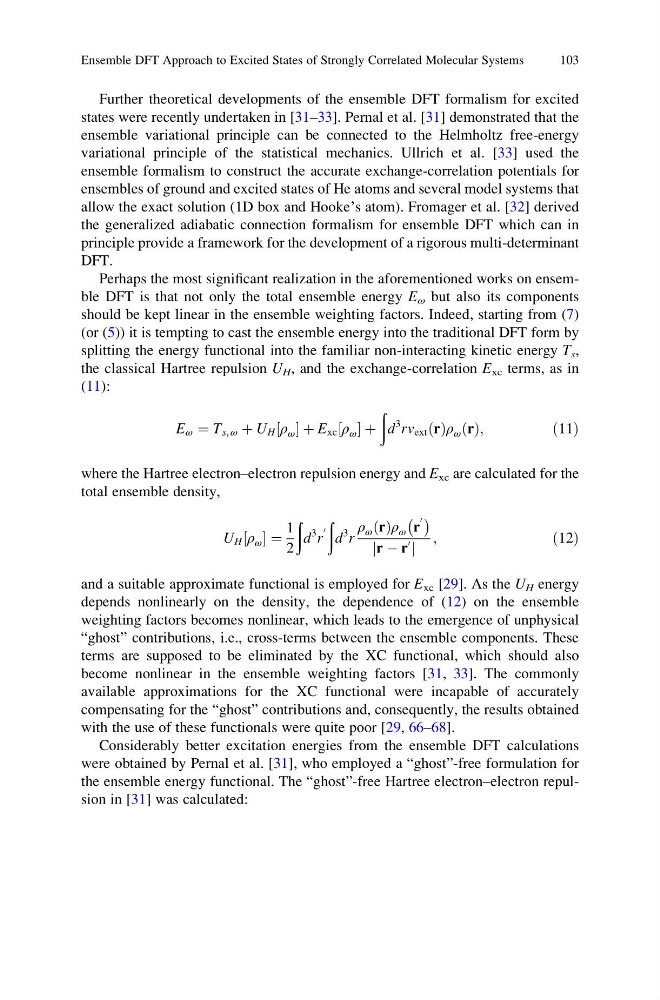
Perhaps the most significant realization in the aforementioned works on ensemble DFT is that not only the total ensemble energy E ω but also its components
should be kept linear in the ensemble weighting factors. Indeed, starting from (7)
(or (5)) it is tempting to cast the ensemble energy into the traditional DFT form by
splitting the energy functional into the familiar non-interacting kinetic energy T s ,
the classical Hartree repulsion U H , and the exchange-correlation E xc terms, as in
(11):
E ω ¼ T s, ω þ U H ρ ω
½ þ E xc ρ ω
½ þ
ð
d
3 rv ext r
ð Þρ ω r
ð Þ;
ð11Þ
where the Hartree electron–electron repulsion energy and E xc are calculated for the
total ensemble density,
U H ρ ω
½ ¼
1
2
ð
d
3 r
0
ð
d
3 r
ρ ω r
ð Þρ ω r
0
À Á
r À r
0
j
j
;
ð12Þ
and a suitable approximate functional is employed for E xc [29]. As the U H energy
depends nonlinearly on the density, the dependence of (12) on the ensemble
weighting factors becomes nonlinear, which leads to the emergence of unphysical
“ghost” contributions, i.e., cross-terms between the ensemble components. These
terms are supposed to be eliminated by the XC functional, which should also
become nonlinear in the ensemble weighting factors [31, 33]. The commonly
available approximations for the XC functional were incapable of accurately
compensating for the “ghost” contributions and, consequently, the results obtained
with the use of these functionals were quite poor [29, 66–68].
Considerably better excitation energies from the ensemble DFT calculations
were obtained by Pernal et al. [31], who employed a “ghost”-free formulation for
the ensemble energy functional. The “ghost”-free Hartree electron–electron repulsion in [31] was calculated:
Ensemble DFT Approach to Excited States of Strongly Correlated Molecular Systems
103
states were recently undertaken in [31–33]. Pernal et al. [31] demonstrated that the
ensemble variational principle can be connected to the Helmholtz free-energy
variational principle of the statistical mechanics. Ullrich et al. [33] used the
ensemble formalism to construct the accurate exchange-correlation potentials for
ensembles of ground and excited states of He atoms and several model systems that
allow the exact solution (1D box and Hooke’s atom). Fromager et al. [32] derived
the generalized adiabatic connection formalism for ensemble DFT which can in
principle provide a framework for the development of a rigorous multi-determinant
DFT.
Perhaps the most significant realization in the aforementioned works on ensemble DFT is that not only the total ensemble energy E ω but also its components
should be kept linear in the ensemble weighting factors. Indeed, starting from (7)
(or (5)) it is tempting to cast the ensemble energy into the traditional DFT form by
splitting the energy functional into the familiar non-interacting kinetic energy T s ,
the classical Hartree repulsion U H , and the exchange-correlation E xc terms, as in
(11):
E ω ¼ T s, ω þ U H ρ ω
½ þ E xc ρ ω
½ þ
ð
d
3 rv ext r
ð Þρ ω r
ð Þ;
ð11Þ
where the Hartree electron–electron repulsion energy and E xc are calculated for the
total ensemble density,
U H ρ ω
½ ¼
1
2
ð
d
3 r
0
ð
d
3 r
ρ ω r
ð Þρ ω r
0
À Á
r À r
0
j
j
;
ð12Þ
and a suitable approximate functional is employed for E xc [29]. As the U H energy
depends nonlinearly on the density, the dependence of (12) on the ensemble
weighting factors becomes nonlinear, which leads to the emergence of unphysical
“ghost” contributions, i.e., cross-terms between the ensemble components. These
terms are supposed to be eliminated by the XC functional, which should also
become nonlinear in the ensemble weighting factors [31, 33]. The commonly
available approximations for the XC functional were incapable of accurately
compensating for the “ghost” contributions and, consequently, the results obtained
with the use of these functionals were quite poor [29, 66–68].
Considerably better excitation energies from the ensemble DFT calculations
were obtained by Pernal et al. [31], who employed a “ghost”-free formulation for
the ensemble energy functional. The “ghost”-free Hartree electron–electron repulsion in [31] was calculated:
Ensemble DFT Approach to Excited States of Strongly Correlated Molecular Systems
103