

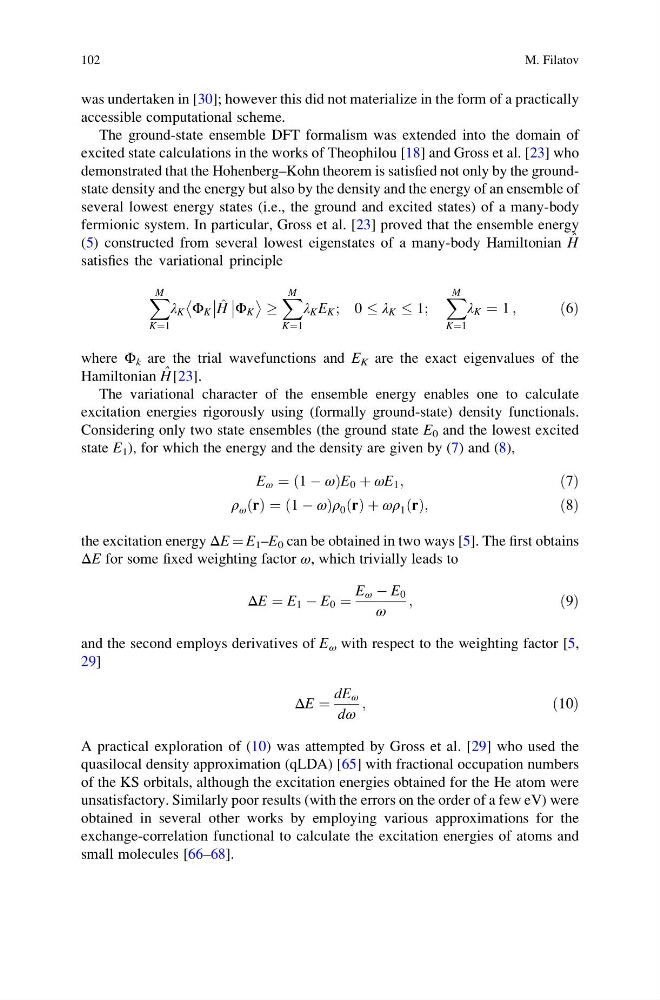
was undertaken in [30]; however this did not materialize in the form of a practically
accessible computational scheme.
The ground-state ensemble DFT formalism was extended into the domain of
excited state calculations in the works of Theophilou [18] and Gross et al. [23] who
demonstrated that the Hohenberg–Kohn theorem is satisfied not only by the groundstate density and the energy but also by the density and the energy of an ensemble of
several lowest energy states (i.e., the ground and excited states) of a many-body
fermionic system. In particular, Gross et al. [23] proved that the ensemble energy
(5) constructed from several lowest eigenstates of a many-body Hamiltonian H ˆ
satisfies the variational principle
X M
K¼1
λ K Φ K
^
H
Φ K
!
X M
K¼1
λ K E K ; 0 λ K 1;
X M
K¼1
λ K ¼ 1 ;
ð6Þ
where Φ k are the trial wavefunctions and E K are the exact eigenvalues of the
Hamiltonian H ˆ [23].
The variational character of the ensemble energy enables one to calculate
excitation energies rigorously using (formally ground-state) density functionals.
Considering only two state ensembles (the ground state E 0 and the lowest excited
state E 1 ), for which the energy and the density are given by (7) and (8),
E ω ¼ 1 À ω
ð
ÞE 0 þ ωE 1 ;
ð7Þ
ρ ω r
ð Þ ¼ 1 À ω
ð
Þρ 0 r
ð Þ þ ωρ 1 r
ð Þ;
ð8Þ
the excitation energy ΔE ¼ E 1 –E 0 can be obtained in two ways [5]. The first obtains
ΔE for some fixed weighting factor ω, which trivially leads to
ΔE ¼ E 1 À E 0 ¼
E ω À E 0
ω
;
ð9Þ
and the second employs derivatives of E ω with respect to the weighting factor [5,
29]
ΔE ¼
dE ω
dω
;
ð10Þ
A practical exploration of (10) was attempted by Gross et al. [29] who used the
quasilocal density approximation (qLDA) [65] with fractional occupation numbers
of the KS orbitals, although the excitation energies obtained for the He atom were
unsatisfactory. Similarly poor results (with the errors on the order of a few eV) were
obtained in several other works by employing various approximations for the
exchange-correlation functional to calculate the excitation energies of atoms and
small molecules [66–68].
102
M. Filatov
accessible computational scheme.
The ground-state ensemble DFT formalism was extended into the domain of
excited state calculations in the works of Theophilou [18] and Gross et al. [23] who
demonstrated that the Hohenberg–Kohn theorem is satisfied not only by the groundstate density and the energy but also by the density and the energy of an ensemble of
several lowest energy states (i.e., the ground and excited states) of a many-body
fermionic system. In particular, Gross et al. [23] proved that the ensemble energy
(5) constructed from several lowest eigenstates of a many-body Hamiltonian H ˆ
satisfies the variational principle
X M
K¼1
λ K Φ K
^
H
Φ K
!
X M
K¼1
λ K E K ; 0 λ K 1;
X M
K¼1
λ K ¼ 1 ;
ð6Þ
where Φ k are the trial wavefunctions and E K are the exact eigenvalues of the
Hamiltonian H ˆ [23].
The variational character of the ensemble energy enables one to calculate
excitation energies rigorously using (formally ground-state) density functionals.
Considering only two state ensembles (the ground state E 0 and the lowest excited
state E 1 ), for which the energy and the density are given by (7) and (8),
E ω ¼ 1 À ω
ð
ÞE 0 þ ωE 1 ;
ð7Þ
ρ ω r
ð Þ ¼ 1 À ω
ð
Þρ 0 r
ð Þ þ ωρ 1 r
ð Þ;
ð8Þ
the excitation energy ΔE ¼ E 1 –E 0 can be obtained in two ways [5]. The first obtains
ΔE for some fixed weighting factor ω, which trivially leads to
ΔE ¼ E 1 À E 0 ¼
E ω À E 0
ω
;
ð9Þ
and the second employs derivatives of E ω with respect to the weighting factor [5,
29]
ΔE ¼
dE ω
dω
;
ð10Þ
A practical exploration of (10) was attempted by Gross et al. [29] who used the
quasilocal density approximation (qLDA) [65] with fractional occupation numbers
of the KS orbitals, although the excitation energies obtained for the He atom were
unsatisfactory. Similarly poor results (with the errors on the order of a few eV) were
obtained in several other works by employing various approximations for the
exchange-correlation functional to calculate the excitation energies of atoms and
small molecules [66–68].
102
M. Filatov