

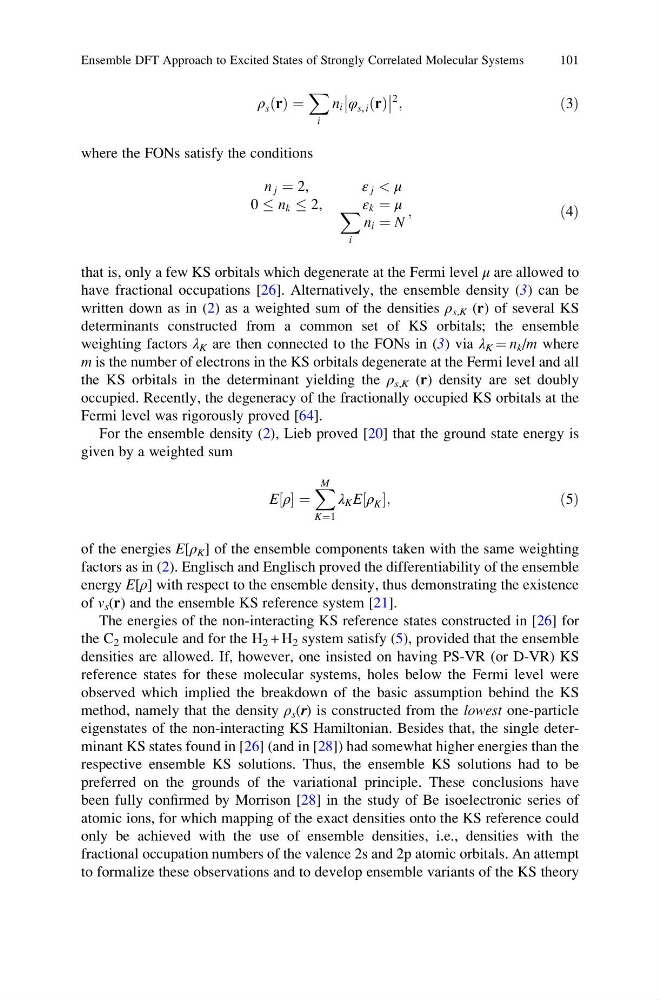
ρ s r
ð Þ ¼
X
i
n i
φ s, i r
ð Þ
2 ;
ð3Þ
where the FONs satisfy the conditions
n j ¼ 2,
ε j < μ
0 n k 2,
ε k ¼ μ
X
i
n i ¼ N
;
ð4Þ
that is, only a few KS orbitals which degenerate at the Fermi level μ are allowed to
have fractional occupations [26]. Alternatively, the ensemble density (3) can be
written down as in (2) as a weighted sum of the densities ρ s,K (r) of several KS
determinants constructed from a common set of KS orbitals; the ensemble
weighting factors λ K are then connected to the FONs in (3) via λ K ¼ n k /m where
m is the number of electrons in the KS orbitals degenerate at the Fermi level and all
the KS orbitals in the determinant yielding the ρ s,K (r) density are set doubly
occupied. Recently, the degeneracy of the fractionally occupied KS orbitals at the
Fermi level was rigorously proved [64].
For the ensemble density (2), Lieb proved [20] that the ground state energy is
given by a weighted sum
E ρ
½ ¼
X M
K¼1
λ K E ρ K
½ ;
ð5Þ
of the energies E[ρ K ] of the ensemble components taken with the same weighting
factors as in (2). Englisch and Englisch proved the differentiability of the ensemble
energy E[ρ] with respect to the ensemble density, thus demonstrating the existence
of v s (r) and the ensemble KS reference system [21].
The energies of the non-interacting KS reference states constructed in [26] for
the C 2 molecule and for the H 2 + H 2 system satisfy (5), provided that the ensemble
densities are allowed. If, however, one insisted on having PS-VR (or D-VR) KS
reference states for these molecular systems, holes below the Fermi level were
observed which implied the breakdown of the basic assumption behind the KS
method, namely that the density ρ s (r) is constructed from the lowest one-particle
eigenstates of the non-interacting KS Hamiltonian. Besides that, the single determinant KS states found in [26] (and in [28]) had somewhat higher energies than the
respective ensemble KS solutions. Thus, the ensemble KS solutions had to be
preferred on the grounds of the variational principle. These conclusions have
been fully confirmed by Morrison [28] in the study of Be isoelectronic series of
atomic ions, for which mapping of the exact densities onto the KS reference could
only be achieved with the use of ensemble densities, i.e., densities with the
fractional occupation numbers of the valence 2s and 2p atomic orbitals. An attempt
to formalize these observations and to develop ensemble variants of the KS theory
Ensemble DFT Approach to Excited States of Strongly Correlated Molecular Systems
101
ð Þ ¼
X
i
n i
φ s, i r
ð Þ
2 ;
ð3Þ
where the FONs satisfy the conditions
n j ¼ 2,
ε j < μ
0 n k 2,
ε k ¼ μ
X
i
n i ¼ N
;
ð4Þ
that is, only a few KS orbitals which degenerate at the Fermi level μ are allowed to
have fractional occupations [26]. Alternatively, the ensemble density (3) can be
written down as in (2) as a weighted sum of the densities ρ s,K (r) of several KS
determinants constructed from a common set of KS orbitals; the ensemble
weighting factors λ K are then connected to the FONs in (3) via λ K ¼ n k /m where
m is the number of electrons in the KS orbitals degenerate at the Fermi level and all
the KS orbitals in the determinant yielding the ρ s,K (r) density are set doubly
occupied. Recently, the degeneracy of the fractionally occupied KS orbitals at the
Fermi level was rigorously proved [64].
For the ensemble density (2), Lieb proved [20] that the ground state energy is
given by a weighted sum
E ρ
½ ¼
X M
K¼1
λ K E ρ K
½ ;
ð5Þ
of the energies E[ρ K ] of the ensemble components taken with the same weighting
factors as in (2). Englisch and Englisch proved the differentiability of the ensemble
energy E[ρ] with respect to the ensemble density, thus demonstrating the existence
of v s (r) and the ensemble KS reference system [21].
The energies of the non-interacting KS reference states constructed in [26] for
the C 2 molecule and for the H 2 + H 2 system satisfy (5), provided that the ensemble
densities are allowed. If, however, one insisted on having PS-VR (or D-VR) KS
reference states for these molecular systems, holes below the Fermi level were
observed which implied the breakdown of the basic assumption behind the KS
method, namely that the density ρ s (r) is constructed from the lowest one-particle
eigenstates of the non-interacting KS Hamiltonian. Besides that, the single determinant KS states found in [26] (and in [28]) had somewhat higher energies than the
respective ensemble KS solutions. Thus, the ensemble KS solutions had to be
preferred on the grounds of the variational principle. These conclusions have
been fully confirmed by Morrison [28] in the study of Be isoelectronic series of
atomic ions, for which mapping of the exact densities onto the KS reference could
only be achieved with the use of ensemble densities, i.e., densities with the
fractional occupation numbers of the valence 2s and 2p atomic orbitals. An attempt
to formalize these observations and to develop ensemble variants of the KS theory
Ensemble DFT Approach to Excited States of Strongly Correlated Molecular Systems
101