

(1)-DFT where the energy is minimized with respect to both R and U. After full
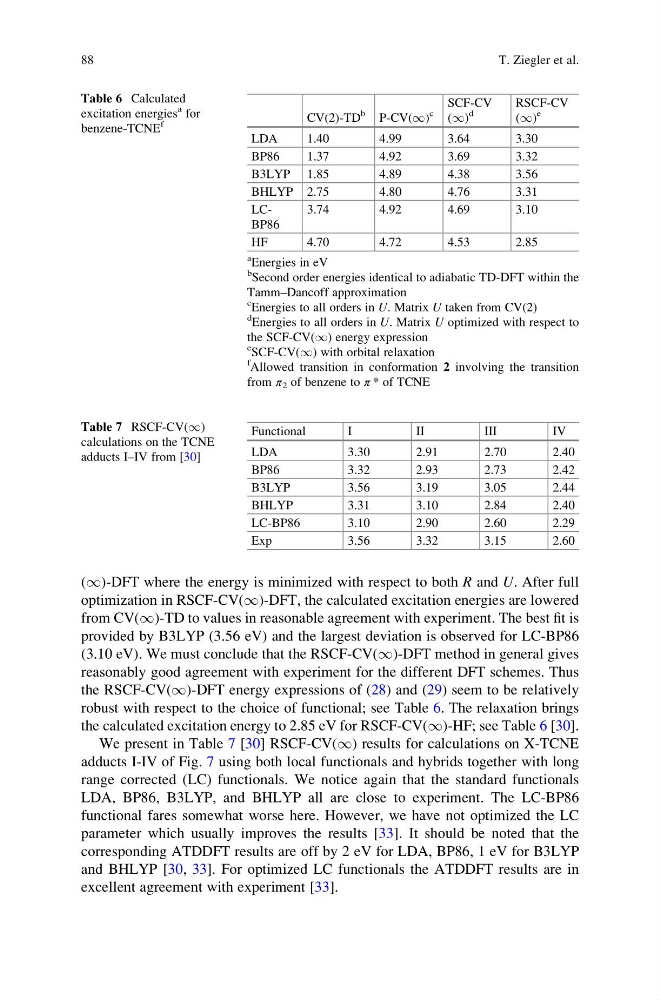
optimization in RSCF-CV(1)-DFT, the calculated excitation energies are lowered
from CV(1)-TD to values in reasonable agreement with experiment. The best fit is
provided by B3LYP (3.56 eV) and the largest deviation is observed for LC-BP86
(3.10 eV). We must conclude that the RSCF-CV(1)-DFT method in general gives
reasonably good agreement with experiment for the different DFT schemes. Thus
the RSCF-CV(1)-DFT energy expressions of (28) and (29) seem to be relatively
robust with respect to the choice of functional; see Table 6. The relaxation brings
the calculated excitation energy to 2.85 eV for RSCF-CV(1)-HF; see Table 6 [30].
We present in Table 7 [30] RSCF-CV(1) results for calculations on X-TCNE
adducts I-IV of Fig. 7 using both local functionals and hybrids together with long
range corrected (LC) functionals. We notice again that the standard functionals
LDA, BP86, B3LYP, and BHLYP all are close to experiment. The LC-BP86
functional fares somewhat worse here. However, we have not optimized the LC
parameter which usually improves the results [33]. It should be noted that the
corresponding ATDDFT results are off by 2 eV for LDA, BP86, 1 eV for B3LYP
and BHLYP [30, 33]. For optimized LC functionals the ATDDFT results are in
excellent agreement with experiment [33].
Table 6 Calculated
excitation energies
a for
benzene-TCNE
f
CV(2)-TD
b
P-CV(1)
c
SCF-CV
(1)
d
RSCF-CV
(1)
e
LDA
1.40
4.99
3.64
3.30
BP86
1.37
4.92
3.69
3.32
B3LYP 1.85
4.89
4.38
3.56
BHLYP 2.75
4.80
4.76
3.31
LCBP86
3.74
4.92
4.69
3.10
HF
4.70
4.72
4.53
2.85
a
Energies in eV
b
Second order energies identical to adiabatic TD-DFT within the
Tamm–Dancoff approximation
c
Energies to all orders in U. Matrix U taken from CV(2)
d
Energies to all orders in U. Matrix U optimized with respect to
the SCF-CV(1) energy expression
e
SCF-CV(1) with orbital relaxation
f
Allowed transition in conformation 2 involving the transition
from π 2 of benzene to π * of TCNE
Table 7 RSCF-CV(1)
calculations on the TCNE
adducts I–IV from [30]
Functional
I
II
III
IV
LDA
3.30
2.91
2.70
2.40
BP86
3.32
2.93
2.73
2.42
B3LYP
3.56
3.19
3.05
2.44
BHLYP
3.31
3.10
2.84
2.40
LC-BP86
3.10
2.90
2.60
2.29
Exp
3.56
3.32
3.15
2.60
88
T. Ziegler et al.
optimization in RSCF-CV(1)-DFT, the calculated excitation energies are lowered
from CV(1)-TD to values in reasonable agreement with experiment. The best fit is
provided by B3LYP (3.56 eV) and the largest deviation is observed for LC-BP86
(3.10 eV). We must conclude that the RSCF-CV(1)-DFT method in general gives
reasonably good agreement with experiment for the different DFT schemes. Thus
the RSCF-CV(1)-DFT energy expressions of (28) and (29) seem to be relatively
robust with respect to the choice of functional; see Table 6. The relaxation brings
the calculated excitation energy to 2.85 eV for RSCF-CV(1)-HF; see Table 6 [30].
We present in Table 7 [30] RSCF-CV(1) results for calculations on X-TCNE
adducts I-IV of Fig. 7 using both local functionals and hybrids together with long
range corrected (LC) functionals. We notice again that the standard functionals
LDA, BP86, B3LYP, and BHLYP all are close to experiment. The LC-BP86
functional fares somewhat worse here. However, we have not optimized the LC
parameter which usually improves the results [33]. It should be noted that the
corresponding ATDDFT results are off by 2 eV for LDA, BP86, 1 eV for B3LYP
and BHLYP [30, 33]. For optimized LC functionals the ATDDFT results are in
excellent agreement with experiment [33].
Table 6 Calculated
excitation energies
a for
benzene-TCNE
f
CV(2)-TD
b
P-CV(1)
c
SCF-CV
(1)
d
RSCF-CV
(1)
e
LDA
1.40
4.99
3.64
3.30
BP86
1.37
4.92
3.69
3.32
B3LYP 1.85
4.89
4.38
3.56
BHLYP 2.75
4.80
4.76
3.31
LCBP86
3.74
4.92
4.69
3.10
HF
4.70
4.72
4.53
2.85
a
Energies in eV
b
Second order energies identical to adiabatic TD-DFT within the
Tamm–Dancoff approximation
c
Energies to all orders in U. Matrix U taken from CV(2)
d
Energies to all orders in U. Matrix U optimized with respect to
the SCF-CV(1) energy expression
e
SCF-CV(1) with orbital relaxation
f
Allowed transition in conformation 2 involving the transition
from π 2 of benzene to π * of TCNE
Table 7 RSCF-CV(1)
calculations on the TCNE
adducts I–IV from [30]
Functional
I
II
III
IV
LDA
3.30
2.91
2.70
2.40
BP86
3.32
2.93
2.73
2.42
B3LYP
3.56
3.19
3.05
2.44
BHLYP
3.31
3.10
2.84
2.40
LC-BP86
3.10
2.90
2.60
2.29
Exp
3.56
3.32
3.15
2.60
88
T. Ziegler et al.