

occupied π-orbital on X to the empty π-orbital on TCNE. The X-TCNE complexes
were first introduced by Stein et al. [33] as a benchmark set for CT-transitions in
connection with their study on the performance of LC functionals.
The charge transfer spectrum for the series of adducts X-TCNE (X¼benzene,
toluene, o-xylene, and naphthalene, TCNE¼tetracyanoethylene) has been studied
extensively by experimental [84–88] and computational techniques [32, 89]. The
experimental investigations include both gas phase [88] and solvation studies
[85, 86] whereas the computational examinations have made use of high level ab
initio schemes [89] and methods based on density functional theory [24, 25, 32, 33].
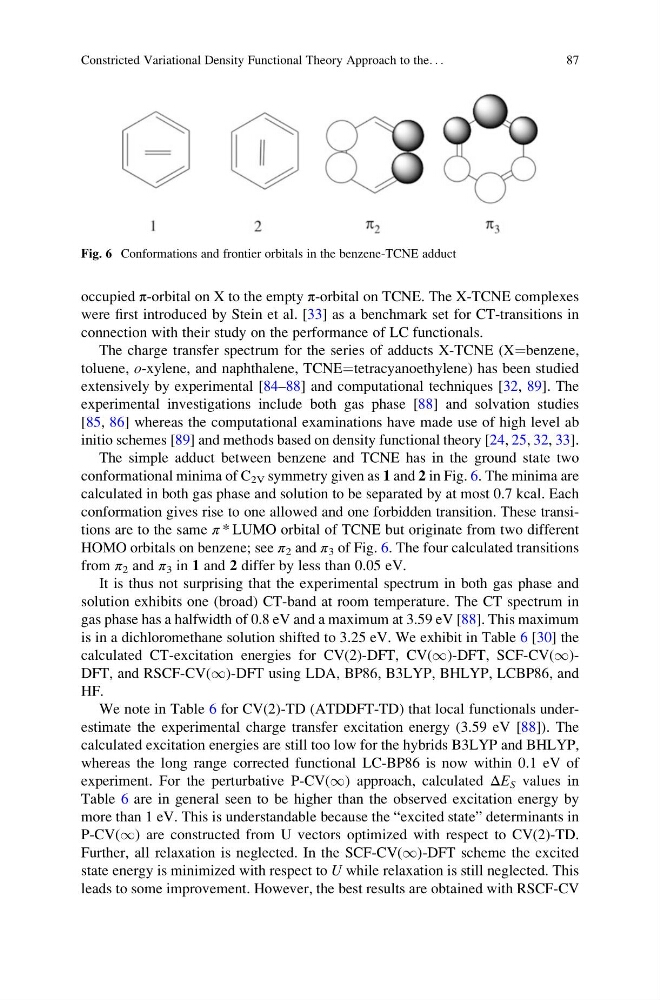
The simple adduct between benzene and TCNE has in the ground state two
conformational minima of C 2V symmetry given as 1 and 2 in Fig. 6. The minima are
calculated in both gas phase and solution to be separated by at most 0.7 kcal. Each
conformation gives rise to one allowed and one forbidden transition. These transitions are to the same π * LUMO orbital of TCNE but originate from two different
HOMO orbitals on benzene; see π 2 and π 3 of Fig. 6. The four calculated transitions
from π 2 and π 3 in 1 and 2 differ by less than 0.05 eV.
It is thus not surprising that the experimental spectrum in both gas phase and
solution exhibits one (broad) CT-band at room temperature. The CT spectrum in
gas phase has a halfwidth of 0.8 eV and a maximum at 3.59 eV [88]. This maximum
is in a dichloromethane solution shifted to 3.25 eV. We exhibit in Table 6 [30] the
calculated CT-excitation energies for CV(2)-DFT, CV(1)-DFT, SCF-CV(1)DFT, and RSCF-CV(1)-DFT using LDA, BP86, B3LYP, BHLYP, LCBP86, and
HF.
We note in Table 6 for CV(2)-TD (ATDDFT-TD) that local functionals underestimate the experimental charge transfer excitation energy (3.59 eV [88]). The
calculated excitation energies are still too low for the hybrids B3LYP and BHLYP,
whereas the long range corrected functional LC-BP86 is now within 0.1 eV of
experiment. For the perturbative P-CV(1) approach, calculated ΔE S values in
Table 6 are in general seen to be higher than the observed excitation energy by
more than 1 eV. This is understandable because the “excited state” determinants in
P-CV(1) are constructed from U vectors optimized with respect to CV(2)-TD.
Further, all relaxation is neglected. In the SCF-CV(1)-DFT scheme the excited
state energy is minimized with respect to U while relaxation is still neglected. This
leads to some improvement. However, the best results are obtained with RSCF-CV
Fig. 6 Conformations and frontier orbitals in the benzene-TCNE adduct
Constricted Variational Density Functional Theory Approach to the. . .
87
were first introduced by Stein et al. [33] as a benchmark set for CT-transitions in
connection with their study on the performance of LC functionals.
The charge transfer spectrum for the series of adducts X-TCNE (X¼benzene,
toluene, o-xylene, and naphthalene, TCNE¼tetracyanoethylene) has been studied
extensively by experimental [84–88] and computational techniques [32, 89]. The
experimental investigations include both gas phase [88] and solvation studies
[85, 86] whereas the computational examinations have made use of high level ab
initio schemes [89] and methods based on density functional theory [24, 25, 32, 33].
The simple adduct between benzene and TCNE has in the ground state two
conformational minima of C 2V symmetry given as 1 and 2 in Fig. 6. The minima are
calculated in both gas phase and solution to be separated by at most 0.7 kcal. Each
conformation gives rise to one allowed and one forbidden transition. These transitions are to the same π * LUMO orbital of TCNE but originate from two different
HOMO orbitals on benzene; see π 2 and π 3 of Fig. 6. The four calculated transitions
from π 2 and π 3 in 1 and 2 differ by less than 0.05 eV.
It is thus not surprising that the experimental spectrum in both gas phase and
solution exhibits one (broad) CT-band at room temperature. The CT spectrum in
gas phase has a halfwidth of 0.8 eV and a maximum at 3.59 eV [88]. This maximum
is in a dichloromethane solution shifted to 3.25 eV. We exhibit in Table 6 [30] the
calculated CT-excitation energies for CV(2)-DFT, CV(1)-DFT, SCF-CV(1)DFT, and RSCF-CV(1)-DFT using LDA, BP86, B3LYP, BHLYP, LCBP86, and
HF.
We note in Table 6 for CV(2)-TD (ATDDFT-TD) that local functionals underestimate the experimental charge transfer excitation energy (3.59 eV [88]). The
calculated excitation energies are still too low for the hybrids B3LYP and BHLYP,
whereas the long range corrected functional LC-BP86 is now within 0.1 eV of
experiment. For the perturbative P-CV(1) approach, calculated ΔE S values in
Table 6 are in general seen to be higher than the observed excitation energy by
more than 1 eV. This is understandable because the “excited state” determinants in
P-CV(1) are constructed from U vectors optimized with respect to CV(2)-TD.
Further, all relaxation is neglected. In the SCF-CV(1)-DFT scheme the excited
state energy is minimized with respect to U while relaxation is still neglected. This
leads to some improvement. However, the best results are obtained with RSCF-CV
Fig. 6 Conformations and frontier orbitals in the benzene-TCNE adduct
Constricted Variational Density Functional Theory Approach to the. . .
87