

In a method which predates RSCF-CV(1) we combined P-CV(n) with orbital
relaxation (RP-CV(n)) to study charge transfer transitions in a series of substituted
anthracene–TCNE systems with various groups in the meso position where n ¼ 4
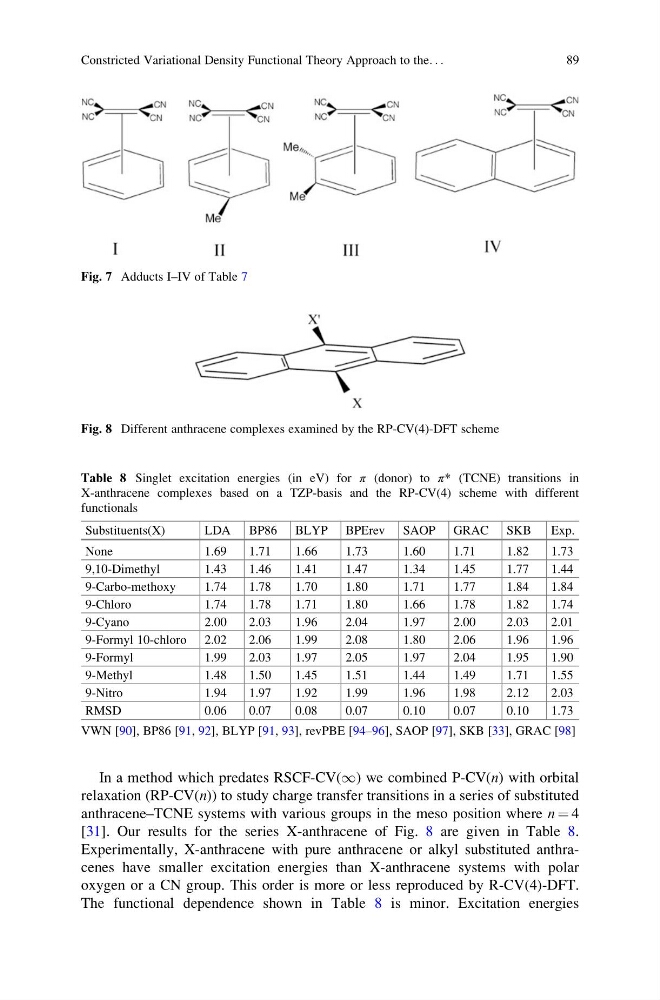
[31]. Our results for the series X-anthracene of Fig. 8 are given in Table 8.
Experimentally, X-anthracene with pure anthracene or alkyl substituted anthracenes have smaller excitation energies than X-anthracene systems with polar
oxygen or a CN group. This order is more or less reproduced by R-CV(4)-DFT.
The functional dependence shown in Table 8 is minor. Excitation energies
Fig. 7 Adducts I–IV of Table 7
Fig. 8 Different anthracene complexes examined by the RP-CV(4)-DFT scheme
Table 8 Singlet excitation energies (in eV) for π (donor) to π* (TCNE) transitions in
X-anthracene complexes based on a TZP-basis and the RP-CV(4) scheme with different
functionals
Substituents(X)
LDA BP86 BLYP BPErev SAOP GRAC SKB
Exp.
None
1.69
1.71
1.66
1.73
1.60
1.71
1.82
1.73
9,10-Dimethyl
1.43
1.46
1.41
1.47
1.34
1.45
1.77
1.44
9-Carbo-methoxy
1.74
1.78
1.70
1.80
1.71
1.77
1.84
1.84
9-Chloro
1.74
1.78
1.71
1.80
1.66
1.78
1.82
1.74
9-Cyano
2.00
2.03
1.96
2.04
1.97
2.00
2.03
2.01
9-Formyl 10-chloro 2.02
2.06
1.99
2.08
1.80
2.06
1.96
1.96
9-Formyl
1.99
2.03
1.97
2.05
1.97
2.04
1.95
1.90
9-Methyl
1.48
1.50
1.45
1.51
1.44
1.49
1.71
1.55
9-Nitro
1.94
1.97
1.92
1.99
1.96
1.98
2.12
2.03
RMSD
0.06
0.07
0.08
0.07
0.10
0.07
0.10
1.73
VWN [90], BP86 [91, 92], BLYP [91, 93], revPBE [94–96], SAOP [97], SKB [33], GRAC [98]
Constricted Variational Density Functional Theory Approach to the. . .
89
relaxation (RP-CV(n)) to study charge transfer transitions in a series of substituted
anthracene–TCNE systems with various groups in the meso position where n ¼ 4
[31]. Our results for the series X-anthracene of Fig. 8 are given in Table 8.
Experimentally, X-anthracene with pure anthracene or alkyl substituted anthracenes have smaller excitation energies than X-anthracene systems with polar
oxygen or a CN group. This order is more or less reproduced by R-CV(4)-DFT.
The functional dependence shown in Table 8 is minor. Excitation energies
Fig. 7 Adducts I–IV of Table 7
Fig. 8 Different anthracene complexes examined by the RP-CV(4)-DFT scheme
Table 8 Singlet excitation energies (in eV) for π (donor) to π* (TCNE) transitions in
X-anthracene complexes based on a TZP-basis and the RP-CV(4) scheme with different
functionals
Substituents(X)
LDA BP86 BLYP BPErev SAOP GRAC SKB
Exp.
None
1.69
1.71
1.66
1.73
1.60
1.71
1.82
1.73
9,10-Dimethyl
1.43
1.46
1.41
1.47
1.34
1.45
1.77
1.44
9-Carbo-methoxy
1.74
1.78
1.70
1.80
1.71
1.77
1.84
1.84
9-Chloro
1.74
1.78
1.71
1.80
1.66
1.78
1.82
1.74
9-Cyano
2.00
2.03
1.96
2.04
1.97
2.00
2.03
2.01
9-Formyl 10-chloro 2.02
2.06
1.99
2.08
1.80
2.06
1.96
1.96
9-Formyl
1.99
2.03
1.97
2.05
1.97
2.04
1.95
1.90
9-Methyl
1.48
1.50
1.45
1.51
1.44
1.49
1.71
1.55
9-Nitro
1.94
1.97
1.92
1.99
1.96
1.98
2.12
2.03
RMSD
0.06
0.07
0.08
0.07
0.10
0.07
0.10
1.73
VWN [90], BP86 [91, 92], BLYP [91, 93], revPBE [94–96], SAOP [97], SKB [33], GRAC [98]
Constricted Variational Density Functional Theory Approach to the. . .
89