

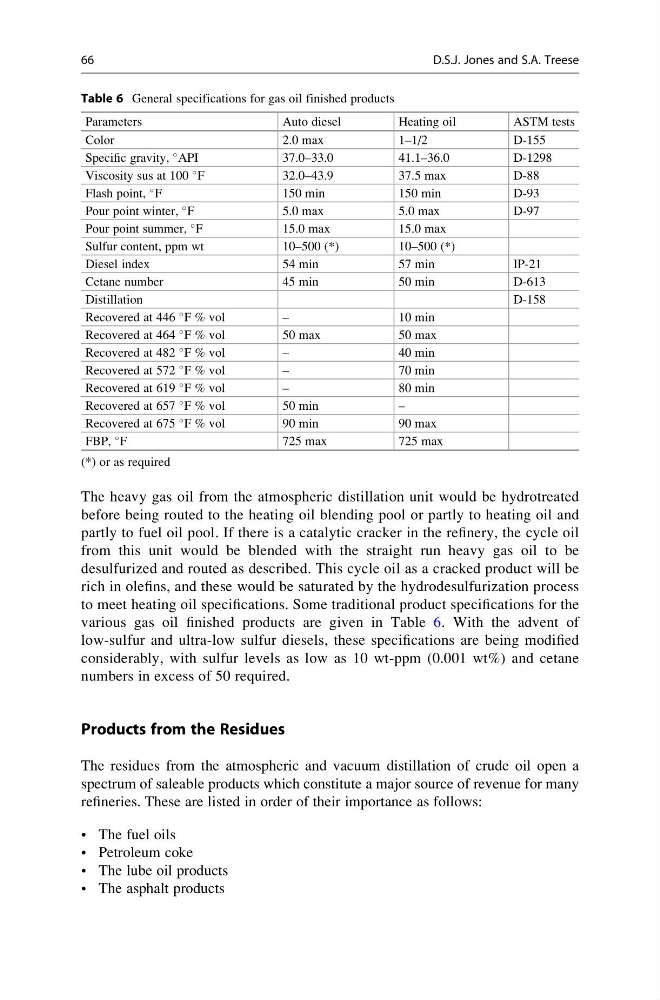
The heavy gas oil from the atmospheric distillation unit would be hydrotreated
before being routed to the heating oil blending pool or partly to heating oil and
partly to fuel oil pool. If there is a catalytic cracker in the refinery, the cycle oil
from this unit would be blended with the straight run heavy gas oil to be
desulfurized and routed as described. This cycle oil as a cracked product will be
rich in olefins, and these would be saturated by the hydrodesulfurization process
to meet heating oil specifications. Some traditional product specifications for the
various gas oil finished products are given in Table 6. With the advent of
low-sulfur and ultra-low sulfur diesels, these specifications are being modified
considerably, with sulfur levels as low as 10 wt-ppm (0.001 wt%) and cetane
numbers in excess of 50 required.
Products from the Residues
The residues from the atmospheric and vacuum distillation of crude oil open a
spectrum of saleable products which constitute a major source of revenue for many
refineries. These are listed in order of their importance as follows:
• The fuel oils
• Petroleum coke
• The lube oil products
• The asphalt products
Table 6 General specifications for gas oil finished products
Parameters
Auto diesel
Heating oil
ASTM tests
Color
2.0 max
1–1/2
D-155
Specific gravity,
API
37.0–33.0
41.1–36.0
D-1298
Viscosity sus at 100
F
32.0–43.9
37.5 max
D-88
Flash point,
F
150 min
150 min
D-93
Pour point winter,
F
5.0 max
5.0 max
D-97
Pour point summer,
F
15.0 max
15.0 max
Sulfur content, ppm wt
10–500 (*)
10–500 (*)
Diesel index
54 min
57 min
IP-21
Cetane number
45 min
50 min
D-613
Distillation
D-158
Recovered at 446
F % vol
–
10 min
Recovered at 464
F % vol
50 max
50 max
Recovered at 482
F % vol
–
40 min
Recovered at 572
F % vol
–
70 min
Recovered at 619
F % vol
–
80 min
Recovered at 657
F % vol
50 min
–
Recovered at 675
F % vol
90 min
90 max
FBP,
F
725 max
725 max
(*) or as required
66
D.S.J. Jones and S.A. Treese
before being routed to the heating oil blending pool or partly to heating oil and
partly to fuel oil pool. If there is a catalytic cracker in the refinery, the cycle oil
from this unit would be blended with the straight run heavy gas oil to be
desulfurized and routed as described. This cycle oil as a cracked product will be
rich in olefins, and these would be saturated by the hydrodesulfurization process
to meet heating oil specifications. Some traditional product specifications for the
various gas oil finished products are given in Table 6. With the advent of
low-sulfur and ultra-low sulfur diesels, these specifications are being modified
considerably, with sulfur levels as low as 10 wt-ppm (0.001 wt%) and cetane
numbers in excess of 50 required.
Products from the Residues
The residues from the atmospheric and vacuum distillation of crude oil open a
spectrum of saleable products which constitute a major source of revenue for many
refineries. These are listed in order of their importance as follows:
• The fuel oils
• Petroleum coke
• The lube oil products
• The asphalt products
Table 6 General specifications for gas oil finished products
Parameters
Auto diesel
Heating oil
ASTM tests
Color
2.0 max
1–1/2
D-155
Specific gravity,
API
37.0–33.0
41.1–36.0
D-1298
Viscosity sus at 100
F
32.0–43.9
37.5 max
D-88
Flash point,
F
150 min
150 min
D-93
Pour point winter,
F
5.0 max
5.0 max
D-97
Pour point summer,
F
15.0 max
15.0 max
Sulfur content, ppm wt
10–500 (*)
10–500 (*)
Diesel index
54 min
57 min
IP-21
Cetane number
45 min
50 min
D-613
Distillation
D-158
Recovered at 446
F % vol
–
10 min
Recovered at 464
F % vol
50 max
50 max
Recovered at 482
F % vol
–
40 min
Recovered at 572
F % vol
–
70 min
Recovered at 619
F % vol
–
80 min
Recovered at 657
F % vol
50 min
–
Recovered at 675
F % vol
90 min
90 max
FBP,
F
725 max
725 max
(*) or as required
66
D.S.J. Jones and S.A. Treese