

The fuel oil products. There are two common fuel oil products in use today. The
first and perhaps the second most common product is the marine diesel. As the
name suggests, it is the fuel used by heavy marine diesel engines. It is the least
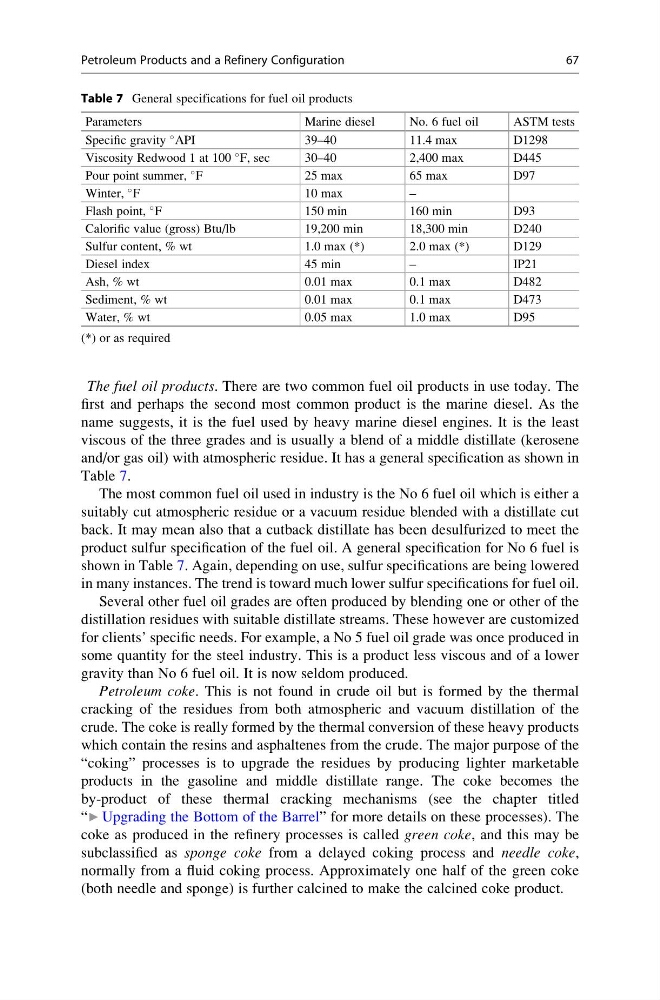
viscous of the three grades and is usually a blend of a middle distillate (kerosene
and/or gas oil) with atmospheric residue. It has a general specification as shown in
Table 7.
The most common fuel oil used in industry is the No 6 fuel oil which is either a
suitably cut atmospheric residue or a vacuum residue blended with a distillate cut
back. It may mean also that a cutback distillate has been desulfurized to meet the
product sulfur specification of the fuel oil. A general specification for No 6 fuel is
shown in Table 7. Again, depending on use, sulfur specifications are being lowered
in many instances. The trend is toward much lower sulfur specifications for fuel oil.
Several other fuel oil grades are often produced by blending one or other of the
distillation residues with suitable distillate streams. These however are customized
for clients’ specific needs. For example, a No 5 fuel oil grade was once produced in
some quantity for the steel industry. This is a product less viscous and of a lower
gravity than No 6 fuel oil. It is now seldom produced.
Petroleum coke. This is not found in crude oil but is formed by the thermal
cracking of the residues from both atmospheric and vacuum distillation of the
crude. The coke is really formed by the thermal conversion of these heavy products
which contain the resins and asphaltenes from the crude. The major purpose of the
“coking” processes is to upgrade the residues by producing lighter marketable
products in the gasoline and middle distillate range. The coke becomes the
by-product of these thermal cracking mechanisms (see the chapter titled
“▶ Upgrading the Bottom of the Barrel” for more details on these processes). The
coke as produced in the refinery processes is called green coke, and this may be
subclassified as sponge coke from a delayed coking process and needle coke,
normally from a fluid coking process. Approximately one half of the green coke
(both needle and sponge) is further calcined to make the calcined coke product.
Table 7 General specifications for fuel oil products
Parameters
Marine diesel
No. 6 fuel oil
ASTM tests
Specific gravity
API
39–40
11.4 max
D1298
Viscosity Redwood 1 at 100
F, sec
30–40
2,400 max
D445
Pour point summer,
F
25 max
65 max
D97
Winter,
F
10 max
–
Flash point,
F
150 min
160 min
D93
Calorific value (gross) Btu/lb
19,200 min
18,300 min
D240
Sulfur content, % wt
1.0 max (*)
2.0 max (*)
D129
Diesel index
45 min
–
IP21
Ash, % wt
0.01 max
0.1 max
D482
Sediment, % wt
0.01 max
0.1 max
D473
Water, % wt
0.05 max
1.0 max
D95
(*) or as required
Petroleum Products and a Refinery Configuration
67
first and perhaps the second most common product is the marine diesel. As the
name suggests, it is the fuel used by heavy marine diesel engines. It is the least
viscous of the three grades and is usually a blend of a middle distillate (kerosene
and/or gas oil) with atmospheric residue. It has a general specification as shown in
Table 7.
The most common fuel oil used in industry is the No 6 fuel oil which is either a
suitably cut atmospheric residue or a vacuum residue blended with a distillate cut
back. It may mean also that a cutback distillate has been desulfurized to meet the
product sulfur specification of the fuel oil. A general specification for No 6 fuel is
shown in Table 7. Again, depending on use, sulfur specifications are being lowered
in many instances. The trend is toward much lower sulfur specifications for fuel oil.
Several other fuel oil grades are often produced by blending one or other of the
distillation residues with suitable distillate streams. These however are customized
for clients’ specific needs. For example, a No 5 fuel oil grade was once produced in
some quantity for the steel industry. This is a product less viscous and of a lower
gravity than No 6 fuel oil. It is now seldom produced.
Petroleum coke. This is not found in crude oil but is formed by the thermal
cracking of the residues from both atmospheric and vacuum distillation of the
crude. The coke is really formed by the thermal conversion of these heavy products
which contain the resins and asphaltenes from the crude. The major purpose of the
“coking” processes is to upgrade the residues by producing lighter marketable
products in the gasoline and middle distillate range. The coke becomes the
by-product of these thermal cracking mechanisms (see the chapter titled
“▶ Upgrading the Bottom of the Barrel” for more details on these processes). The
coke as produced in the refinery processes is called green coke, and this may be
subclassified as sponge coke from a delayed coking process and needle coke,
normally from a fluid coking process. Approximately one half of the green coke
(both needle and sponge) is further calcined to make the calcined coke product.
Table 7 General specifications for fuel oil products
Parameters
Marine diesel
No. 6 fuel oil
ASTM tests
Specific gravity
API
39–40
11.4 max
D1298
Viscosity Redwood 1 at 100
F, sec
30–40
2,400 max
D445
Pour point summer,
F
25 max
65 max
D97
Winter,
F
10 max
–
Flash point,
F
150 min
160 min
D93
Calorific value (gross) Btu/lb
19,200 min
18,300 min
D240
Sulfur content, % wt
1.0 max (*)
2.0 max (*)
D129
Diesel index
45 min
–
IP21
Ash, % wt
0.01 max
0.1 max
D482
Sediment, % wt
0.01 max
0.1 max
D473
Water, % wt
0.05 max
1.0 max
D95
(*) or as required
Petroleum Products and a Refinery Configuration
67