

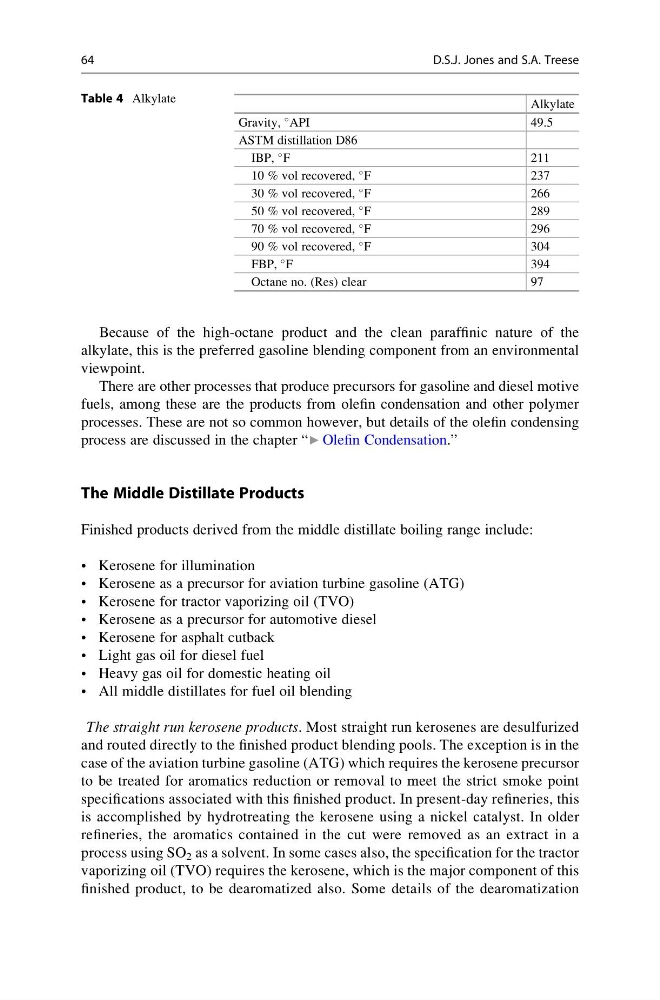
Because of the high-octane product and the clean paraffinic nature of the
alkylate, this is the preferred gasoline blending component from an environmental
viewpoint.
There are other processes that produce precursors for gasoline and diesel motive
fuels, among these are the products from olefin condensation and other polymer
processes. These are not so common however, but details of the olefin condensing
process are discussed in the chapter “▶ Olefin Condensation.”
The Middle Distillate Products
Finished products derived from the middle distillate boiling range include:
• Kerosene for illumination
• Kerosene as a precursor for aviation turbine gasoline (ATG)
• Kerosene for tractor vaporizing oil (TVO)
• Kerosene as a precursor for automotive diesel
• Kerosene for asphalt cutback
• Light gas oil for diesel fuel
• Heavy gas oil for domestic heating oil
• All middle distillates for fuel oil blending
The straight run kerosene products. Most straight run kerosenes are desulfurized
and routed directly to the finished product blending pools. The exception is in the
case of the aviation turbine gasoline (ATG) which requires the kerosene precursor
to be treated for aromatics reduction or removal to meet the strict smoke point
specifications associated with this finished product. In present-day refineries, this
is accomplished by hydrotreating the kerosene using a nickel catalyst. In older
refineries, the aromatics contained in the cut were removed as an extract in a
process using SO 2 as a solvent. In some cases also, the specification for the tractor
vaporizing oil (TVO) requires the kerosene, which is the major component of this
finished product, to be dearomatized also. Some details of the dearomatization
Table 4 Alkylate
Alkylate
Gravity,
API
49.5
ASTM distillation D86
IBP,
F
211
10 % vol recovered,
F
237
30 % vol recovered,
F
266
50 % vol recovered,
F
289
70 % vol recovered,
F
296
90 % vol recovered,
F
304
FBP,
F
394
Octane no. (Res) clear
97
64
D.S.J. Jones and S.A. Treese
alkylate, this is the preferred gasoline blending component from an environmental
viewpoint.
There are other processes that produce precursors for gasoline and diesel motive
fuels, among these are the products from olefin condensation and other polymer
processes. These are not so common however, but details of the olefin condensing
process are discussed in the chapter “▶ Olefin Condensation.”
The Middle Distillate Products
Finished products derived from the middle distillate boiling range include:
• Kerosene for illumination
• Kerosene as a precursor for aviation turbine gasoline (ATG)
• Kerosene for tractor vaporizing oil (TVO)
• Kerosene as a precursor for automotive diesel
• Kerosene for asphalt cutback
• Light gas oil for diesel fuel
• Heavy gas oil for domestic heating oil
• All middle distillates for fuel oil blending
The straight run kerosene products. Most straight run kerosenes are desulfurized
and routed directly to the finished product blending pools. The exception is in the
case of the aviation turbine gasoline (ATG) which requires the kerosene precursor
to be treated for aromatics reduction or removal to meet the strict smoke point
specifications associated with this finished product. In present-day refineries, this
is accomplished by hydrotreating the kerosene using a nickel catalyst. In older
refineries, the aromatics contained in the cut were removed as an extract in a
process using SO 2 as a solvent. In some cases also, the specification for the tractor
vaporizing oil (TVO) requires the kerosene, which is the major component of this
finished product, to be dearomatized also. Some details of the dearomatization
Table 4 Alkylate
Alkylate
Gravity,
API
49.5
ASTM distillation D86
IBP,
F
211
10 % vol recovered,
F
237
30 % vol recovered,
F
266
50 % vol recovered,
F
289
70 % vol recovered,
F
296
90 % vol recovered,
F
304
FBP,
F
394
Octane no. (Res) clear
97
64
D.S.J. Jones and S.A. Treese