

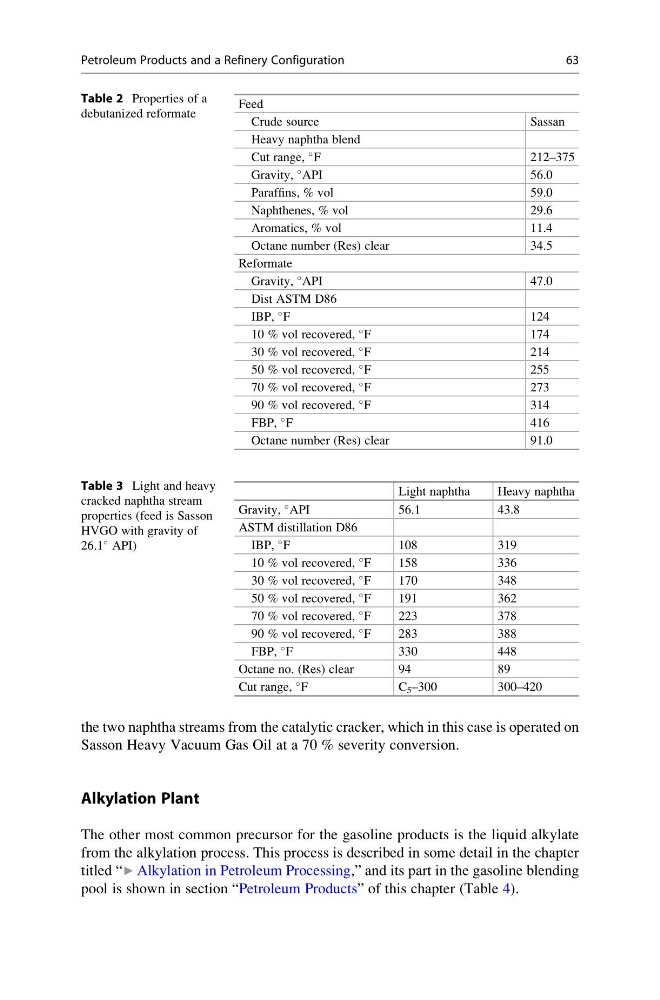
the two naphtha streams from the catalytic cracker, which in this case is operated on
Sasson Heavy Vacuum Gas Oil at a 70 % severity conversion.
Alkylation Plant
The other most common precursor for the gasoline products is the liquid alkylate
from the alkylation process. This process is described in some detail in the chapter
titled “▶ Alkylation in Petroleum Processing,” and its part in the gasoline blending
pool is shown in section “Petroleum Products” of this chapter (Table 4).
Table 2 Properties of a
debutanized reformate
Feed
Crude source
Sassan
Heavy naphtha blend
Cut range,
F
212–375
Gravity,
API
56.0
Paraffins, % vol
59.0
Naphthenes, % vol
29.6
Aromatics, % vol
11.4
Octane number (Res) clear
34.5
Reformate
Gravity,
API
47.0
Dist ASTM D86
IBP,
F
124
10 % vol recovered,
F
174
30 % vol recovered,
F
214
50 % vol recovered,
F
255
70 % vol recovered,
F
273
90 % vol recovered,
F
314
FBP,
F
416
Octane number (Res) clear
91.0
Table 3 Light and heavy
cracked naphtha stream
properties (feed is Sasson
HVGO with gravity of
26.1
API)
Light naphtha
Heavy naphtha
Gravity,
API
56.1
43.8
ASTM distillation D86
IBP,
F
108
319
10 % vol recovered,
F
158
336
30 % vol recovered,
F
170
348
50 % vol recovered,
F
191
362
70 % vol recovered,
F
223
378
90 % vol recovered,
F
283
388
FBP,
F
330
448
Octane no. (Res) clear
94
89
Cut range,
F
C 5 –300
300–420
Petroleum Products and a Refinery Configuration
63
Sasson Heavy Vacuum Gas Oil at a 70 % severity conversion.
Alkylation Plant
The other most common precursor for the gasoline products is the liquid alkylate
from the alkylation process. This process is described in some detail in the chapter
titled “▶ Alkylation in Petroleum Processing,” and its part in the gasoline blending
pool is shown in section “Petroleum Products” of this chapter (Table 4).
Table 2 Properties of a
debutanized reformate
Feed
Crude source
Sassan
Heavy naphtha blend
Cut range,
F
212–375
Gravity,
API
56.0
Paraffins, % vol
59.0
Naphthenes, % vol
29.6
Aromatics, % vol
11.4
Octane number (Res) clear
34.5
Reformate
Gravity,
API
47.0
Dist ASTM D86
IBP,
F
124
10 % vol recovered,
F
174
30 % vol recovered,
F
214
50 % vol recovered,
F
255
70 % vol recovered,
F
273
90 % vol recovered,
F
314
FBP,
F
416
Octane number (Res) clear
91.0
Table 3 Light and heavy
cracked naphtha stream
properties (feed is Sasson
HVGO with gravity of
26.1
API)
Light naphtha
Heavy naphtha
Gravity,
API
56.1
43.8
ASTM distillation D86
IBP,
F
108
319
10 % vol recovered,
F
158
336
30 % vol recovered,
F
170
348
50 % vol recovered,
F
191
362
70 % vol recovered,
F
223
378
90 % vol recovered,
F
283
388
FBP,
F
330
448
Octane no. (Res) clear
94
89
Cut range,
F
C 5 –300
300–420
Petroleum Products and a Refinery Configuration
63