

material and labor cost records. Refinery development engineers are involved in
cost estimating only so far as they develop and provide the basic technical data that
is used to prepare the capital cost of a plant or process. To execute this part of their
duty properly, development engineers should know a little about cost estimates and
the significance of the various items included in them. This section therefore sets
out to define in broad terms the various levels of estimating, their degree of
accuracy, and the scope of the engineering development that is required for each
of them.
The accuracy of cost estimates will vary between that based on comparing
similar plants or processes on a capacity basis to the actual cost of a plant when
all the bills have been paid and the plant is operational. Obviously the accuracy
based on similarity of the process or plant is very low while that based on project
end cost must be 100 %. That is, it is no longer an estimate but is now a fact.
In between these two levels, however, estimates may be prepared giving increasing
degrees of accuracy as engineering and construction of the process advances. The
accuracy of estimates increases as more and more money is committed to the
project. The progress of a project uses milestone cost estimates coupled with
completion schedules for its measurement and control. In the life of a construction
project, therefore, about four “control estimates” may be developed. For want of
better terms, these may be referred to as:
• The capacity factored estimate
• The equipment factored estimate
• The semi-definitive estimate
• The definitive estimate
Companies have their own terms for these estimates, but the important
point is to develop these estimates at a time in the project when they can be
most useful and when sufficient information is available for their best accuracy.
Figure 7 shows typical phases of a project when these estimates may be best
developed.
The following paragraphs now describe these estimates in more detail and
emphasize the process engineer’s input.
The Capacity Factored Estimate
In most process studies, this is the first estimate to be prepared. It is the one that
requires the minimum amount of engineering but is the least accurate. This is
because the plant that is used to factor from will not exactly match the plant in
question. It is good enough however when comparing different processes where the
estimates are on the same basis.
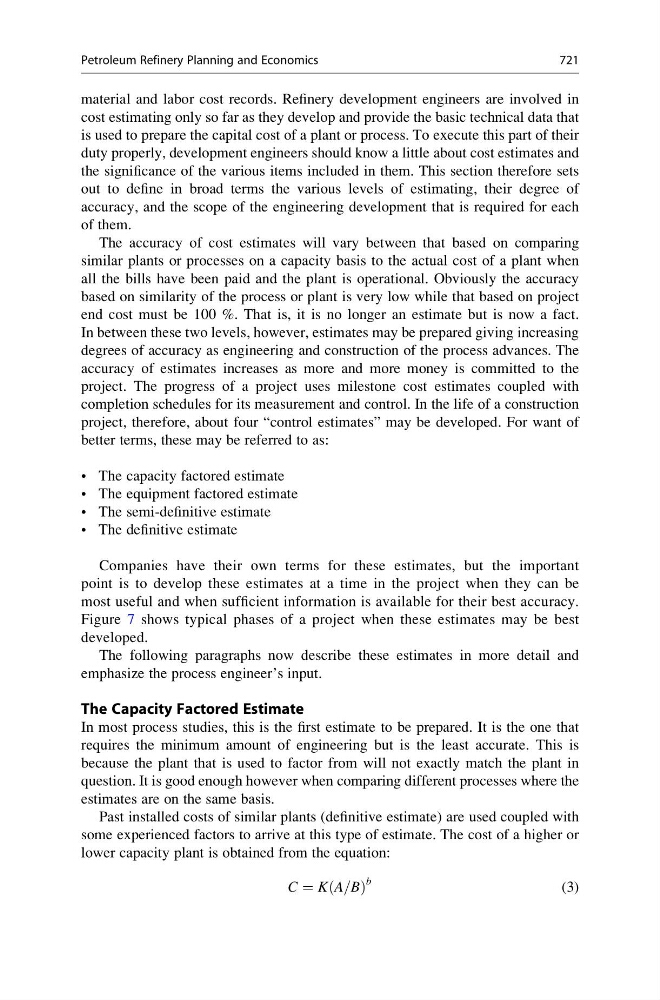
Past installed costs of similar plants (definitive estimate) are used coupled with
some experienced factors to arrive at this type of estimate. The cost of a higher or
lower capacity plant is obtained from the equation:
C ¼ K A=B
ð
Þ
b
(3)
Petroleum Refinery Planning and Economics
721