

where
C = cost of the plant in question.
K = known cost of a similar plant of size B.
A = the capacity of the plant in question (usually in vol/unit time).
B = capacity of known plant.
b = an exponential factor ranging between 0.5 and 0.8.
An exponent of 1.0 is equivalent to saying that the costs are directly proportional to the
unit capacity; an exponent of 0.0 corresponds to a unit where the costs remain the same
regardless of capacity (this is approximately the case for labor costs). The estimator’s
experience and records of the type of plant determine the exponent to be used. Usually,
this is 0.6; a listing of these factors is given in Appendix 7. Table 14 shows an example of
a capacity factored estimate for the thermal cracking unit used in Item 3 above.
In this example, the direct field cost is used as the cost figure to be capacity factored.
This allows the cost estimator to adjust between the direct field cost and the total cost
using current experience for field indirects, office costs, escalation, and contingencies.
In this case, a multiplier of 1.5 times the direct field cost is used to collect these items.
The Equipment Factored Estimate
This estimate requires a substantial amount of process engineering to define the
specific plant or process that is to be estimated. Briefly, the following process
activity is required:
Estimate Types
%
100
100%
90
90
80
80
70
70
60
60
Project Duration
50
Percent Progress
50
40
40
0
2 5
5 0
Construction Duration
Project
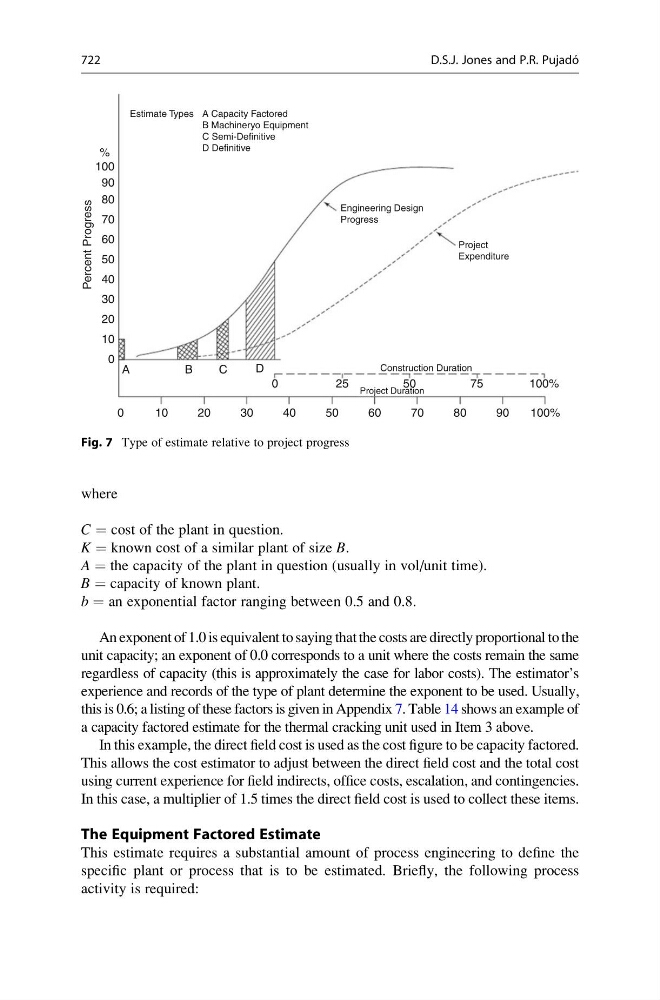
Expenditure
Engineering Design
Progress
75
100%
30
30
20
20
10
10
0
A
B
C
D
0
A Capacity Factored
B Machineryo Equipment
C Semi-Definitive
D Definitive
Fig. 7 Type of estimate relative to project progress
722
D.S.J. Jones and P.R. Pujado ´