

Scheme 3. This is the same as scheme 2 except the vacuum residue is not cracked.
Details of this scheme are:
Total capital costs for additional facilities = 194.780 MM $.
Total additional product income = 96.509 MM $/year.
Total operating cost is an additional 8.122 MM $/year.
Scheme 4. This also includes the vacuum distillation of the atmospheric residue as
in schemes 2 and 3. The wax distillate in this case however is routed to a
hydrocracker where LPG, naphtha for reforming to gasoline, and diesel are
produced. An additional hydrogen plant is required for this scheme. Details of
the scheme are summarized below:
• Total capital cost for additional facilities = 306.012 MM $
• Total additional income 119.502 MM $/year
• Total operating cost is an additional 12.6 MM $/year.
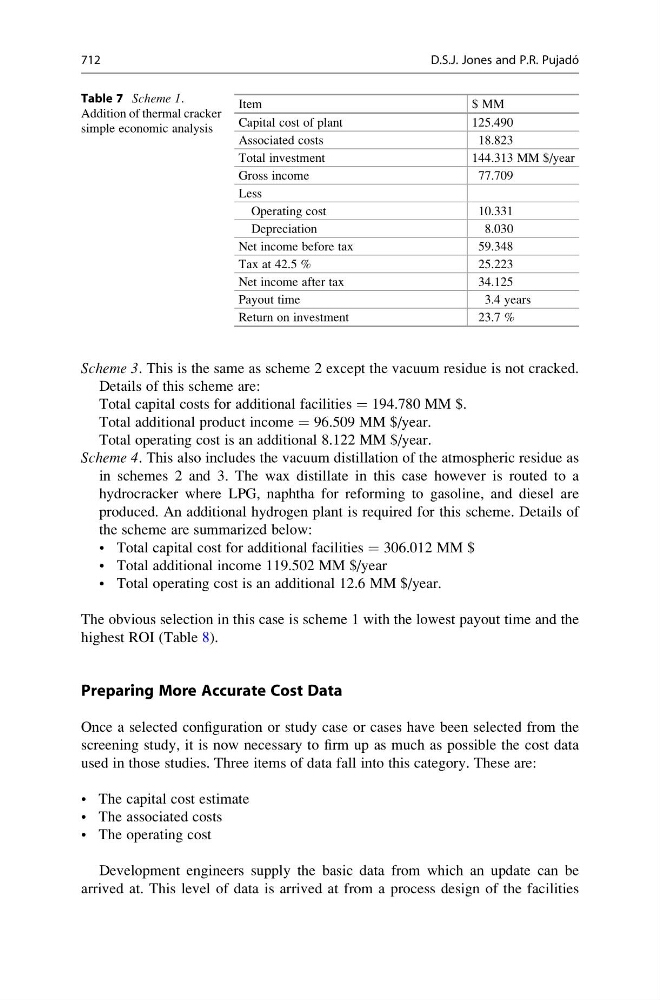
The obvious selection in this case is scheme 1 with the lowest payout time and the
highest ROI (Table 8).
Preparing More Accurate Cost Data
Once a selected configuration or study case or cases have been selected from the
screening study, it is now necessary to firm up as much as possible the cost data
used in those studies. Three items of data fall into this category. These are:
• The capital cost estimate
• The associated costs
• The operating cost
Development engineers supply the basic data from which an update can be
arrived at. This level of data is arrived at from a process design of the facilities
Table 7 Scheme 1.
Addition of thermal cracker
simple economic analysis
Item
$ MM
Capital cost of plant
125.490
Associated costs
18.823
Total investment
144.313 MM $/year
Gross income
77.709
Less
Operating cost
10.331
Depreciation
8.030
Net income before tax
59.348
Tax at 42.5 %
25.223
Net income after tax
34.125
Payout time
3.4 years
Return on investment
23.7 %
712
D.S.J. Jones and P.R. Pujado ´