

• The same as option 2, except there will be no thermal cracker for the vacuum
residue.
• Vacuum distill all the atmospheric residue and hydrocrack the waxy distillate.
• Process the atmospheric residue through a delayed coking unit.
• Finally, use a proprietary fluid coking unit for the atmospheric residue that
eliminates the coke by converting it into low Btu gas.
The last two options are eliminated after a preliminary study because there is no
economically attractive outlet for the coke and no effective use for the low Btu gas
in this refinery.
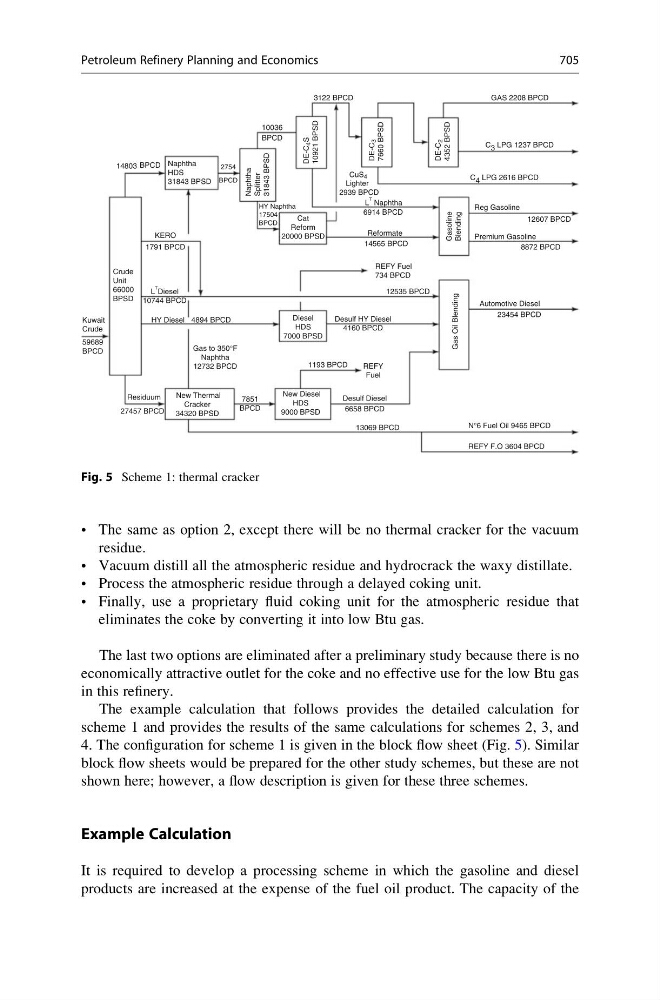
The example calculation that follows provides the detailed calculation for
scheme 1 and provides the results of the same calculations for schemes 2, 3, and
4. The configuration for scheme 1 is given in the block flow sheet (Fig. 5). Similar
block flow sheets would be prepared for the other study schemes, but these are not
shown here; however, a flow description is given for these three schemes.
Example Calculation
It is required to develop a processing scheme in which the gasoline and diesel
products are increased at the expense of the fuel oil product. The capacity of the
Naphtha
HDS
31843 BPSD
DE-C2
4352 BPSD
DE-C
3
7660 BPSD
DE-C
4S
10921 BPSD
Cat
Reform
20000 BPSD
Diesel
HDS
7000 BPSD
New Diesel
HDS
9000 BPSD
New Thermal
Cracker
34320 BPSD
Naphtha
Splitter
31843 BPSD
Gasoline
Blending
Gas Oil Blending
Crude
Unit
66000
BPSD
Kuwait
Crude
59689
BPCD
14803
2754
BPCD
1791 BPCD
4894 BPCD
7851
BPCD
Gas to 350°F
Naphtha
12732 BPCD
HY Diesel
KERO
BPCD
BPCD
Lighter
2939 BPCD
6914 BPCD
14565 BPCD
12535 BPCD
Reformate
REFY Fuel
734 BPCD
Desulf HY Diesel
4160 BPCD
Desulf Diesel
6658 BPCD
CuS 4
BPCD
HY Naphtha
17504
10036
3122 BPCD
L
T Naphtha
L
T
Diesel
10744 BPCD
REFY
Fuel
1193 BPCD
13069 BPCD
Residuum
27457 BPCD
GAS 2208 BPCD
C 3 LPG 1237 BPCD
C 4 LPG 2616 BPCD
Reg Gasoline
Premium Gasoline
Automotive Diesel
N°6 Fuel Oil 9465 BPCD
12607 BPCD
8872 BPCD
23454 BPCD
REFY F.O 3604 BPCD
Fig. 5 Scheme 1: thermal cracker
Petroleum Refinery Planning and Economics
705