

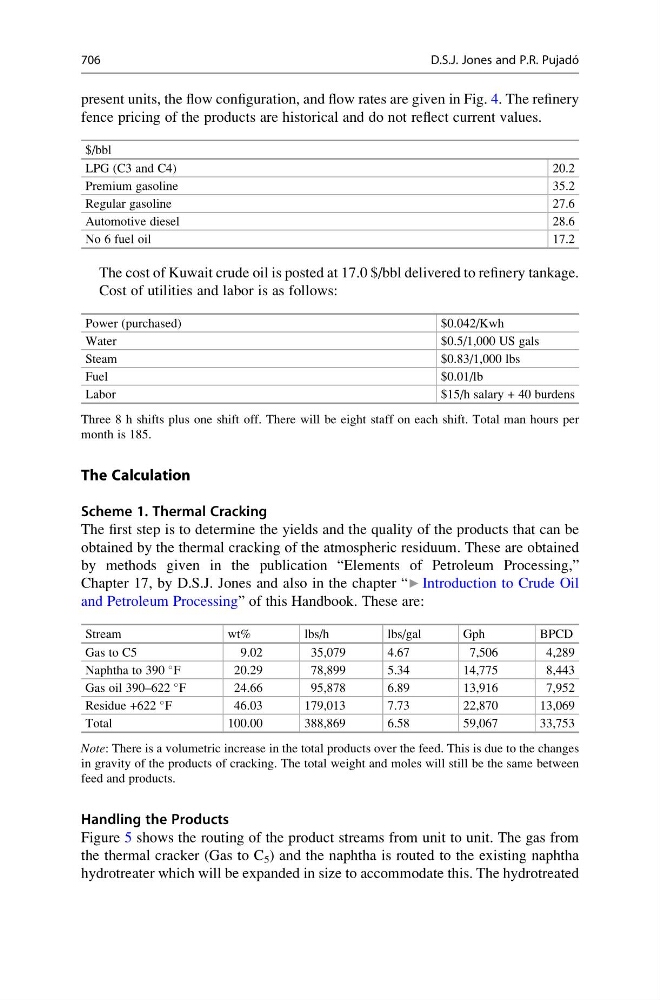
present units, the flow configuration, and flow rates are given in Fig. 4. The refinery
fence pricing of the products are historical and do not reflect current values.
$/bbl
LPG (C3 and C4)
20.2
Premium gasoline
35.2
Regular gasoline
27.6
Automotive diesel
28.6
No 6 fuel oil
17.2
The cost of Kuwait crude oil is posted at 17.0 $/bbl delivered to refinery tankage.
Cost of utilities and labor is as follows:
Power (purchased)
$0.042/Kwh
Water
$0.5/1,000 US gals
Steam
$0.83/1,000 lbs
Fuel
$0.01/lb
Labor
$15/h salary + 40 burdens
Three 8 h shifts plus one shift off. There will be eight staff on each shift. Total man hours per
month is 185.
The Calculation
Scheme 1. Thermal Cracking
The first step is to determine the yields and the quality of the products that can be
obtained by the thermal cracking of the atmospheric residuum. These are obtained
by methods given in the publication “Elements of Petroleum Processing,”
Chapter 17, by D.S.J. Jones and also in the chapter “▶ Introduction to Crude Oil
and Petroleum Processing” of this Handbook. These are:
Stream
wt%
lbs/h
lbs/gal
Gph
BPCD
Gas to C5
9.02
35,079
4.67
7,506
4,289
Naphtha to 390
F
20.29
78,899
5.34
14,775
8,443
Gas oil 390–622
F
24.66
95,878
6.89
13,916
7,952
Residue +622
F
46.03
179,013
7.73
22,870
13,069
Total
100.00
388,869
6.58
59,067
33,753
Note: There is a volumetric increase in the total products over the feed. This is due to the changes
in gravity of the products of cracking. The total weight and moles will still be the same between
feed and products.
Handling the Products
Figure 5 shows the routing of the product streams from unit to unit. The gas from
the thermal cracker (Gas to C 5 ) and the naphtha is routed to the existing naphtha
hydrotreater which will be expanded in size to accommodate this. The hydrotreated
706
D.S.J. Jones and P.R. Pujado ´