

This example has been chosen because the ultimate product slate is achieved
through the addition of new processes, changing operating conditions of existing
units, and of course blending base stocks.
The example then is a requirement by a petroleum refinery to upgrade its fuel oil
product to more financially lucrative lighter products. This is a fairly common
program in this particular industry because of the fluctuating needs of the fuel
market. The example calculation given here to illustrate the study is the base
configuration published in an earlier book Elements of Petroleum Processing by
D.S.J. Jones. This may be found at the end of the first chapter of that book, and the
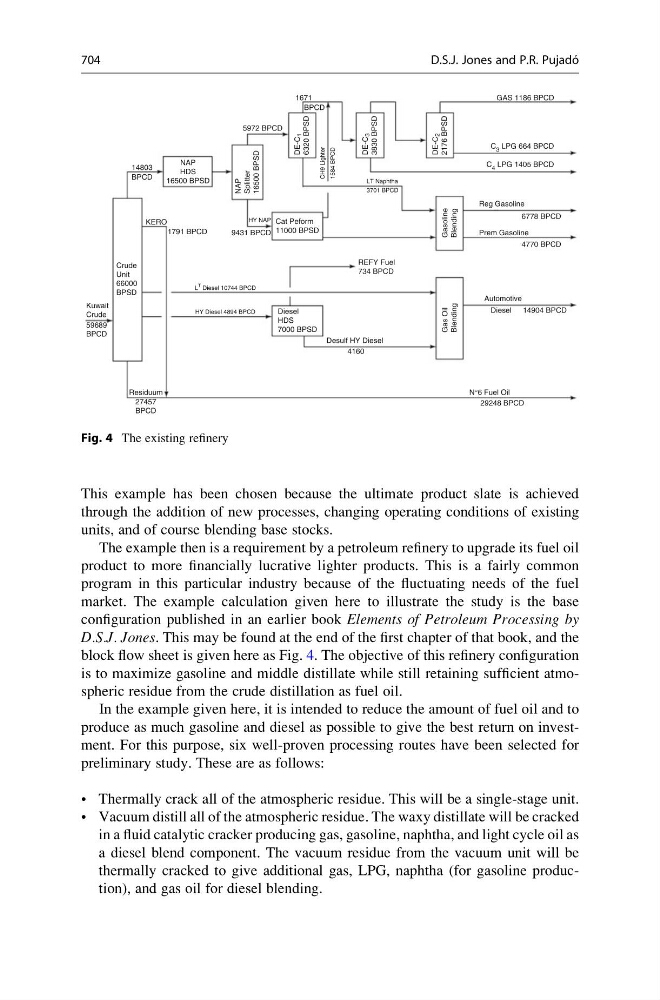
block flow sheet is given here as Fig. 4. The objective of this refinery configuration
is to maximize gasoline and middle distillate while still retaining sufficient atmospheric residue from the crude distillation as fuel oil.
In the example given here, it is intended to reduce the amount of fuel oil and to
produce as much gasoline and diesel as possible to give the best return on investment. For this purpose, six well-proven processing routes have been selected for
preliminary study. These are as follows:
• Thermally crack all of the atmospheric residue. This will be a single-stage unit.
• Vacuum distill all of the atmospheric residue. The waxy distillate will be cracked
in a fluid catalytic cracker producing gas, gasoline, naphtha, and light cycle oil as
a diesel blend component. The vacuum residue from the vacuum unit will be
thermally cracked to give additional gas, LPG, naphtha (for gasoline production), and gas oil for diesel blending.
GAS 1186 BPCD
C 3 LPG 664 BPCD
C 4 LPG 1405 BPCD
Reg Gasoline
Prem Gasoline
Automotive
Diesel
N°6 Fuel Oil
6778 BPCD
4770 BPCD
14904 BPCD
29248 BPCD
1671
14803
BPCD
Crude
Unit
66000
BPSD
Kuwait
Crude
59689
BPCD
Residuum
27457
BPCD
NAP
HDS
16500 BPSD
KERO
1791 BPCD
L T Diesel 10744 BPCD
HY Diesel 4894 BPCD
HY NAP
5972 BPCD
BPCD
9431 BPCD
Cat Peform
11000 BPSD
Diesel
HDS
7000 BPSD
Desulf HY Diesel
DE-C2
2176 BPSD
DE-C3
3830 BPSD
DE-C1
6320 BPSD
CH9 Lighter
1584 BPCD
NAP
Splitter
16500 BPSD
Gas Oil
Blending
Gasoline
Blending
4160
REFY Fuel
734 BPCD
LT Naphtha
3701 BPCD
Fig. 4 The existing refinery
704
D.S.J. Jones and P.R. Pujado ´