

A variety of fuels are available for marine diesel engines (Chevron, Diesel Fuels
Technical Review, 2007). There is a set of four marine distillate fuels, some of
which contain small amounts of resid, and a set of 15 marine residual fuels in which
resid is the majority constituent.
Marine fuels range in viscosity from less than one centistoke (cSt) to about
700 cSt at 50
C (122
F) (1 cSt = 1 mm
2 /s). The higher viscosity grades are
preheated during use to bring their viscosity into the range suitable for injection
(8–27 cSt). Marine fuels also contain more sulfur than on-road diesel fuel, although,
in some areas and ports, only low sulfur fuels are permitted. The maximum sulfur
limit varies from 1 % to 4.5 % by mass for different grades and Sulfur Emission
Control Areas (SECAs).
Several organizations issue marine fuel specifications. ISO 8217 of the International Standards Organization (ISO) is the primary standard. The International
Maritime Organization (IMO) also develops regulations for shipping. Among the
measures adopted within IMO is MARPOL (the International Convention for the
Prevention of Pollution from Ships); this is the main international convention
covering the prevention of operational or accidental pollution of the marine environment by ships. MARPOL Annex VI also limits the usage of fuels to prevent air
pollution.
The shipping industry prefers higher viscosity residual fuels because they are
less expensive. Although residual fuels do not burn as readily as distillate fuels, the
slow speeds (60–200 rpm) of the large marine engines allow more time for
combustion to occur.
Fuel Oil Products
The single most common fuel oil marketed today is the No. 6 grade. Of the lighter
grades, Nos. 1, 2, and 3 were distillate fuels (mostly regular-grade kerosene and gas
oil types). These pretty much disappeared from the markets during the 1980s.
No. 5 fuel was a light residual fuel used mostly in the steel industry. It is no longer
widely used. No. 6 fuel is a heavy residual fuel, normally a mixture of atmospheric
and vacuum distillation residues cut back to adjust for viscosity with kerosene or
gas oil cutter stock. This fuel oil product is almost entirely used as ship bunker oil,
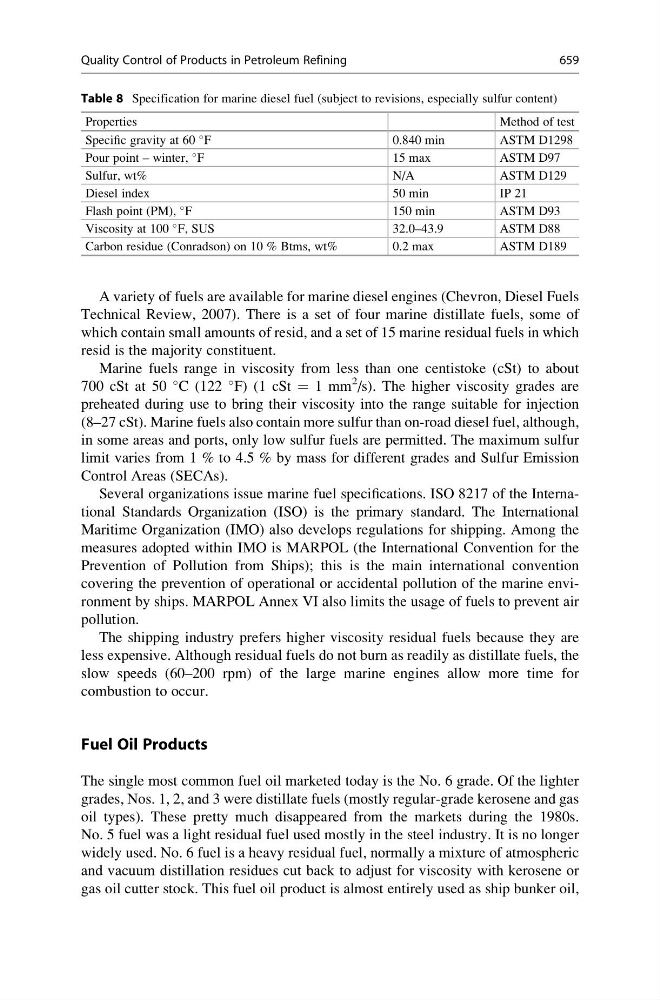
Table 8 Specification for marine diesel fuel (subject to revisions, especially sulfur content)
Properties
Method of test
Specific gravity at 60
F
0.840 min
ASTM D1298
Pour point – winter,
F
15 max
ASTM D97
Sulfur, wt%
N/A
ASTM D129
Diesel index
50 min
IP 21
Flash point (PM),
F
150 min
ASTM D93
Viscosity at 100
F, SUS
32.0–43.9
ASTM D88
Carbon residue (Conradson) on 10 % Btms, wt%
0.2 max
ASTM D189
Quality Control of Products in Petroleum Refining
659