

higher aromatics level, if emissions are equivalent to those of a specific reference
fuel with a 10 mass percent aromatics level. In that case, other fuel properties
(cetane number, sulfur, nitrogen, aromatics, and polynuclear aromatics) are
recorded. Fuel marketed under this certification must be within the recorded limits
of these five properties.
ULSD became widely available in Western Europe and Japan (10 ppm sulfur
maximum) starting in 2005; the U.S. (15 ppm sulfur maximum) followed in 2006.
Full transition to ULSD has occurred over a period of several years, with 100 % of
on-highway and off-road diesel meeting ULSD specifications by 2009 in Europe
and by 2010–2014 in the U.S. While ULSD enables use of advanced exhaust aftertreatment technology on new diesel engines, it is also fully compatible with, and
will help reduce sulfate emissions from, existing older technology diesel engines.
The third gas oil product is really a blend of the gas oil distillate and atmospheric
residuum. Its color is black and has the following much reduced specification. This
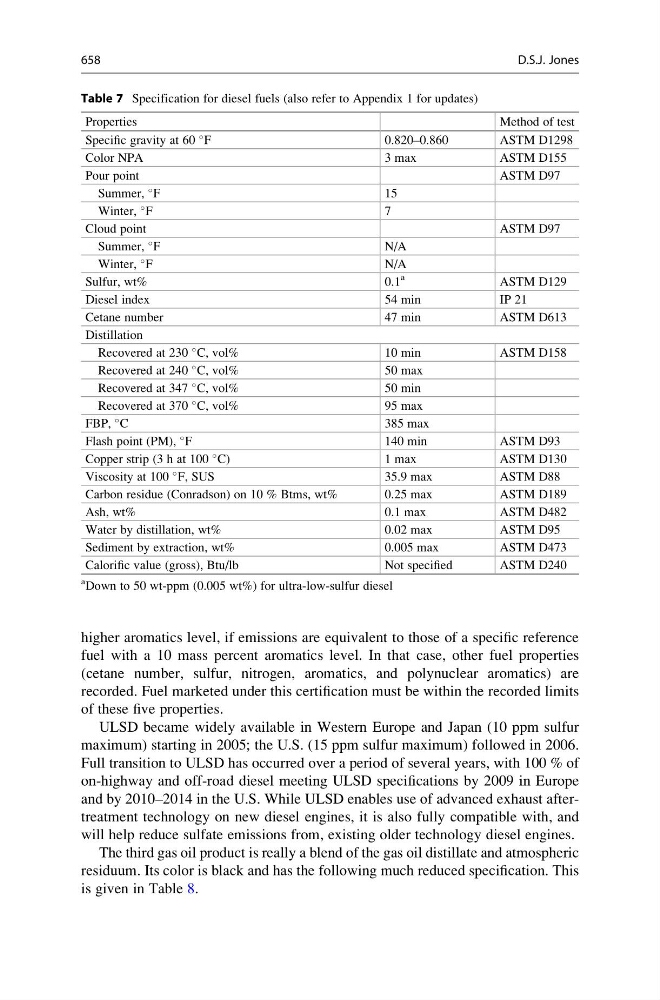
is given in Table 8.
Table 7 Specification for diesel fuels (also refer to Appendix 1 for updates)
Properties
Method of test
Specific gravity at 60
F
0.820–0.860
ASTM D1298
Color NPA
3 max
ASTM D155
Pour point
ASTM D97
Summer,
F
1 5
Winter,
F
7
Cloud point
ASTM D97
Summer,
F
N/A
Winter,
F
N/A
Sulfur, wt%
0.1
a
ASTM D129
Diesel index
54 min
IP 21
Cetane number
47 min
ASTM D613
Distillation
Recovered at 230
C, vol%
10 min
ASTM D158
Recovered at 240
C, vol%
50 max
Recovered at 347
C, vol%
50 min
Recovered at 370
C, vol%
95 max
FBP,
C
385 max
Flash point (PM),
F
140 min
ASTM D93
Copper strip (3 h at 100
C)
1 max
ASTM D130
Viscosity at 100
F, SUS
35.9 max
ASTM D88
Carbon residue (Conradson) on 10 % Btms, wt%
0.25 max
ASTM D189
Ash, wt%
0.1 max
ASTM D482
Water by distillation, wt%
0.02 max
ASTM D95
Sediment by extraction, wt%
0.005 max
ASTM D473
Calorific value (gross), Btu/lb
Not specified
ASTM D240
a
Down to 50 wt-ppm (0.005 wt%) for ultra-low-sulfur diesel
658
D.S.J. Jones