

More stringent specifications have applied since 2006. In the past, diesel engine
manufacturers have produced engines to meet the increasingly stringent emissions
standards through improvements to the combustion process itself. In order to meet
additional regulatory standards (U.S. 2007+, Europe 2009+), most new diesel
engines will need to employ some type of advanced exhaust after-treatment technology. Because most exhaust after-treatment devices are very sensitive to sulfur
(some devices can be permanently damaged by prolonged exposure to fuel sulfur
levels as low as 50 ppm), vehicles so equipped must use ultra-low sulfur diesel
(ULSD) fuel, officially designated as S15 in the ASTM diesel fuel standard. The
term “ultra-low sulfur diesel” may refer to different levels of sulfur in different
parts of the world. However, for the purposes of this review (Chevron, Diesel Fuels
Technical Review, 2007), ULSD refers to diesel fuel containing less than 15 ppm
sulfur in the U.S. and less than 10 ppm sulfur in Europe and the Asia-Pacific region.
In California, the Air Resources Board (ARB) has regulated an additional
requirement. All diesel fuel sold in this state must have an aromatics content of
10 mass percent or less. Alternatively, a fuel supplier can test and certify a fuel with
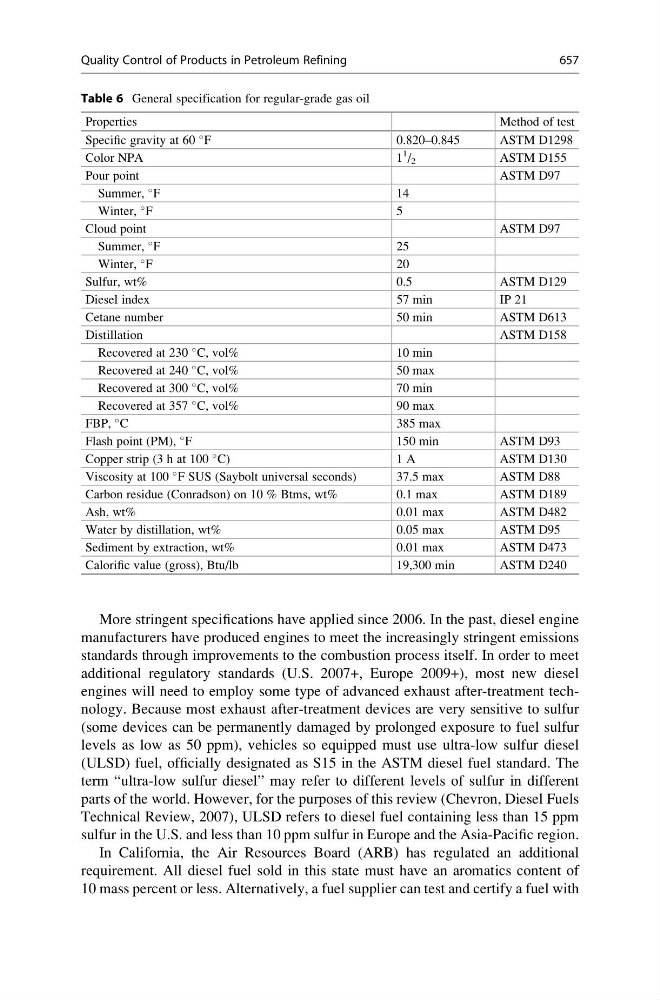
Table 6 General specification for regular-grade gas oil
Properties
Method of test
Specific gravity at 60
F
0.820–0.845
ASTM D1298
Color NPA
1
1
/ 2
ASTM D155
Pour point
ASTM D97
Summer,
F
1 4
Winter,
F
5
Cloud point
ASTM D97
Summer,
F
2 5
Winter,
F
2 0
Sulfur, wt%
0.5
ASTM D129
Diesel index
57 min
IP 21
Cetane number
50 min
ASTM D613
Distillation
ASTM D158
Recovered at 230
C, vol%
10 min
Recovered at 240
C, vol%
50 max
Recovered at 300
C, vol%
70 min
Recovered at 357
C, vol%
90 max
FBP,
C
385 max
Flash point (PM),
F
150 min
ASTM D93
Copper strip (3 h at 100
C)
1 A
ASTM D130
Viscosity at 100
F SUS (Saybolt universal seconds)
37.5 max
ASTM D88
Carbon residue (Conradson) on 10 % Btms, wt%
0.1 max
ASTM D189
Ash, wt%
0.01 max
ASTM D482
Water by distillation, wt%
0.05 max
ASTM D95
Sediment by extraction, wt%
0.01 max
ASTM D473
Calorific value (gross), Btu/lb
19,300 min
ASTM D240
Quality Control of Products in Petroleum Refining
657