

Heating oil is used predominately as domestic heating oil in many countries. Its
most important properties are the pour point and sulfur content. A full specification
of the gas oil is given in Table 6.
The specification for automotive-grade gas oil (diesel fuel) is given in Table 7.
Certain properties of this product are more stringent than those for heating oil to
meet the present environmental requirements and the present design features of the
diesel engines. The one item that stands out as being very stringent is the sulfur
content of the diesel. This specification became effective in 2002.
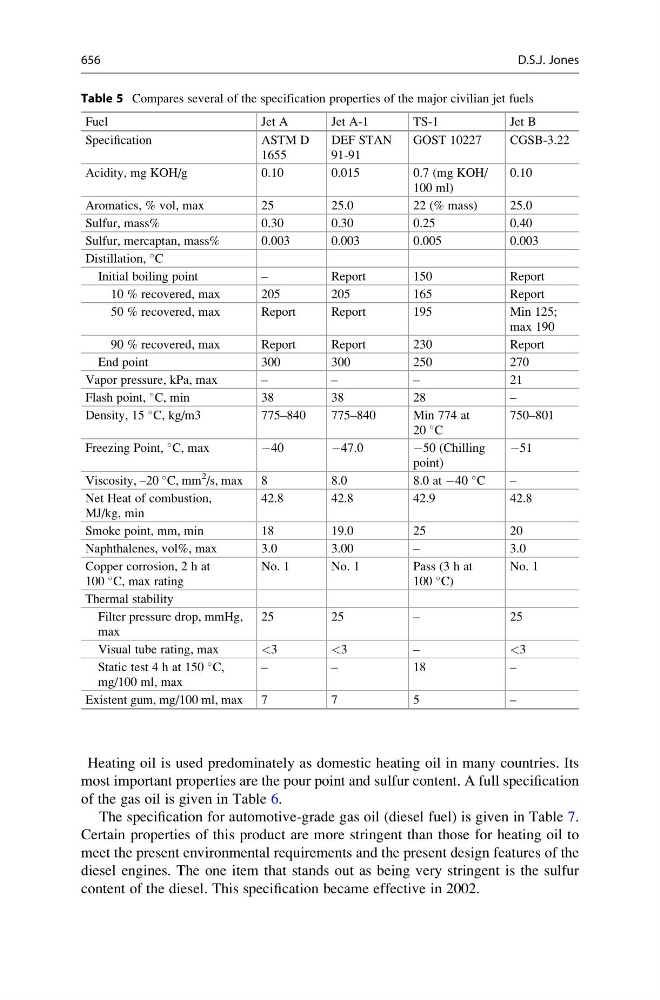
Table 5 Compares several of the specification properties of the major civilian jet fuels
Fuel
Jet A
Jet A-1
TS-1
Jet B
Specification
ASTM D
1655
DEF STAN
91-91
GOST 10227
CGSB-3.22
Acidity, mg KOH/g
0.10
0.015
0.7 (mg KOH/
100 ml)
0.10
Aromatics, % vol, max
25
25.0
22 (% mass)
25.0
Sulfur, mass%
0.30
0.30
0.25
0.40
Sulfur, mercaptan, mass%
0.003
0.003
0.005
0.003
Distillation,
C
Initial boiling point
–
Report
150
Report
10 % recovered, max
205
205
165
Report
50 % recovered, max
Report
Report
195
Min 125;
max 190
90 % recovered, max
Report
Report
230
Report
End point
300
300
250
270
Vapor pressure, kPa, max
–
–
–
21
Flash point,
C, min
38
38
28
–
Density, 15
C, kg/m3
775–840
775–840
Min 774 at
20
C
750–801
Freezing Point,
C, max
À40
À47.0
À50 (Chilling
point)
À51
Viscosity, –20
C, mm
2
/s, max 8
8.0
8.0 at À40
C
–
Net Heat of combustion,
MJ/kg, min
42.8
42.8
42.9
42.8
Smoke point, mm, min
18
19.0
25
20
Naphthalenes, vol%, max
3.0
3.00
–
3.0
Copper corrosion, 2 h at
100
C, max rating
No. 1
No. 1
Pass (3 h at
100
C)
No. 1
Thermal stability
Filter pressure drop, mmHg,
max
25
25
–
25
Visual tube rating, max
<3
<3
–
<3
Static test 4 h at 150
C,
mg/100 ml, max
–
–
18
–
Existent gum, mg/100 ml, max 7
7
5
–
656
D.S.J. Jones