

with some market outlet to stationary power plants in producing steam for their
turbines. For the last 20 years or so, these markets have been in decline. Power
plants are converting to the use of coal or natural gas, and ships are leaning more to
the use of marine diesel or just diesel fuel. Environmental restrictions are calling for
a continual decrease in the sulfur content of this particular product. As a result,
No. 6 fuel is the least valued refinery product and is worth less than the crude feed
itself. Refiners are now installing processes (such as “deep oil cracking” and residue
hydrocracking) to upgrade this product to the more valued distillates such as
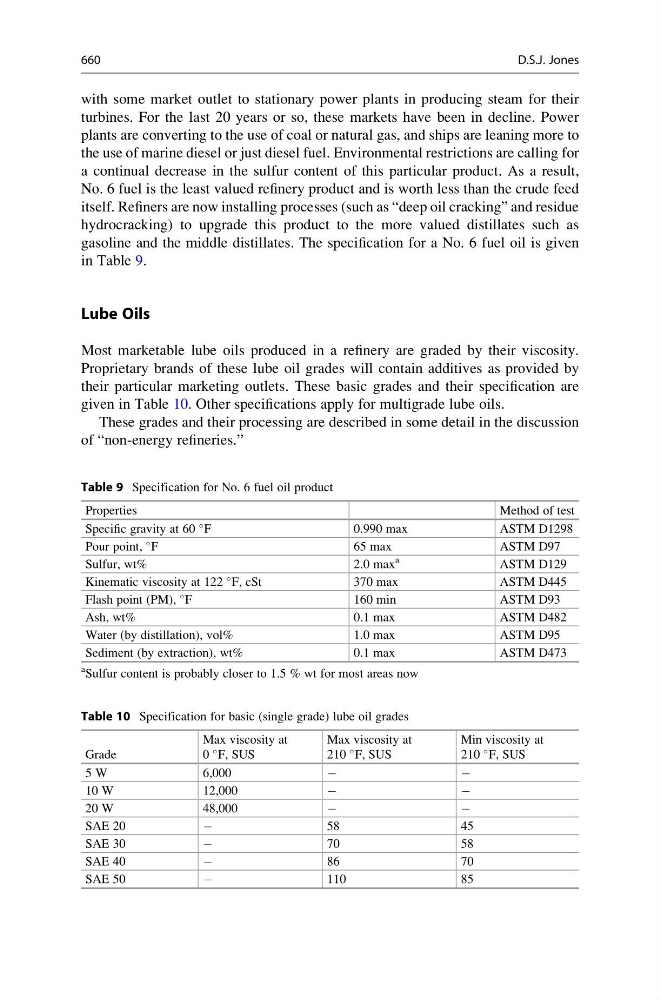
gasoline and the middle distillates. The specification for a No. 6 fuel oil is given
in Table 9.
Lube Oils
Most marketable lube oils produced in a refinery are graded by their viscosity.
Proprietary brands of these lube oil grades will contain additives as provided by
their particular marketing outlets. These basic grades and their specification are
given in Table 10. Other specifications apply for multigrade lube oils.
These grades and their processing are described in some detail in the discussion
of “non-energy refineries.”
Table 9 Specification for No. 6 fuel oil product
Properties
Method of test
Specific gravity at 60
F
0.990 max
ASTM D1298
Pour point,
F
65 max
ASTM D97
Sulfur, wt%
2.0 max
a
ASTM D129
Kinematic viscosity at 122
F, cSt
370 max
ASTM D445
Flash point (PM),
F
160 min
ASTM D93
Ash, wt%
0.1 max
ASTM D482
Water (by distillation), vol%
1.0 max
ASTM D95
Sediment (by extraction), wt%
0.1 max
ASTM D473
a
Sulfur content is probably closer to 1.5 % wt for most areas now
Table 10 Specification for basic (single grade) lube oil grades
Grade
Max viscosity at
0
F, SUS
Max viscosity at
210
F, SUS
Min viscosity at
210
F, SUS
5 W
6,000
À
À
10 W
12,000
À
À
20 W
48,000
À
À
SAE 20
À
58
45
SAE 30
À
70
58
SAE 40
À
86
70
SAE 50
À
110
85
660
D.S.J. Jones