

• It is a good practice to select a few tubes in different sections of the furnace to load
as “test tubes” before beginning to load the entire furnace. Usually, you pick about
1–3 % of the furnace tubes as test tubes. Load this subset of tubes just like you load
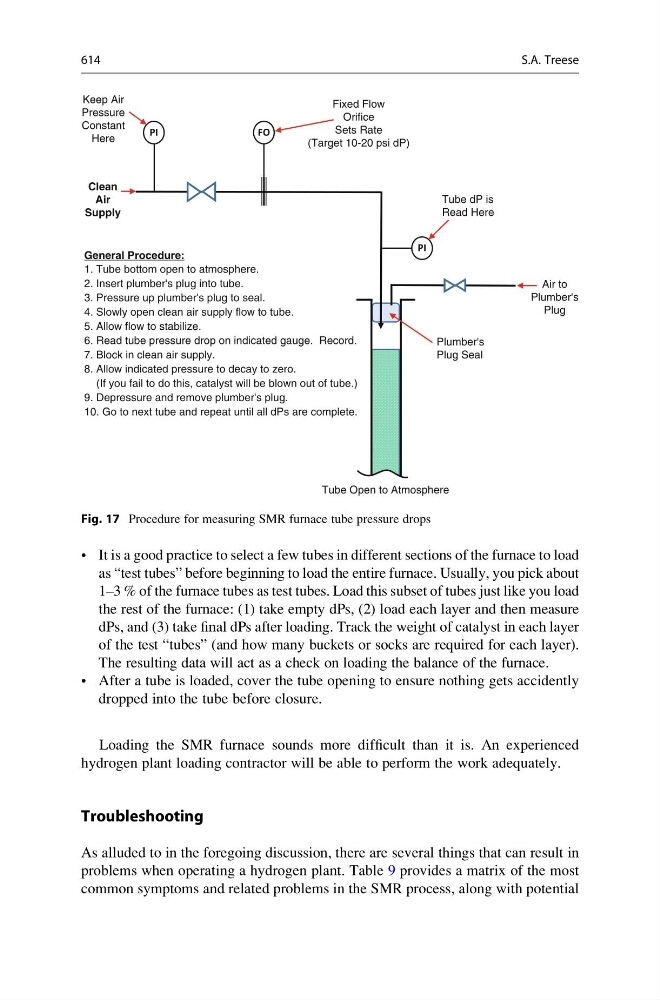
the rest of the furnace: (1) take empty dPs, (2) load each layer and then measure
dPs, and (3) take final dPs after loading. Track the weight of catalyst in each layer
of the test “tubes” (and how many buckets or socks are required for each layer).
The resulting data will act as a check on loading the balance of the furnace.
• After a tube is loaded, cover the tube opening to ensure nothing gets accidently
dropped into the tube before closure.
Loading the SMR furnace sounds more difficult than it is. An experienced
hydrogen plant loading contractor will be able to perform the work adequately.
Troubleshooting
As alluded to in the foregoing discussion, there are several things that can result in
problems when operating a hydrogen plant. Table 9 provides a matrix of the most
common symptoms and related problems in the SMR process, along with potential
Keep Air
Pressure
Constant
Here
Fixed Flow
Orifice
Sets Rate
(Target 10-20 psi dP)
Clean
Air
Supply
Tube dP is
Read Here
General Procedure:
1. Tube bottom open to atmosphere.
2. Insert plumber's plug into tube.
3. Pressure up plumber's plug to seal.
4. Slowly open clean air supply flow to tube.
5. Allow flow to stabilize.
6. Read tube pressure drop on indicated gauge. Record.
7. Block in clean air supply.
8. Allow indicated pressure to decay to zero.
(If you fail to do this, catalyst will be blown out of tube.)
9. Depressure and remove plumber's plug.
10. Go to next tube and repeat until all dPs are complete.
Air to
Plumber's
Plug
Plumber's
Plug Seal
Tube Open to Atmosphere
PI
FO
PI
Fig. 17 Procedure for measuring SMR furnace tube pressure drops
614
S.A. Treese