

Purification
There are two general approaches to purification of raw hydrogen which we will
consider here:
1. Pressure swing adsorption
2. Wet chemical/solvent with methanation
Pressure Swing Adsorption
In modern hydrogen plants, pressure swing adsorption (PSA) is the most common
method of purification. The resulting product is nearly 100 % pure hydrogen, and
the off-gas can be used as fuel in the SMR furnace.
Refer to the section “Pressure Swing Adsorption” of this chapter for more
detailed discussion of PSAs. The following comments address how a PSA is
applied in SMR hydrogen plant service.
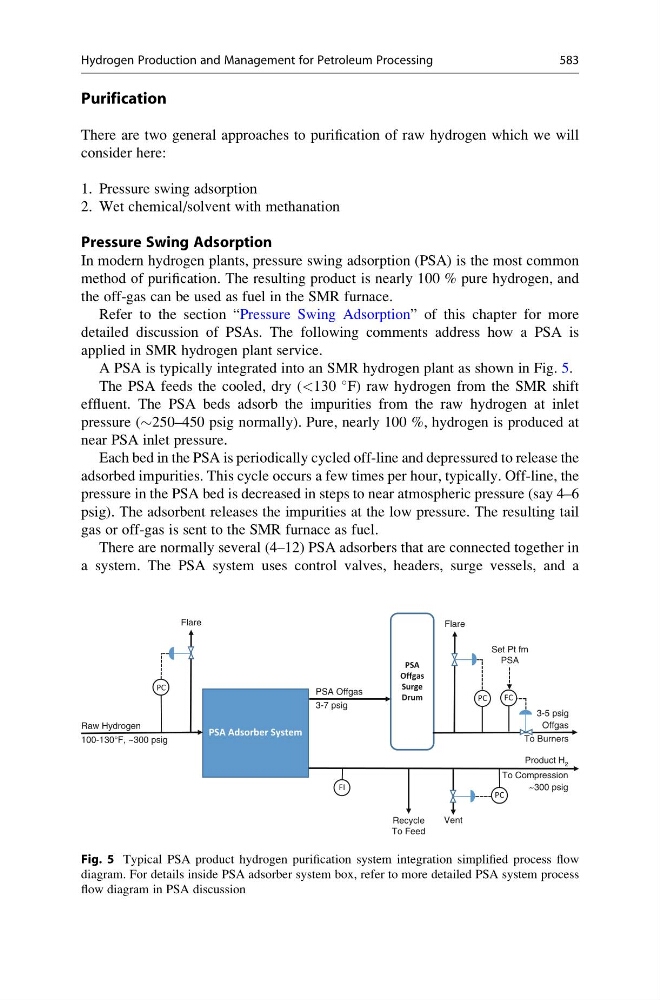
A PSA is typically integrated into an SMR hydrogen plant as shown in Fig. 5.
The PSA feeds the cooled, dry (<130
F) raw hydrogen from the SMR shift
effluent. The PSA beds adsorb the impurities from the raw hydrogen at inlet
pressure ($250–450 psig normally). Pure, nearly 100 %, hydrogen is produced at
near PSA inlet pressure.
Each bed in the PSA is periodically cycled off-line and depressured to release the
adsorbed impurities. This cycle occurs a few times per hour, typically. Off-line, the
pressure in the PSA bed is decreased in steps to near atmospheric pressure (say 4–6
psig). The adsorbent releases the impurities at the low pressure. The resulting tail
gas or off-gas is sent to the SMR furnace as fuel.
There are normally several (4–12) PSA adsorbers that are connected together in
a system. The PSA system uses control valves, headers, surge vessels, and a
Flare
Flare
Set Pt fm
PSA
PSA Offgas
3-7 psig
3-5 psig
Offgas
To Burners
Raw Hydrogen
100-130°F, ~300 psig
Product H 2
To Compression
~300 psig
Recycle
To Feed
Vent
PSA Adsorber System
PSA
Offgas
Surge
Drum
FI
PC
FC
PC
PC
Fig. 5 Typical PSA product hydrogen purification system integration simplified process flow
diagram. For details inside PSA adsorber system box, refer to more detailed PSA system process
flow diagram in PSA discussion
Hydrogen Production and Management for Petroleum Processing
583