

programmable logic controller to swing each bed through the adsorption-desorption
steps in sequence to provide continuous product hydrogen flow. The off-gas is
collected in a surge drum to moderate pressure and composition changes before it is
sent to the SMR furnace to be burned. The off-gas provides about 50–70 % of the
SMR fuel requirement.
Hydrogen recovery in a PSA tied to an SMR unit typically ranges from 80 % to
92 % of the total hydrogen produced in the plant, with a good typical value of about
85 %. The multiple steps in the bed regeneration sequence help optimize hydrogen
product recovery. More steps increase recovery, but can require more beds and
additional complexity. There may be 50–100 individual steps in the sequence for
several beds.
Hydrogen recovery can also be enhanced by online analyzers to monitor product
or intermediate-pressure step gases.
One downside of a PSA tied to a continuous process is that it either works or it
does not. There are several problems that can cause a PSA to trip. In a trip, your
hydrogen product is immediately lost and the hydrogen plant will experience a
major upset as the off-gas fuel is lost immediately – causing a major furnace firing
disturbance.
The most frequent problems for PSAs are valve failures. These can be expected a
few times a year. Sometimes, the PSA logic can work around a problem by
removing pairs of beds from service and not interrupting the flow; but often a
problem trips the unit. Operators will develop experience to manage the trips
with time.
The finished PSA product is nearly 100 % hydrogen, with traces of nitrogen and
CO (typically <100 ppm N 2 , <10 ppm CO). N 2 and CO are the first gases that
will break through a PSA. The PSA operation can be adjusted to allow more or less
N 2 /CO slip, depending on the hydrogen user limitations. For instance, if the
hydrogen is used in an isomerization unit, you would want less than 1 ppm
CO. This can be achieved by a PSA, with some loss of recovery. More typically,
a CO level of <10 vppm in the product hydrogen is the target. Allowing more CO to
slip into the product hydrogen does not significantly increase the amount of
hydrogen recovered and, at some point, actually decreases net hydrogen recovery
because methanation begins consuming the hydrogen in the users.
Wet Chemical/Solvent with Methanation
Most of the older hydrogen plants used a wet chemical/solvent approach to hydrogen purification. These systems remove nearly all the CO 2 , but leave CO in the
product hydrogen; hence, plants using wet chemical/solvent purification follow the
CO 2 removal with a methanation step to eliminate the CO.
The chemical processes used here generally follow these equations, using DGA
as an example solvent:
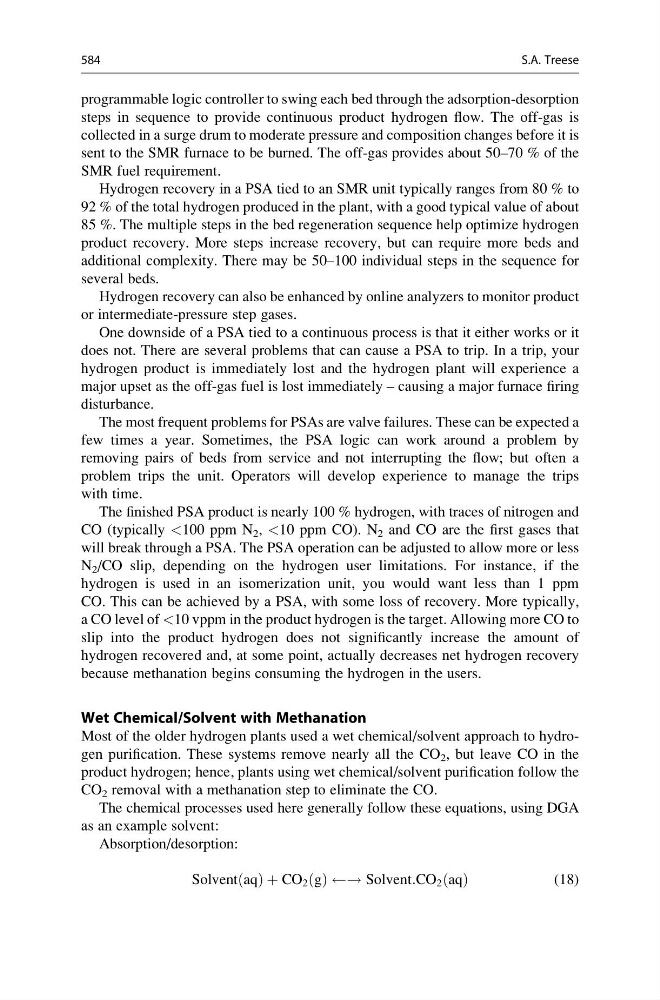
Absorption/desorption:
Solvent aq
ð Þ þ CO 2 g
ð Þ ! Solvent:CO 2 aq
ð Þ
(18)
584
S.A. Treese