

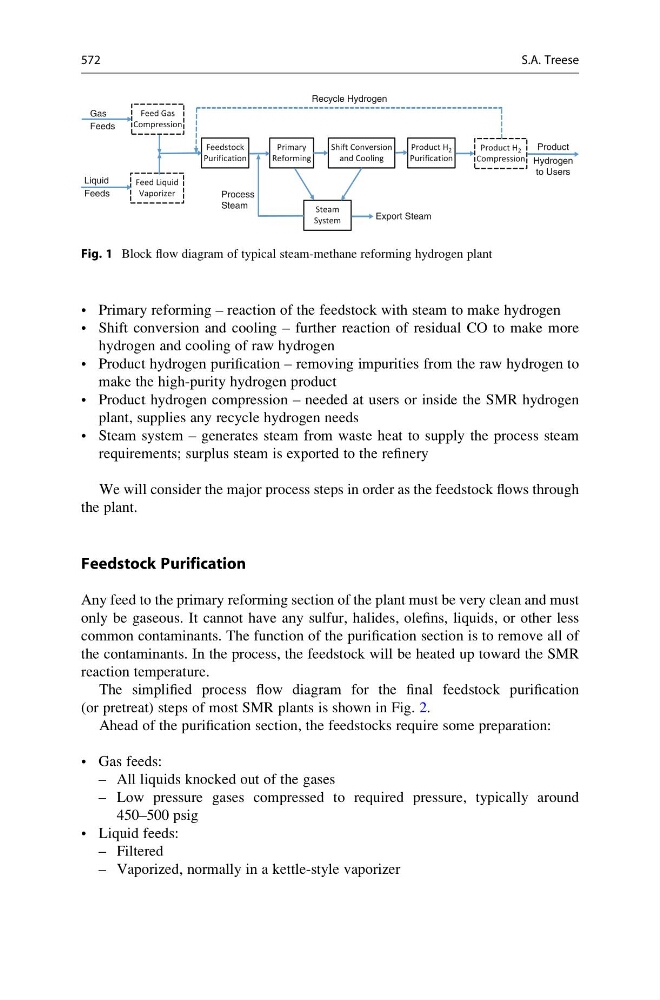
• Primary reforming – reaction of the feedstock with steam to make hydrogen
• Shift conversion and cooling – further reaction of residual CO to make more
hydrogen and cooling of raw hydrogen
• Product hydrogen purification – removing impurities from the raw hydrogen to
make the high-purity hydrogen product
• Product hydrogen compression – needed at users or inside the SMR hydrogen
plant, supplies any recycle hydrogen needs
• Steam system – generates steam from waste heat to supply the process steam
requirements; surplus steam is exported to the refinery
We will consider the major process steps in order as the feedstock flows through
the plant.
Feedstock Purification
Any feed to the primary reforming section of the plant must be very clean and must
only be gaseous. It cannot have any sulfur, halides, olefins, liquids, or other less
common contaminants. The function of the purification section is to remove all of
the contaminants. In the process, the feedstock will be heated up toward the SMR
reaction temperature.
The simplified process flow diagram for the final feedstock purification
(or pretreat) steps of most SMR plants is shown in Fig. 2.
Ahead of the purification section, the feedstocks require some preparation:
• Gas feeds:
– All liquids knocked out of the gases
– Low pressure gases compressed to required pressure, typically around
450–500 psig
• Liquid feeds:
– Filtered
– Vaporized, normally in a kettle-style vaporizer
Product
Hydrogen
to Users
Recycle Hydrogen
Gas
Feeds
Liquid
Feeds
Process
Steam
Export Steam
Feed Gas
Compression
Feed Liquid
Vaporizer
Feedstock
Purification
Primary
Reforming
Shift Conversion
and Cooling
Product H 2
Purification
Product H 2
Compression
Steam
System
Fig. 1 Block flow diagram of typical steam-methane reforming hydrogen plant
572
S.A. Treese
• Shift conversion and cooling – further reaction of residual CO to make more
hydrogen and cooling of raw hydrogen
• Product hydrogen purification – removing impurities from the raw hydrogen to
make the high-purity hydrogen product
• Product hydrogen compression – needed at users or inside the SMR hydrogen
plant, supplies any recycle hydrogen needs
• Steam system – generates steam from waste heat to supply the process steam
requirements; surplus steam is exported to the refinery
We will consider the major process steps in order as the feedstock flows through
the plant.
Feedstock Purification
Any feed to the primary reforming section of the plant must be very clean and must
only be gaseous. It cannot have any sulfur, halides, olefins, liquids, or other less
common contaminants. The function of the purification section is to remove all of
the contaminants. In the process, the feedstock will be heated up toward the SMR
reaction temperature.
The simplified process flow diagram for the final feedstock purification
(or pretreat) steps of most SMR plants is shown in Fig. 2.
Ahead of the purification section, the feedstocks require some preparation:
• Gas feeds:
– All liquids knocked out of the gases
– Low pressure gases compressed to required pressure, typically around
450–500 psig
• Liquid feeds:
– Filtered
– Vaporized, normally in a kettle-style vaporizer
Product
Hydrogen
to Users
Recycle Hydrogen
Gas
Feeds
Liquid
Feeds
Process
Steam
Export Steam
Feed Gas
Compression
Feed Liquid
Vaporizer
Feedstock
Purification
Primary
Reforming
Shift Conversion
and Cooling
Product H 2
Purification
Product H 2
Compression
Steam
System
Fig. 1 Block flow diagram of typical steam-methane reforming hydrogen plant
572
S.A. Treese