

Advantages of the SMR process are:
• High yields and efficiency – low cost of hydrogen
• High-purity hydrogen product (93–100 %)
• Feedstock flexibility (natural gas, refinery gases, refinery liquids – anything with
carbon)
• Relatively easy to operate (governed by equilibrium)
• Relatively easy to monitor (you cannot ignore an SMR, however)
• Scalable – smallest units less than 1 MMscfd to more than 800 MMscfd
• Open art technology, although some equipment and design methods are
proprietary
• Many design, equipment, catalyst, and sorbent suppliers, who will help train
your personnel and monitor plant
• Well-established safety and support organizations (e.g., AIChE Annual Safety in
Ammonia Plants and Related Facilities Symposia)
The disadvantages of the SMR process are largely manageable:
• Severe operating conditions push materials limits
• Cleanup of feedstock and products can be complex
• SMR plants work best at high loads – they do not operate well below 50 % rate
• They like stable production rates – rate changes require a lot of adjustments that
are not automatic
• The plants produce CO/CO 2 , NO x , trace organic oxygenates (like methanol), and
trace ammonia – all of which must be reported and managed within environmental limits
• An absolutely stable supply of boiler feedwater is required – loss of boiler
feedwater for a few minutes (or sometimes seconds) can have drastic
consequences
Now, we will walk through the process step by step. The process will focus
primarily on making hydrogen from natural gas or refinery gases, with appropriate
touches on SMR of refinery liquids.
SMR Processes: Step by Step
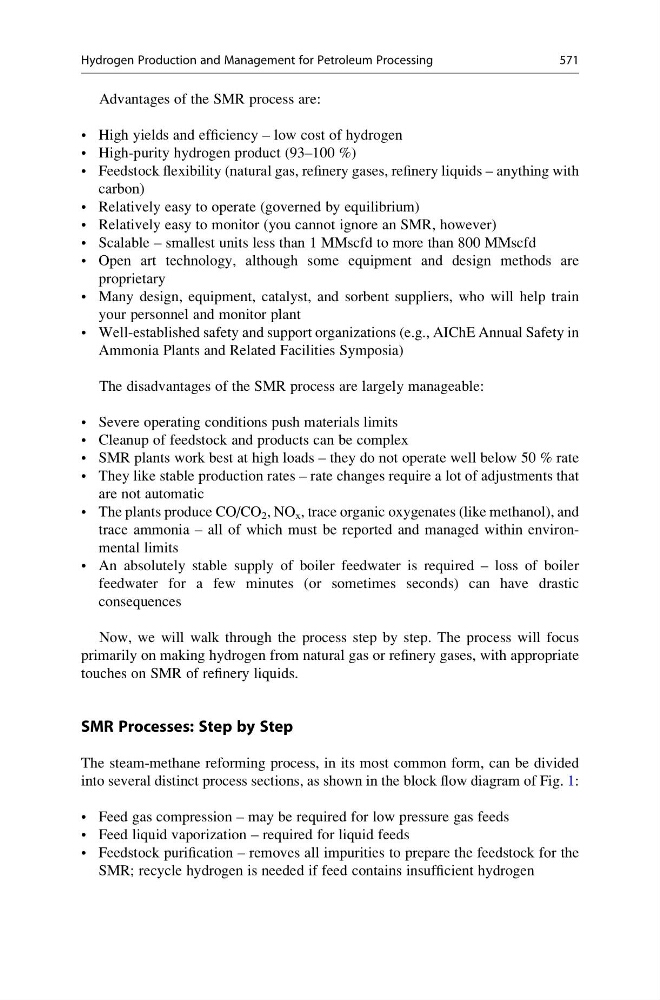
The steam-methane reforming process, in its most common form, can be divided
into several distinct process sections, as shown in the block flow diagram of Fig. 1:
• Feed gas compression – may be required for low pressure gas feeds
• Feed liquid vaporization – required for liquid feeds
• Feedstock purification – removes all impurities to prepare the feedstock for the
SMR; recycle hydrogen is needed if feed contains insufficient hydrogen
Hydrogen Production and Management for Petroleum Processing
571
• High yields and efficiency – low cost of hydrogen
• High-purity hydrogen product (93–100 %)
• Feedstock flexibility (natural gas, refinery gases, refinery liquids – anything with
carbon)
• Relatively easy to operate (governed by equilibrium)
• Relatively easy to monitor (you cannot ignore an SMR, however)
• Scalable – smallest units less than 1 MMscfd to more than 800 MMscfd
• Open art technology, although some equipment and design methods are
proprietary
• Many design, equipment, catalyst, and sorbent suppliers, who will help train
your personnel and monitor plant
• Well-established safety and support organizations (e.g., AIChE Annual Safety in
Ammonia Plants and Related Facilities Symposia)
The disadvantages of the SMR process are largely manageable:
• Severe operating conditions push materials limits
• Cleanup of feedstock and products can be complex
• SMR plants work best at high loads – they do not operate well below 50 % rate
• They like stable production rates – rate changes require a lot of adjustments that
are not automatic
• The plants produce CO/CO 2 , NO x , trace organic oxygenates (like methanol), and
trace ammonia – all of which must be reported and managed within environmental limits
• An absolutely stable supply of boiler feedwater is required – loss of boiler
feedwater for a few minutes (or sometimes seconds) can have drastic
consequences
Now, we will walk through the process step by step. The process will focus
primarily on making hydrogen from natural gas or refinery gases, with appropriate
touches on SMR of refinery liquids.
SMR Processes: Step by Step
The steam-methane reforming process, in its most common form, can be divided
into several distinct process sections, as shown in the block flow diagram of Fig. 1:
• Feed gas compression – may be required for low pressure gas feeds
• Feed liquid vaporization – required for liquid feeds
• Feedstock purification – removes all impurities to prepare the feedstock for the
SMR; recycle hydrogen is needed if feed contains insufficient hydrogen
Hydrogen Production and Management for Petroleum Processing
571