

FINELY DISPERSEDOIL
DILUTECATALYSTENVIRON-OIL FEED
MENT
STEAM
STEAM
STEAM
OIL FEED
REGEN
CATALYST
STEAM OR LIFT GAS
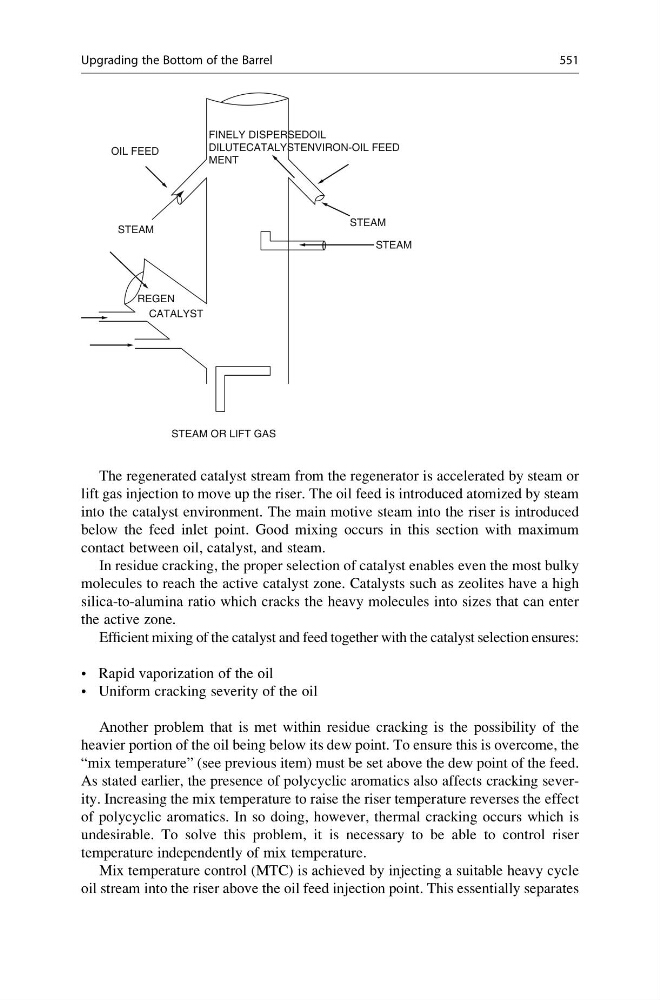
The regenerated catalyst stream from the regenerator is accelerated by steam or
lift gas injection to move up the riser. The oil feed is introduced atomized by steam
into the catalyst environment. The main motive steam into the riser is introduced
below the feed inlet point. Good mixing occurs in this section with maximum
contact between oil, catalyst, and steam.
In residue cracking, the proper selection of catalyst enables even the most bulky
molecules to reach the active catalyst zone. Catalysts such as zeolites have a high
silica-to-alumina ratio which cracks the heavy molecules into sizes that can enter
the active zone.
Efficient mixing of the catalyst and feed together with the catalyst selection ensures:
• Rapid vaporization of the oil
• Uniform cracking severity of the oil
Another problem that is met within residue cracking is the possibility of the
heavier portion of the oil being below its dew point. To ensure this is overcome, the
“mix temperature” (see previous item) must be set above the dew point of the feed.
As stated earlier, the presence of polycyclic aromatics also affects cracking severity. Increasing the mix temperature to raise the riser temperature reverses the effect
of polycyclic aromatics. In so doing, however, thermal cracking occurs which is
undesirable. To solve this problem, it is necessary to be able to control riser
temperature independently of mix temperature.
Mix temperature control (MTC) is achieved by injecting a suitable heavy cycle
oil stream into the riser above the oil feed injection point. This essentially separates
Upgrading the Bottom of the Barrel
551
DILUTECATALYSTENVIRON-OIL FEED
MENT
STEAM
STEAM
STEAM
OIL FEED
REGEN
CATALYST
STEAM OR LIFT GAS
The regenerated catalyst stream from the regenerator is accelerated by steam or
lift gas injection to move up the riser. The oil feed is introduced atomized by steam
into the catalyst environment. The main motive steam into the riser is introduced
below the feed inlet point. Good mixing occurs in this section with maximum
contact between oil, catalyst, and steam.
In residue cracking, the proper selection of catalyst enables even the most bulky
molecules to reach the active catalyst zone. Catalysts such as zeolites have a high
silica-to-alumina ratio which cracks the heavy molecules into sizes that can enter
the active zone.
Efficient mixing of the catalyst and feed together with the catalyst selection ensures:
• Rapid vaporization of the oil
• Uniform cracking severity of the oil
Another problem that is met within residue cracking is the possibility of the
heavier portion of the oil being below its dew point. To ensure this is overcome, the
“mix temperature” (see previous item) must be set above the dew point of the feed.
As stated earlier, the presence of polycyclic aromatics also affects cracking severity. Increasing the mix temperature to raise the riser temperature reverses the effect
of polycyclic aromatics. In so doing, however, thermal cracking occurs which is
undesirable. To solve this problem, it is necessary to be able to control riser
temperature independently of mix temperature.
Mix temperature control (MTC) is achieved by injecting a suitable heavy cycle
oil stream into the riser above the oil feed injection point. This essentially separates
Upgrading the Bottom of the Barrel
551