

that is through preheating the feed. Doing this, however, immediately reduces the
catalyst circulation rate to maintain heat balance. This, of course, has an adverse
effect on conversion. The preheating of the feed can, however, be compensated for
by cooling the catalyst. Thus, the catalyst circulation rate can be retained and in
many cases can be increased. Indeed, by careful manipulation of the heat balance,
the net increase in catalyst circulation rate can be as high as 1 unit cat/oil ratio. The
higher equilibrium catalyst activity possible at the lower regeneration temperature
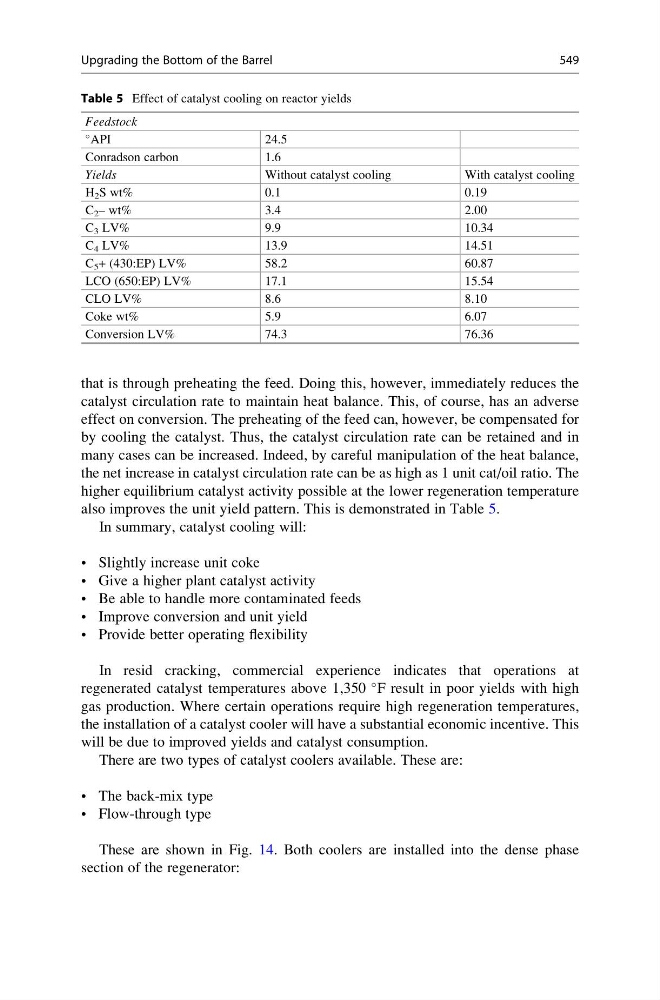
also improves the unit yield pattern. This is demonstrated in Table 5.
In summary, catalyst cooling will:
• Slightly increase unit coke
• Give a higher plant catalyst activity
• Be able to handle more contaminated feeds
• Improve conversion and unit yield
• Provide better operating flexibility
In resid cracking, commercial experience indicates that operations at
regenerated catalyst temperatures above 1,350
F result in poor yields with high
gas production. Where certain operations require high regeneration temperatures,
the installation of a catalyst cooler will have a substantial economic incentive. This
will be due to improved yields and catalyst consumption.
There are two types of catalyst coolers available. These are:
• The back-mix type
• Flow-through type
These are shown in Fig. 14. Both coolers are installed into the dense phase
section of the regenerator:
Table 5 Effect of catalyst cooling on reactor yields
Feedstock
API
24.5
Conradson carbon
1.6
Yields
Without catalyst cooling
With catalyst cooling
H 2 S wt%
0.1
0.19
C 2 – wt%
3.4
2.00
C 3 LV%
9.9
10.34
C 4 LV%
13.9
14.51
C 5 + (430:EP) LV%
58.2
60.87
LCO (650:EP) LV%
17.1
15.54
CLO LV%
8.6
8.10
Coke wt%
5.9
6.07
Conversion LV%
74.3
76.36
Upgrading the Bottom of the Barrel
549
catalyst circulation rate to maintain heat balance. This, of course, has an adverse
effect on conversion. The preheating of the feed can, however, be compensated for
by cooling the catalyst. Thus, the catalyst circulation rate can be retained and in
many cases can be increased. Indeed, by careful manipulation of the heat balance,
the net increase in catalyst circulation rate can be as high as 1 unit cat/oil ratio. The
higher equilibrium catalyst activity possible at the lower regeneration temperature
also improves the unit yield pattern. This is demonstrated in Table 5.
In summary, catalyst cooling will:
• Slightly increase unit coke
• Give a higher plant catalyst activity
• Be able to handle more contaminated feeds
• Improve conversion and unit yield
• Provide better operating flexibility
In resid cracking, commercial experience indicates that operations at
regenerated catalyst temperatures above 1,350
F result in poor yields with high
gas production. Where certain operations require high regeneration temperatures,
the installation of a catalyst cooler will have a substantial economic incentive. This
will be due to improved yields and catalyst consumption.
There are two types of catalyst coolers available. These are:
• The back-mix type
• Flow-through type
These are shown in Fig. 14. Both coolers are installed into the dense phase
section of the regenerator:
Table 5 Effect of catalyst cooling on reactor yields
Feedstock
API
24.5
Conradson carbon
1.6
Yields
Without catalyst cooling
With catalyst cooling
H 2 S wt%
0.1
0.19
C 2 – wt%
3.4
2.00
C 3 LV%
9.9
10.34
C 4 LV%
13.9
14.51
C 5 + (430:EP) LV%
58.2
60.87
LCO (650:EP) LV%
17.1
15.54
CLO LV%
8.6
8.10
Coke wt%
5.9
6.07
Conversion LV%
74.3
76.36
Upgrading the Bottom of the Barrel
549