

close to the feed dew point temperature. In conventional units, this is about 20–30
C
above the riser outlet temperature. This can be approximated by the expression
T M ¼ T R þ 0:1 Δ H C
(3)
where
T M ¼ the mix temperature
T R ¼ riser outlet temperature
C
Δ H C ¼ heat of cracking in kJ=kg
This mix temperature is also slightly dependent on the catalyst temperature.
Cracking severity is affected by polycyclic aromatics and nitrogen. This is so
because these compounds tend to be absorbed into the catalyst. Rising the mix
temperature by increasing the riser temperature reverses the absorption process.
Unfortunately, a higher riser temperature leads to undesirable thermal cracking and
production of dry gas.
950
900
850
Temperature
°F
800
750
12.0
11.8
11.6
Watson Characterization Factor ‘K’
11.4
11.2
11.0
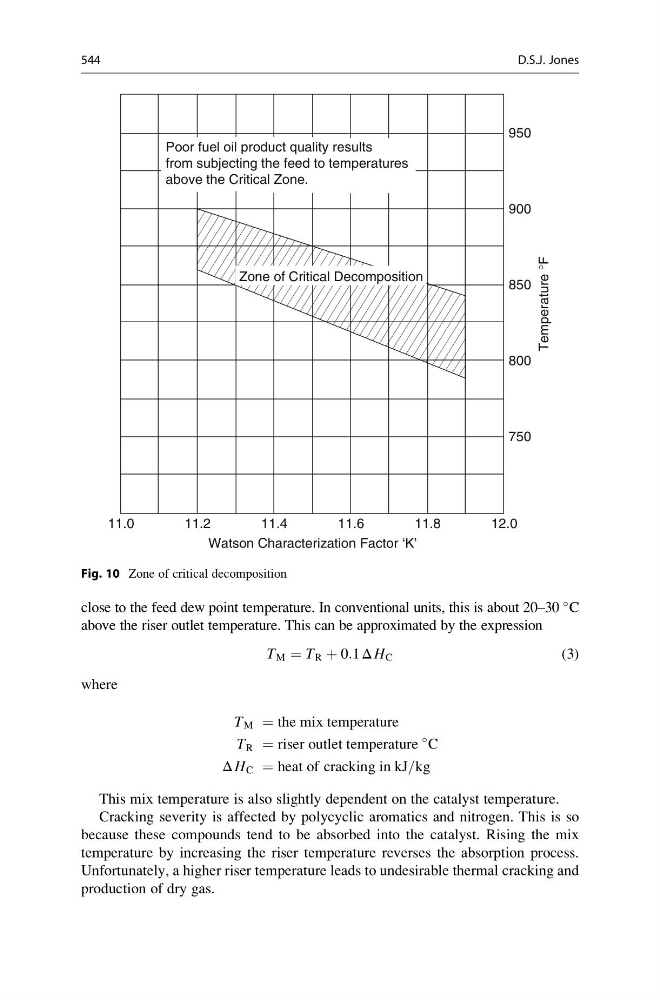
Poor fuel oil product quality results
from subjecting the feed to temperatures
above the Critical Zone.
Zone of Critical Decomposition
Fig. 10 Zone of critical decomposition
544
D.S.J. Jones
C
above the riser outlet temperature. This can be approximated by the expression
T M ¼ T R þ 0:1 Δ H C
(3)
where
T M ¼ the mix temperature
T R ¼ riser outlet temperature
C
Δ H C ¼ heat of cracking in kJ=kg
This mix temperature is also slightly dependent on the catalyst temperature.
Cracking severity is affected by polycyclic aromatics and nitrogen. This is so
because these compounds tend to be absorbed into the catalyst. Rising the mix
temperature by increasing the riser temperature reverses the absorption process.
Unfortunately, a higher riser temperature leads to undesirable thermal cracking and
production of dry gas.
950
900
850
Temperature
°F
800
750
12.0
11.8
11.6
Watson Characterization Factor ‘K’
11.4
11.2
11.0
Poor fuel oil product quality results
from subjecting the feed to temperatures
above the Critical Zone.
Zone of Critical Decomposition
Fig. 10 Zone of critical decomposition
544
D.S.J. Jones