

leave the scrubber and are routed to a conventional fractionating facility. Steam is
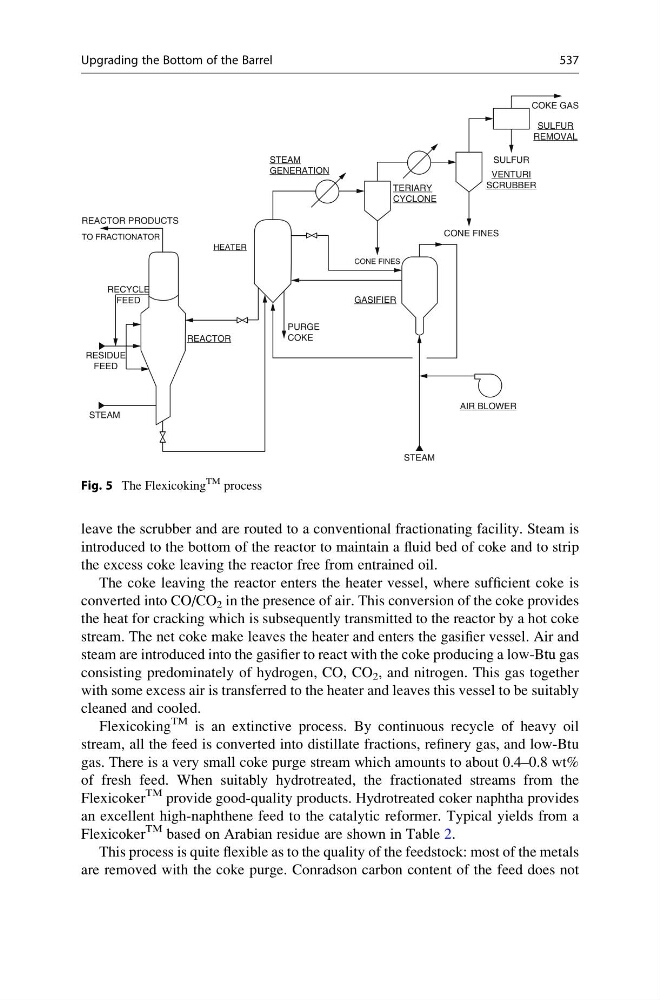
introduced to the bottom of the reactor to maintain a fluid bed of coke and to strip
the excess coke leaving the reactor free from entrained oil.
The coke leaving the reactor enters the heater vessel, where sufficient coke is
converted into CO/CO 2 in the presence of air. This conversion of the coke provides
the heat for cracking which is subsequently transmitted to the reactor by a hot coke
stream. The net coke make leaves the heater and enters the gasifier vessel. Air and
steam are introduced into the gasifier to react with the coke producing a low-Btu gas
consisting predominately of hydrogen, CO, CO 2 , and nitrogen. This gas together
with some excess air is transferred to the heater and leaves this vessel to be suitably
cleaned and cooled.
Flexicoking
TM is an extinctive process. By continuous recycle of heavy oil
stream, all the feed is converted into distillate fractions, refinery gas, and low-Btu
gas. There is a very small coke purge stream which amounts to about 0.4–0.8 wt%
of fresh feed. When suitably hydrotreated, the fractionated streams from the
Flexicoker
TM provide good-quality products. Hydrotreated coker naphtha provides
an excellent high-naphthene feed to the catalytic reformer. Typical yields from a
Flexicoker
TM based on Arabian residue are shown in Table 2.
This process is quite flexible as to the quality of the feedstock: most of the metals
are removed with the coke purge. Conradson carbon content of the feed does not
AIR BLOWER
STEAM
CONE FINES
CONE FINES
PURGE
COKE
GASIFIER
REACTOR
STEAM
RESIDUE
FEED
RECYCLE
FEED
REACTOR PRODUCTS
TO FRACTIONATOR
HEATER
STEAM
GENERATION
COKE GAS
SULFUR
REMOVAL
SULFUR
VENTURI
SCRUBBER
TERIARY
CYCLONE
Fig. 5 The Flexicoking
TM process
Upgrading the Bottom of the Barrel
537
introduced to the bottom of the reactor to maintain a fluid bed of coke and to strip
the excess coke leaving the reactor free from entrained oil.
The coke leaving the reactor enters the heater vessel, where sufficient coke is
converted into CO/CO 2 in the presence of air. This conversion of the coke provides
the heat for cracking which is subsequently transmitted to the reactor by a hot coke
stream. The net coke make leaves the heater and enters the gasifier vessel. Air and
steam are introduced into the gasifier to react with the coke producing a low-Btu gas
consisting predominately of hydrogen, CO, CO 2 , and nitrogen. This gas together
with some excess air is transferred to the heater and leaves this vessel to be suitably
cleaned and cooled.
Flexicoking
TM is an extinctive process. By continuous recycle of heavy oil
stream, all the feed is converted into distillate fractions, refinery gas, and low-Btu
gas. There is a very small coke purge stream which amounts to about 0.4–0.8 wt%
of fresh feed. When suitably hydrotreated, the fractionated streams from the
Flexicoker
TM provide good-quality products. Hydrotreated coker naphtha provides
an excellent high-naphthene feed to the catalytic reformer. Typical yields from a
Flexicoker
TM based on Arabian residue are shown in Table 2.
This process is quite flexible as to the quality of the feedstock: most of the metals
are removed with the coke purge. Conradson carbon content of the feed does not
AIR BLOWER
STEAM
CONE FINES
CONE FINES
PURGE
COKE
GASIFIER
REACTOR
STEAM
RESIDUE
FEED
RECYCLE
FEED
REACTOR PRODUCTS
TO FRACTIONATOR
HEATER
STEAM
GENERATION
COKE GAS
SULFUR
REMOVAL
SULFUR
VENTURI
SCRUBBER
TERIARY
CYCLONE
Fig. 5 The Flexicoking
TM process
Upgrading the Bottom of the Barrel
537