

affect the yield as may be expected. Where an economic use can be found for the
low-Btu gas, the process offers an attractive route for upgrading low-quality
fuel oil.
The Principles and Correlations Associated with Thermal
Cracking Processes
The Soaking Volume Concept
The design of a thermal cracker is keyed to the configuration and temperature
profile across the heater and soaking drum or soaking coil. The degree of cracking is
dependent on this temperature profile and the residence time of the oil under these
conditions.
The thermal cracking reaction is accepted as being of the first order thus it
complies with the equation:
In conv
ð
Þ¼ A
ð Þe
ÀE=RTÂt
(1)
where
A, E, R ¼ constants
t ¼ reaction time
T ¼ reaction temperature
The thermal cracking reaction occurs in the heater along a curve of increasing
temperature. In this concept of design, the cracking progression is expressed by a
soaking volume factor (SVF) which is defined by the following equation:
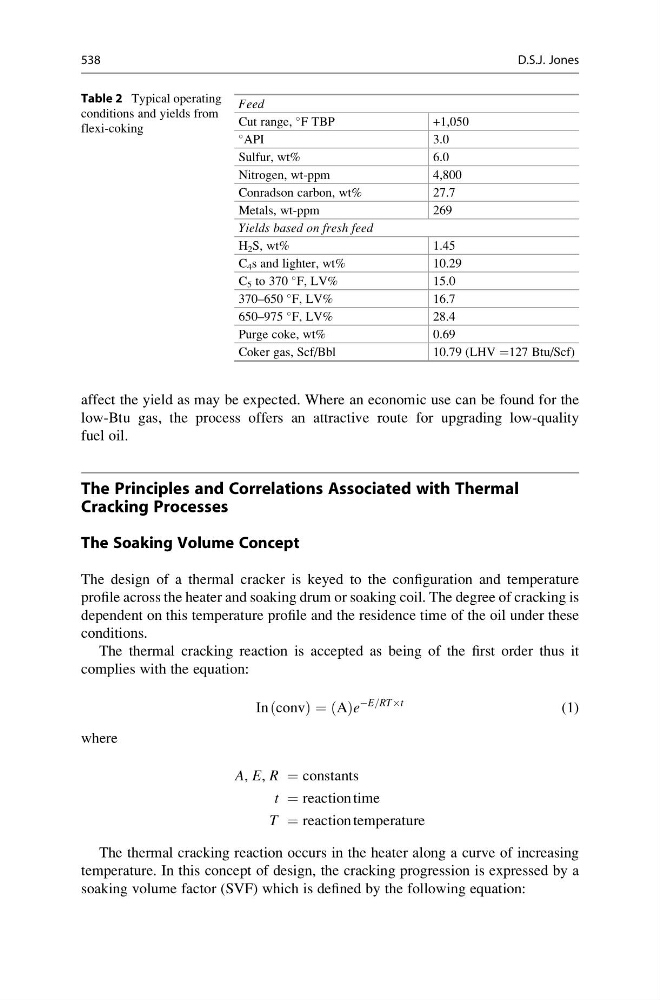
Table 2 Typical operating
conditions and yields from
flexi-coking
Feed
Cut range,
F TBP
+1,050
API
3.0
Sulfur, wt%
6.0
Nitrogen, wt-ppm
4,800
Conradson carbon, wt%
27.7
Metals, wt-ppm
269
Yields based on fresh feed
H 2 S, wt%
1.45
C 4 s and lighter, wt%
10.29
C 5 to 370
F, LV%
15.0
370–650
F, LV%
16.7
650–975
F, LV%
28.4
Purge coke, wt%
0.69
Coker gas, Scf/Bbl
10.79 (LHV =127 Btu/Scf)
538
D.S.J. Jones
low-Btu gas, the process offers an attractive route for upgrading low-quality
fuel oil.
The Principles and Correlations Associated with Thermal
Cracking Processes
The Soaking Volume Concept
The design of a thermal cracker is keyed to the configuration and temperature
profile across the heater and soaking drum or soaking coil. The degree of cracking is
dependent on this temperature profile and the residence time of the oil under these
conditions.
The thermal cracking reaction is accepted as being of the first order thus it
complies with the equation:
In conv
ð
Þ¼ A
ð Þe
ÀE=RTÂt
(1)
where
A, E, R ¼ constants
t ¼ reaction time
T ¼ reaction temperature
The thermal cracking reaction occurs in the heater along a curve of increasing
temperature. In this concept of design, the cracking progression is expressed by a
soaking volume factor (SVF) which is defined by the following equation:
Table 2 Typical operating
conditions and yields from
flexi-coking
Feed
Cut range,
F TBP
+1,050
API
3.0
Sulfur, wt%
6.0
Nitrogen, wt-ppm
4,800
Conradson carbon, wt%
27.7
Metals, wt-ppm
269
Yields based on fresh feed
H 2 S, wt%
1.45
C 4 s and lighter, wt%
10.29
C 5 to 370
F, LV%
15.0
370–650
F, LV%
16.7
650–975
F, LV%
28.4
Purge coke, wt%
0.69
Coker gas, Scf/Bbl
10.79 (LHV =127 Btu/Scf)
538
D.S.J. Jones