

coke. No residual fuel oil is left. This process is particularly useful in handling
very heavy crudes such as Bachaquero or the Canadian “heavy oil” crudes.
A suitable market for the coke must be found, and coke quality requirements
may impose further processing such as calcining with, of course, a resulting
additional cost.
Two major types of coking processes are in operation today: these are the
delayed coking process and the fluid coking process. The intricacies, delicate
operation, and cost of the conventional fluid process make it an unlikely contender
when simple and cheap ways to convert residues into more valuable products are
desired. A fairly recent development of the fluid coking process, however, allows
for the conversion of the coke into low-Btu gas. Only the delayed coking process
and a proprietary process for fluid coking will be discussed here.
Delayed Coking Process
The delayed coking process is illustrated in Fig. 4.
The fuel oil or heavy oil feed is routed to a cracking furnace similar to other
thermal cracking processes. The effluent from the furnace is sent to one of a set of
several coking drums without quenching. The effluent is normally at a coil outlet
temperature of around 920
F and at a pressure of 30–50 psig and the coking drum is
filled in about 12–24 h. The vapors leaving the top of the drum while filling are
routed to the fractionator, where they are fractionated to the distillate products. The
very long residence period of the effluent in the coking drums results in the
complete destruction of the heavy fractions, and a solid residue rich in carbon is
left in the drum as coke.
When the drum is full of coke, it is cooled and the top and bottom of the drum are
opened. Special high-pressure water jets are used to cut and remove the coke
through the drum’s bottom opening.
FURNACE
SOAKER
QUENCH
FRACTIONATOR
GAS+GASOLINE
GAS OIL
CRACKED
RESIDUES
SHORT
RESIDUE
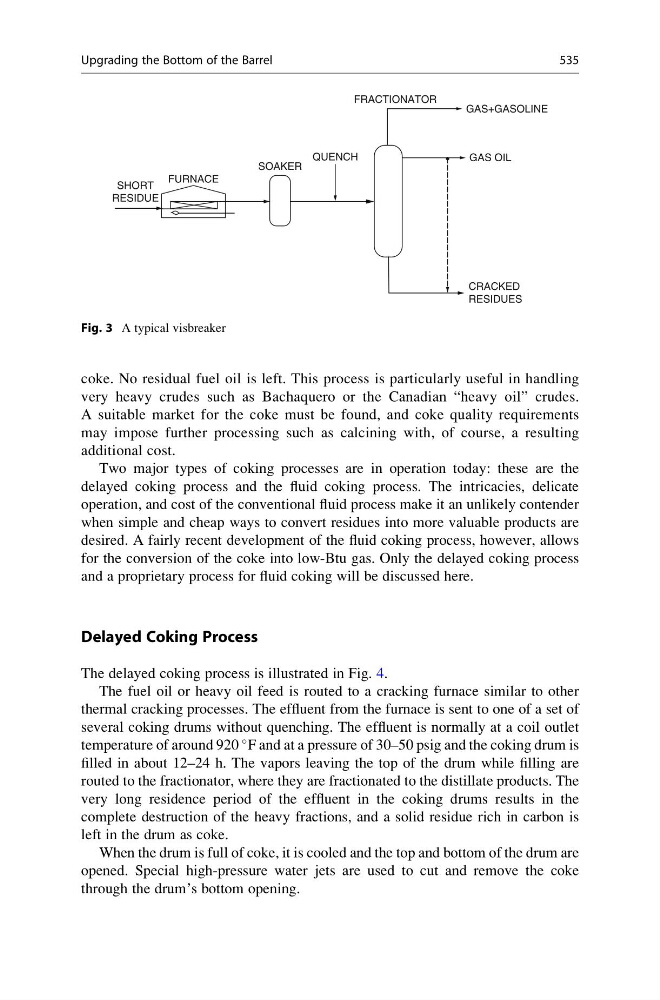
Fig. 3 A typical visbreaker
Upgrading the Bottom of the Barrel
535
very heavy crudes such as Bachaquero or the Canadian “heavy oil” crudes.
A suitable market for the coke must be found, and coke quality requirements
may impose further processing such as calcining with, of course, a resulting
additional cost.
Two major types of coking processes are in operation today: these are the
delayed coking process and the fluid coking process. The intricacies, delicate
operation, and cost of the conventional fluid process make it an unlikely contender
when simple and cheap ways to convert residues into more valuable products are
desired. A fairly recent development of the fluid coking process, however, allows
for the conversion of the coke into low-Btu gas. Only the delayed coking process
and a proprietary process for fluid coking will be discussed here.
Delayed Coking Process
The delayed coking process is illustrated in Fig. 4.
The fuel oil or heavy oil feed is routed to a cracking furnace similar to other
thermal cracking processes. The effluent from the furnace is sent to one of a set of
several coking drums without quenching. The effluent is normally at a coil outlet
temperature of around 920
F and at a pressure of 30–50 psig and the coking drum is
filled in about 12–24 h. The vapors leaving the top of the drum while filling are
routed to the fractionator, where they are fractionated to the distillate products. The
very long residence period of the effluent in the coking drums results in the
complete destruction of the heavy fractions, and a solid residue rich in carbon is
left in the drum as coke.
When the drum is full of coke, it is cooled and the top and bottom of the drum are
opened. Special high-pressure water jets are used to cut and remove the coke
through the drum’s bottom opening.
FURNACE
SOAKER
QUENCH
FRACTIONATOR
GAS+GASOLINE
GAS OIL
CRACKED
RESIDUES
SHORT
RESIDUE
Fig. 3 A typical visbreaker
Upgrading the Bottom of the Barrel
535