

rate, and the second reactor is operated at a lower temperature to take advantage of
the more favorable equilibrium distribution of higher-octane isomers. Two reactors
are generally specified for the Par-Isom process, but a single reactor can be
employed to reduce the capital and operating cost of the unit, but with a small
debit in performance.
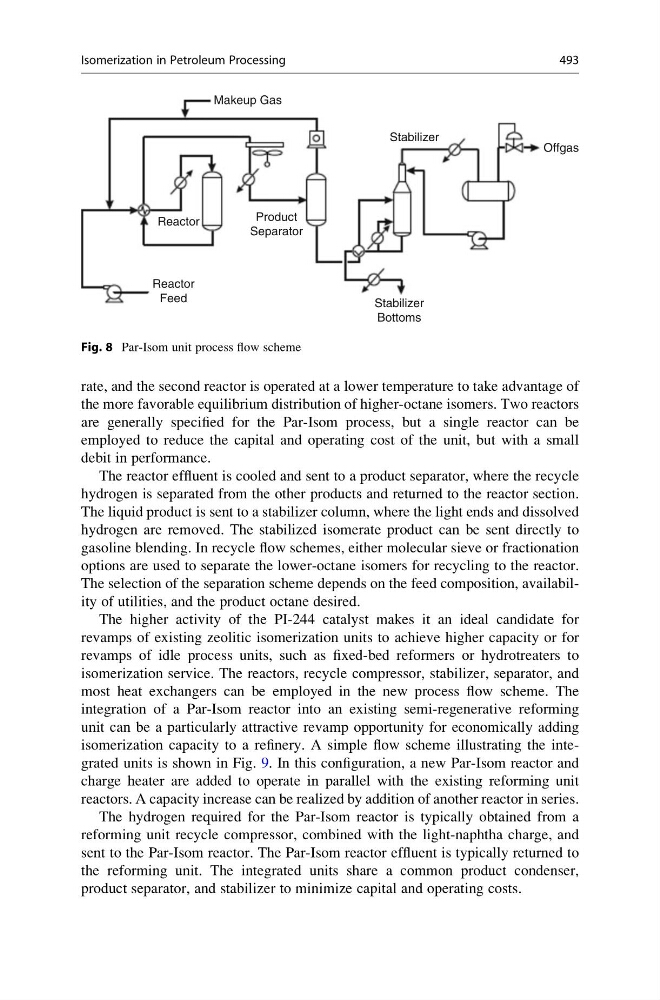
The reactor effluent is cooled and sent to a product separator, where the recycle
hydrogen is separated from the other products and returned to the reactor section.
The liquid product is sent to a stabilizer column, where the light ends and dissolved
hydrogen are removed. The stabilized isomerate product can be sent directly to
gasoline blending. In recycle flow schemes, either molecular sieve or fractionation
options are used to separate the lower-octane isomers for recycling to the reactor.
The selection of the separation scheme depends on the feed composition, availability of utilities, and the product octane desired.
The higher activity of the PI-244 catalyst makes it an ideal candidate for
revamps of existing zeolitic isomerization units to achieve higher capacity or for
revamps of idle process units, such as fixed-bed reformers or hydrotreaters to
isomerization service. The reactors, recycle compressor, stabilizer, separator, and
most heat exchangers can be employed in the new process flow scheme. The
integration of a Par-Isom reactor into an existing semi-regenerative reforming
unit can be a particularly attractive revamp opportunity for economically adding
isomerization capacity to a refinery. A simple flow scheme illustrating the integrated units is shown in Fig. 9. In this configuration, a new Par-Isom reactor and
charge heater are added to operate in parallel with the existing reforming unit
reactors. A capacity increase can be realized by addition of another reactor in series.
The hydrogen required for the Par-Isom reactor is typically obtained from a
reforming unit recycle compressor, combined with the light-naphtha charge, and
sent to the Par-Isom reactor. The Par-Isom reactor effluent is typically returned to
the reforming unit. The integrated units share a common product condenser,
product separator, and stabilizer to minimize capital and operating costs.
Makeup Gas
Stabilizer
Offgas
Stabilizer
Bottoms
Product
Separator
Reactor
Reactor
Feed
Fig. 8 Par-Isom unit process flow scheme
Isomerization in Petroleum Processing
493
the more favorable equilibrium distribution of higher-octane isomers. Two reactors
are generally specified for the Par-Isom process, but a single reactor can be
employed to reduce the capital and operating cost of the unit, but with a small
debit in performance.
The reactor effluent is cooled and sent to a product separator, where the recycle
hydrogen is separated from the other products and returned to the reactor section.
The liquid product is sent to a stabilizer column, where the light ends and dissolved
hydrogen are removed. The stabilized isomerate product can be sent directly to
gasoline blending. In recycle flow schemes, either molecular sieve or fractionation
options are used to separate the lower-octane isomers for recycling to the reactor.
The selection of the separation scheme depends on the feed composition, availability of utilities, and the product octane desired.
The higher activity of the PI-244 catalyst makes it an ideal candidate for
revamps of existing zeolitic isomerization units to achieve higher capacity or for
revamps of idle process units, such as fixed-bed reformers or hydrotreaters to
isomerization service. The reactors, recycle compressor, stabilizer, separator, and
most heat exchangers can be employed in the new process flow scheme. The
integration of a Par-Isom reactor into an existing semi-regenerative reforming
unit can be a particularly attractive revamp opportunity for economically adding
isomerization capacity to a refinery. A simple flow scheme illustrating the integrated units is shown in Fig. 9. In this configuration, a new Par-Isom reactor and
charge heater are added to operate in parallel with the existing reforming unit
reactors. A capacity increase can be realized by addition of another reactor in series.
The hydrogen required for the Par-Isom reactor is typically obtained from a
reforming unit recycle compressor, combined with the light-naphtha charge, and
sent to the Par-Isom reactor. The Par-Isom reactor effluent is typically returned to
the reforming unit. The integrated units share a common product condenser,
product separator, and stabilizer to minimize capital and operating costs.
Makeup Gas
Stabilizer
Offgas
Stabilizer
Bottoms
Product
Separator
Reactor
Reactor
Feed
Fig. 8 Par-Isom unit process flow scheme
Isomerization in Petroleum Processing
493