

Although the equilibrium conversion of the paraffin in Reaction (1) is low at
paraffin isomerization conditions, sufficient olefins are present to be converted to
a carbonium ion by the strong Brønsted acid site (Reaction 2):
þ
CH 3 ÀCH 2 ÀCH ¼ CH 2 þ H
þ
½ A
À
½ ! CH 3 ÀCH 2 ÀCHÀCH 3 þ A
À
:
(2)
The formation of the carbonium ion removes product olefins from Reaction (1) and
allows the equilibrium in Reaction (1) to proceed. The carbonium ion in Reaction
(2) undergoes a skeletal isomerization, possibly through a cycloalkyl intermediate
as shown in Reaction (3).
CH 3 −CH 2 −CH−CH 3 CH 2
C−CH 3
cyclopropyl
cation
→
→
+
+
+
CH 3 −C−CH 3 .
CH 3
CH 2
ð3Þ
Reaction (3) proceeds with difficulty because it requires the formation of a primary
carbonium ion at some point in the reaction. Nevertheless, the strong acidity of
isomerization catalysts provides enough driving force for the reaction to proceed at
high rates. The mechanism of the final step is disputed. The isoparaffinic carbonium
ion may be converted to an olefin through loss of a proton to the catalyst site and
then quickly be hydrogenated to the analogous isoparaffin (Reactions 4A and 4B),
or it may form the isoparaffin by hydride transfer from a normal paraffin, forming
a normal carbonium ion intermediate as well as an isoparaffin (Santen 2012)
(Reaction 5):
→
+
CH 3 −C−CH 3 + A− CH 3 −C=CH 2 + [H+] [A−]
CH 3
CH 3
ð4AÞ
100
80
60
40
mole %
20
0
2−MP + 3−MP / ΣC 6 Paraffins
2, 2−D MB / ΣC
6 Par affin s
2, 3−DMB/ΣC 6 Paraffins
93
149
M C P / (M C P + C H )
204
Temperature, °C
260
316
n−H exa ne / ΣC 6 Par affin s
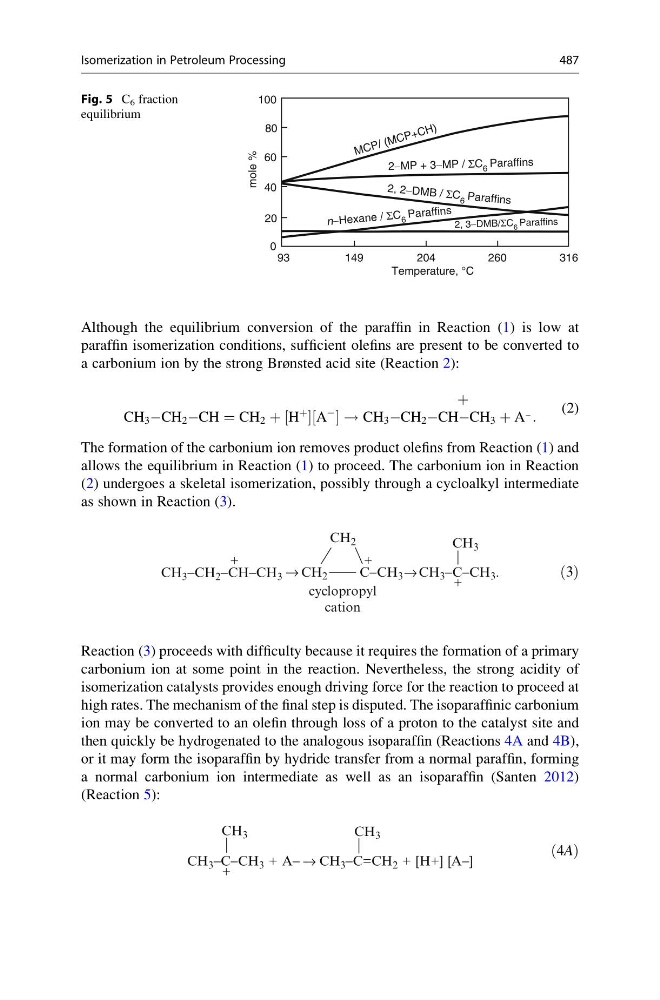
Fig. 5 C 6 fraction
equilibrium
Isomerization in Petroleum Processing
487
paraffin isomerization conditions, sufficient olefins are present to be converted to
a carbonium ion by the strong Brønsted acid site (Reaction 2):
þ
CH 3 ÀCH 2 ÀCH ¼ CH 2 þ H
þ
½ A
À
½ ! CH 3 ÀCH 2 ÀCHÀCH 3 þ A
À
:
(2)
The formation of the carbonium ion removes product olefins from Reaction (1) and
allows the equilibrium in Reaction (1) to proceed. The carbonium ion in Reaction
(2) undergoes a skeletal isomerization, possibly through a cycloalkyl intermediate
as shown in Reaction (3).
CH 3 −CH 2 −CH−CH 3 CH 2
C−CH 3
cyclopropyl
cation
→
→
+
+
+
CH 3 −C−CH 3 .
CH 3
CH 2
ð3Þ
Reaction (3) proceeds with difficulty because it requires the formation of a primary
carbonium ion at some point in the reaction. Nevertheless, the strong acidity of
isomerization catalysts provides enough driving force for the reaction to proceed at
high rates. The mechanism of the final step is disputed. The isoparaffinic carbonium
ion may be converted to an olefin through loss of a proton to the catalyst site and
then quickly be hydrogenated to the analogous isoparaffin (Reactions 4A and 4B),
or it may form the isoparaffin by hydride transfer from a normal paraffin, forming
a normal carbonium ion intermediate as well as an isoparaffin (Santen 2012)
(Reaction 5):
→
+
CH 3 −C−CH 3 + A− CH 3 −C=CH 2 + [H+] [A−]
CH 3
CH 3
ð4AÞ
100
80
60
40
mole %
20
0
2−MP + 3−MP / ΣC 6 Paraffins
2, 2−D MB / ΣC
6 Par affin s
2, 3−DMB/ΣC 6 Paraffins
93
149
M C P / (M C P + C H )
204
Temperature, °C
260
316
n−H exa ne / ΣC 6 Par affin s
Fig. 5 C 6 fraction
equilibrium
Isomerization in Petroleum Processing
487