

Similarly, the multibranched hexane isomer 2,2-dimethylbutane (2,2-DMB) has
a RON about 67 numbers higher than n-hexane. The single-branched isomer
2-methylpentane (2-MP) has a RON only about 49 numbers higher than n-hexane.
Clearly branched isoparaffins and in particular multibranched isomers are the
desired components for gasoline production.
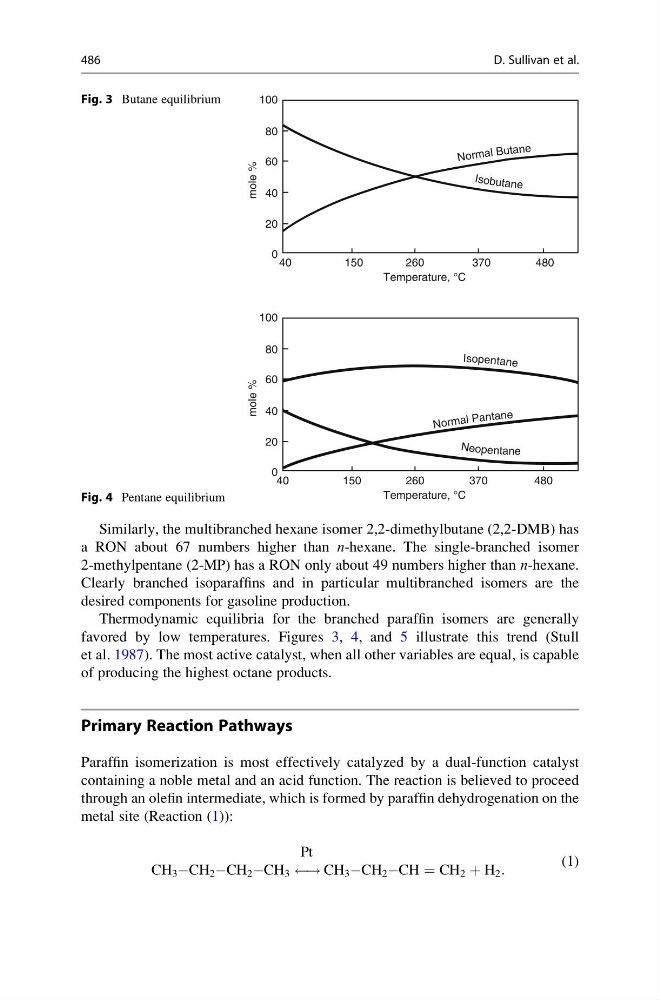
Thermodynamic equilibria for the branched paraffin isomers are generally
favored by low temperatures. Figures 3, 4, and 5 illustrate this trend (Stull
et al. 1987). The most active catalyst, when all other variables are equal, is capable
of producing the highest octane products.
Primary Reaction Pathways
Paraffin isomerization is most effectively catalyzed by a dual-function catalyst
containing a noble metal and an acid function. The reaction is believed to proceed
through an olefin intermediate, which is formed by paraffin dehydrogenation on the
metal site (Reaction (1)):
Pt
CH 3 ÀCH 2 ÀCH 2 ÀCH 3 ! CH 3 ÀCH 2 ÀCH ¼ CH 2 þ H 2 :
(1)
100
80
60
40
mole %
20
0
40
150
260
Temperature, °C
370
480
No rm al Bu tan e
Is ob uta ne
Fig. 3 Butane equilibrium
100
80
60
40
mole %
20
0
40
150
260
Temperature, °C
370
480
No rm al Pa nta ne
Ne ope ntane
Isope nta ne
Fig. 4 Pentane equilibrium
486
D. Sullivan et al.
a RON about 67 numbers higher than n-hexane. The single-branched isomer
2-methylpentane (2-MP) has a RON only about 49 numbers higher than n-hexane.
Clearly branched isoparaffins and in particular multibranched isomers are the
desired components for gasoline production.
Thermodynamic equilibria for the branched paraffin isomers are generally
favored by low temperatures. Figures 3, 4, and 5 illustrate this trend (Stull
et al. 1987). The most active catalyst, when all other variables are equal, is capable
of producing the highest octane products.
Primary Reaction Pathways
Paraffin isomerization is most effectively catalyzed by a dual-function catalyst
containing a noble metal and an acid function. The reaction is believed to proceed
through an olefin intermediate, which is formed by paraffin dehydrogenation on the
metal site (Reaction (1)):
Pt
CH 3 ÀCH 2 ÀCH 2 ÀCH 3 ! CH 3 ÀCH 2 ÀCH ¼ CH 2 þ H 2 :
(1)
100
80
60
40
mole %
20
0
40
150
260
Temperature, °C
370
480
No rm al Bu tan e
Is ob uta ne
Fig. 3 Butane equilibrium
100
80
60
40
mole %
20
0
40
150
260
Temperature, °C
370
480
No rm al Pa nta ne
Ne ope ntane
Isope nta ne
Fig. 4 Pentane equilibrium
486
D. Sullivan et al.