

technologies available to address lowering benzene content including
prefractionation, saturation, isomerization, and extraction, and they are a subject
of other literature (Shecterle 2008).
The C 5 –C 6 isomerization unit is typically part of a naphtha complex used to
produce gasoline. The naphtha feed is typically hydrotreated to remove contaminants harmful to downstream processes. The naphtha feed is divided into lighter
and heavier fractions using a naphtha splitter. The lighter fraction, typically
a C 5 –C 6 hydrocarbon fraction, is sent to the isomerization unit, whereas the heavier
fraction, typically C 7 + hydrocarbons, is sent to the catalytic reforming unit. The
reforming unit converts these naphthas rich in paraffins and naphthenes to a product
that is high in octane number and rich in aromatic hydrocarbons, using a platinumcontaining acidic catalyst at elevated temperatures and pressures.
Process Chemistry of Paraffin Isomerization
The octane rating of the components used in the manufacture of the various
commercial gasoline grades is indicative of the antiknock quality of a given fuel
or component. The inherent octane values of different hydrocarbons have led to a
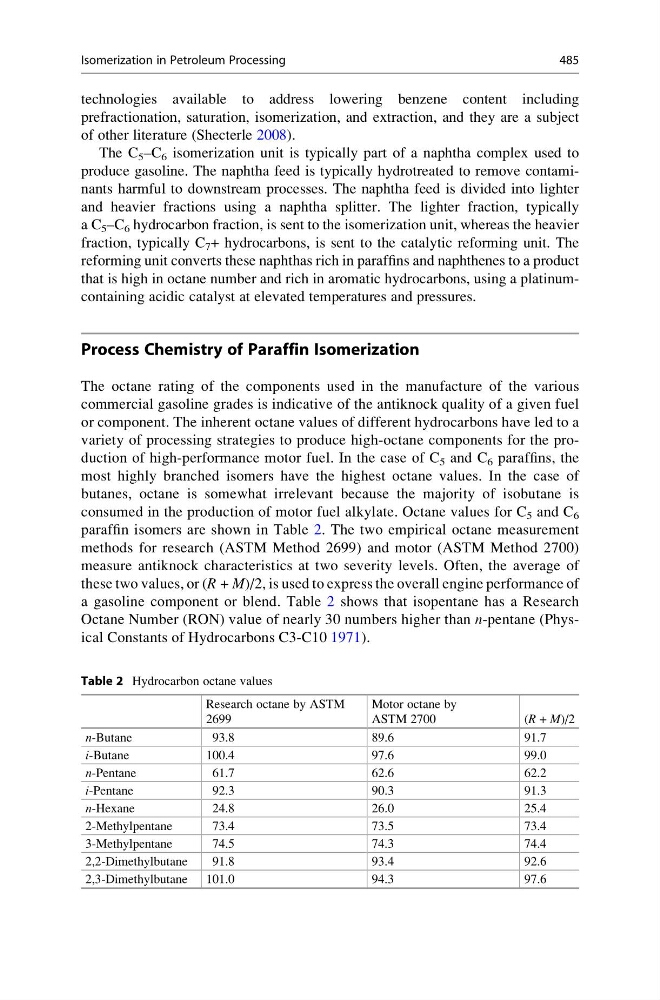
variety of processing strategies to produce high-octane components for the production of high-performance motor fuel. In the case of C 5 and C 6 paraffins, the
most highly branched isomers have the highest octane values. In the case of
butanes, octane is somewhat irrelevant because the majority of isobutane is
consumed in the production of motor fuel alkylate. Octane values for C 5 and C 6
paraffin isomers are shown in Table 2. The two empirical octane measurement
methods for research (ASTM Method 2699) and motor (ASTM Method 2700)
measure antiknock characteristics at two severity levels. Often, the average of
these two values, or (R + M)/2, is used to express the overall engine performance of
a gasoline component or blend. Table 2 shows that isopentane has a Research
Octane Number (RON) value of nearly 30 numbers higher than n-pentane (Physical Constants of Hydrocarbons C3-C10 1971).
Table 2 Hydrocarbon octane values
Research octane by ASTM
2699
Motor octane by
ASTM 2700
(R + M)/2
n-Butane
93.8
89.6
91.7
i-Butane
100.4
97.6
99.0
n-Pentane
61.7
62.6
62.2
i-Pentane
92.3
90.3
91.3
n-Hexane
24.8
26.0
25.4
2-Methylpentane
73.4
73.5
73.4
3-Methylpentane
74.5
74.3
74.4
2,2-Dimethylbutane
91.8
93.4
92.6
2,3-Dimethylbutane 101.0
94.3
97.6
Isomerization in Petroleum Processing
485
prefractionation, saturation, isomerization, and extraction, and they are a subject
of other literature (Shecterle 2008).
The C 5 –C 6 isomerization unit is typically part of a naphtha complex used to
produce gasoline. The naphtha feed is typically hydrotreated to remove contaminants harmful to downstream processes. The naphtha feed is divided into lighter
and heavier fractions using a naphtha splitter. The lighter fraction, typically
a C 5 –C 6 hydrocarbon fraction, is sent to the isomerization unit, whereas the heavier
fraction, typically C 7 + hydrocarbons, is sent to the catalytic reforming unit. The
reforming unit converts these naphthas rich in paraffins and naphthenes to a product
that is high in octane number and rich in aromatic hydrocarbons, using a platinumcontaining acidic catalyst at elevated temperatures and pressures.
Process Chemistry of Paraffin Isomerization
The octane rating of the components used in the manufacture of the various
commercial gasoline grades is indicative of the antiknock quality of a given fuel
or component. The inherent octane values of different hydrocarbons have led to a
variety of processing strategies to produce high-octane components for the production of high-performance motor fuel. In the case of C 5 and C 6 paraffins, the
most highly branched isomers have the highest octane values. In the case of
butanes, octane is somewhat irrelevant because the majority of isobutane is
consumed in the production of motor fuel alkylate. Octane values for C 5 and C 6
paraffin isomers are shown in Table 2. The two empirical octane measurement
methods for research (ASTM Method 2699) and motor (ASTM Method 2700)
measure antiknock characteristics at two severity levels. Often, the average of
these two values, or (R + M)/2, is used to express the overall engine performance of
a gasoline component or blend. Table 2 shows that isopentane has a Research
Octane Number (RON) value of nearly 30 numbers higher than n-pentane (Physical Constants of Hydrocarbons C3-C10 1971).
Table 2 Hydrocarbon octane values
Research octane by ASTM
2699
Motor octane by
ASTM 2700
(R + M)/2
n-Butane
93.8
89.6
91.7
i-Butane
100.4
97.6
99.0
n-Pentane
61.7
62.6
62.2
i-Pentane
92.3
90.3
91.3
n-Hexane
24.8
26.0
25.4
2-Methylpentane
73.4
73.5
73.4
3-Methylpentane
74.5
74.3
74.4
2,2-Dimethylbutane
91.8
93.4
92.6
2,3-Dimethylbutane 101.0
94.3
97.6
Isomerization in Petroleum Processing
485