

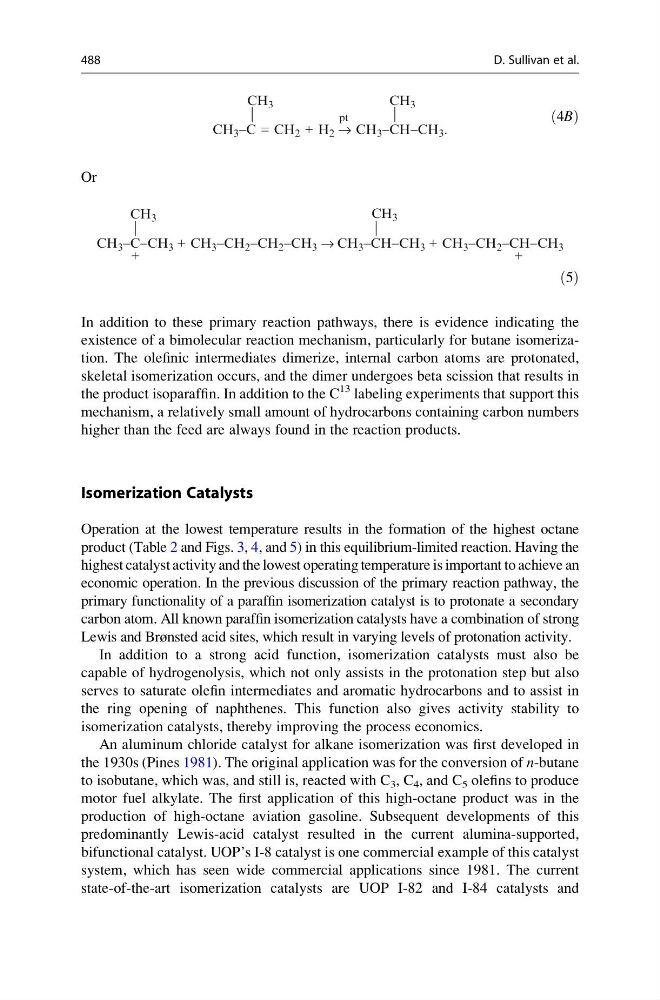
→
CH 3 −C = CH 2 + H 2
CH 3 −CH−CH 3 .
pt
CH 3
CH 3
ð4BÞ
Or
+
+
CH 3
CH 3
CH 3 −C−CH 3 + CH 3 −CH 2 −CH 2 −CH 3 → CH 3 −CH−CH 3 + CH 3 −CH 2 −CH−CH 3
ð5Þ
In addition to these primary reaction pathways, there is evidence indicating the
existence of a bimolecular reaction mechanism, particularly for butane isomerization. The olefinic intermediates dimerize, internal carbon atoms are protonated,
skeletal isomerization occurs, and the dimer undergoes beta scission that results in
the product isoparaffin. In addition to the C
13 labeling experiments that support this
mechanism, a relatively small amount of hydrocarbons containing carbon numbers
higher than the feed are always found in the reaction products.
Isomerization Catalysts
Operation at the lowest temperature results in the formation of the highest octane
product (Table 2 and Figs. 3, 4, and 5) in this equilibrium-limited reaction. Having the
highest catalyst activity and the lowest operating temperature is important to achieve an
economic operation. In the previous discussion of the primary reaction pathway, the
primary functionality of a paraffin isomerization catalyst is to protonate a secondary
carbon atom. All known paraffin isomerization catalysts have a combination of strong
Lewis and Brønsted acid sites, which result in varying levels of protonation activity.
In addition to a strong acid function, isomerization catalysts must also be
capable of hydrogenolysis, which not only assists in the protonation step but also
serves to saturate olefin intermediates and aromatic hydrocarbons and to assist in
the ring opening of naphthenes. This function also gives activity stability to
isomerization catalysts, thereby improving the process economics.
An aluminum chloride catalyst for alkane isomerization was first developed in
the 1930s (Pines 1981). The original application was for the conversion of n-butane
to isobutane, which was, and still is, reacted with C 3 , C 4 , and C 5 olefins to produce
motor fuel alkylate. The first application of this high-octane product was in the
production of high-octane aviation gasoline. Subsequent developments of this
predominantly Lewis-acid catalyst resulted in the current alumina-supported,
bifunctional catalyst. UOP’s I-8 catalyst is one commercial example of this catalyst
system, which has seen wide commercial applications since 1981. The current
state-of-the-art isomerization catalysts are UOP I-82 and I-84 catalysts and
488
D. Sullivan et al.
CH 3 −C = CH 2 + H 2
CH 3 −CH−CH 3 .
pt
CH 3
CH 3
ð4BÞ
Or
+
+
CH 3
CH 3
CH 3 −C−CH 3 + CH 3 −CH 2 −CH 2 −CH 3 → CH 3 −CH−CH 3 + CH 3 −CH 2 −CH−CH 3
ð5Þ
In addition to these primary reaction pathways, there is evidence indicating the
existence of a bimolecular reaction mechanism, particularly for butane isomerization. The olefinic intermediates dimerize, internal carbon atoms are protonated,
skeletal isomerization occurs, and the dimer undergoes beta scission that results in
the product isoparaffin. In addition to the C
13 labeling experiments that support this
mechanism, a relatively small amount of hydrocarbons containing carbon numbers
higher than the feed are always found in the reaction products.
Isomerization Catalysts
Operation at the lowest temperature results in the formation of the highest octane
product (Table 2 and Figs. 3, 4, and 5) in this equilibrium-limited reaction. Having the
highest catalyst activity and the lowest operating temperature is important to achieve an
economic operation. In the previous discussion of the primary reaction pathway, the
primary functionality of a paraffin isomerization catalyst is to protonate a secondary
carbon atom. All known paraffin isomerization catalysts have a combination of strong
Lewis and Brønsted acid sites, which result in varying levels of protonation activity.
In addition to a strong acid function, isomerization catalysts must also be
capable of hydrogenolysis, which not only assists in the protonation step but also
serves to saturate olefin intermediates and aromatic hydrocarbons and to assist in
the ring opening of naphthenes. This function also gives activity stability to
isomerization catalysts, thereby improving the process economics.
An aluminum chloride catalyst for alkane isomerization was first developed in
the 1930s (Pines 1981). The original application was for the conversion of n-butane
to isobutane, which was, and still is, reacted with C 3 , C 4 , and C 5 olefins to produce
motor fuel alkylate. The first application of this high-octane product was in the
production of high-octane aviation gasoline. Subsequent developments of this
predominantly Lewis-acid catalyst resulted in the current alumina-supported,
bifunctional catalyst. UOP’s I-8 catalyst is one commercial example of this catalyst
system, which has seen wide commercial applications since 1981. The current
state-of-the-art isomerization catalysts are UOP I-82 and I-84 catalysts and
488
D. Sullivan et al.