

SPA-Catalyzed InAlk Process
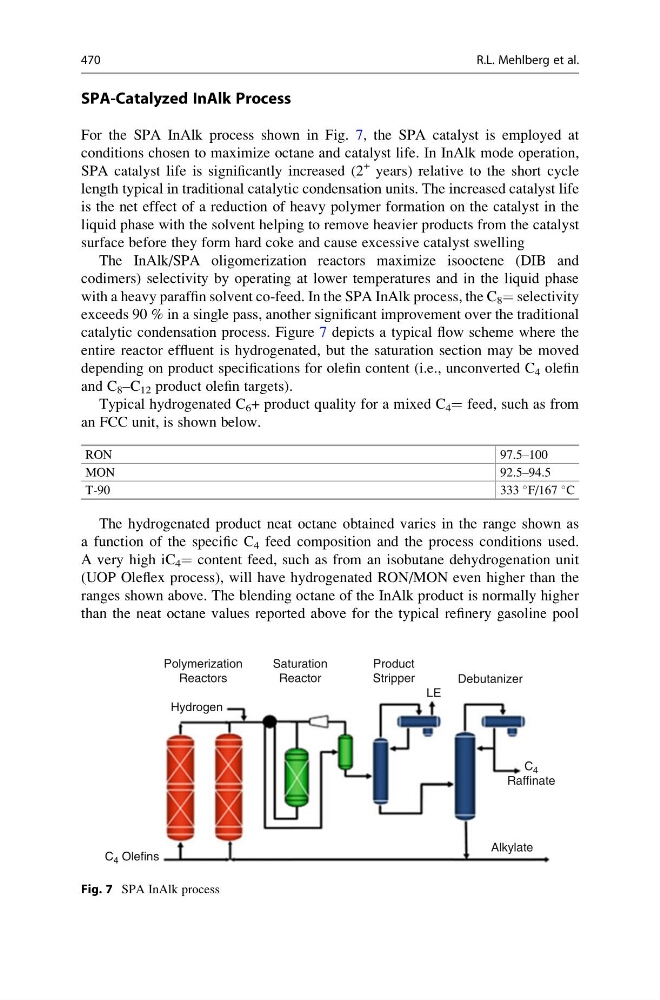
For the SPA InAlk process shown in Fig. 7, the SPA catalyst is employed at
conditions chosen to maximize octane and catalyst life. In InAlk mode operation,
SPA catalyst life is significantly increased (2
+ years) relative to the short cycle
length typical in traditional catalytic condensation units. The increased catalyst life
is the net effect of a reduction of heavy polymer formation on the catalyst in the
liquid phase with the solvent helping to remove heavier products from the catalyst
surface before they form hard coke and cause excessive catalyst swelling
The InAlk/SPA oligomerization reactors maximize isooctene (DIB and
codimers) selectivity by operating at lower temperatures and in the liquid phase
with a heavy paraffin solvent co-feed. In the SPA InAlk process, the C 8 = selectivity
exceeds 90 % in a single pass, another significant improvement over the traditional
catalytic condensation process. Figure 7 depicts a typical flow scheme where the
entire reactor effluent is hydrogenated, but the saturation section may be moved
depending on product specifications for olefin content (i.e., unconverted C 4 olefin
and C 8 –C 12 product olefin targets).
Typical hydrogenated C 6 + product quality for a mixed C 4 = feed, such as from
an FCC unit, is shown below.
RON
97.5–100
MON
92.5–94.5
T-90
333
F/167
C
The hydrogenated product neat octane obtained varies in the range shown as
a function of the specific C 4 feed composition and the process conditions used.
A very high iC 4 = content feed, such as from an isobutane dehydrogenation unit
(UOP Oleflex process), will have hydrogenated RON/MON even higher than the
ranges shown above. The blending octane of the InAlk product is normally higher
than the neat octane values reported above for the typical refinery gasoline pool
Polymerization
Reactors
Saturation
Reactor
Product
Stripper
Debutanizer
C 4
Raffinate
Alkylate
C 4 Olefins
Hydrogen
LE
Fig. 7 SPA InAlk process
470
R.L. Mehlberg et al.
For the SPA InAlk process shown in Fig. 7, the SPA catalyst is employed at
conditions chosen to maximize octane and catalyst life. In InAlk mode operation,
SPA catalyst life is significantly increased (2
+ years) relative to the short cycle
length typical in traditional catalytic condensation units. The increased catalyst life
is the net effect of a reduction of heavy polymer formation on the catalyst in the
liquid phase with the solvent helping to remove heavier products from the catalyst
surface before they form hard coke and cause excessive catalyst swelling
The InAlk/SPA oligomerization reactors maximize isooctene (DIB and
codimers) selectivity by operating at lower temperatures and in the liquid phase
with a heavy paraffin solvent co-feed. In the SPA InAlk process, the C 8 = selectivity
exceeds 90 % in a single pass, another significant improvement over the traditional
catalytic condensation process. Figure 7 depicts a typical flow scheme where the
entire reactor effluent is hydrogenated, but the saturation section may be moved
depending on product specifications for olefin content (i.e., unconverted C 4 olefin
and C 8 –C 12 product olefin targets).
Typical hydrogenated C 6 + product quality for a mixed C 4 = feed, such as from
an FCC unit, is shown below.
RON
97.5–100
MON
92.5–94.5
T-90
333
F/167
C
The hydrogenated product neat octane obtained varies in the range shown as
a function of the specific C 4 feed composition and the process conditions used.
A very high iC 4 = content feed, such as from an isobutane dehydrogenation unit
(UOP Oleflex process), will have hydrogenated RON/MON even higher than the
ranges shown above. The blending octane of the InAlk product is normally higher
than the neat octane values reported above for the typical refinery gasoline pool
Polymerization
Reactors
Saturation
Reactor
Product
Stripper
Debutanizer
C 4
Raffinate
Alkylate
C 4 Olefins
Hydrogen
LE
Fig. 7 SPA InAlk process
470
R.L. Mehlberg et al.