

trimethylpentenes, including diisobutene (DIB). The technology uses a conventional adiabatic fixed-bed reactor.
To minimize production of undesired heavy oligomer products, a C 4 alcohol co-feed
is required in the process as a selectivity modifier. The alcohols used are formed in the
process by reaction of C 4 olefins with H 2 O. The C 4 alcohols are recovered from the
oligomer product by water washing and recycled to the reactor section.
Optional saturation of the isooctene product requires the addition of a hydrogenation reactor and a product stripper for the removal of light ends.
Overall isobutene conversions in excess of 95 % are achievable, but n-butene
conversion is much lower, typically 10–20 %. Higher nC 4 = conversion can be
achieved with a higher cost unit design, but the resin InAlk process is best suited for
applications accepting or desiring fairly low nC 4 = conversion. For feeds that
require high nC 4 = conversion SPA InAlk is generally preferred. Selectivity to the
desired diisobutenes or isobutene/n-butene codimers is set by the design conditions
to meet gasoline T 90 or other requirements, generally in the 85–90 % C 8 = range,
with the balance being mostly trimers (C 12 =). The selectivity to heavier compounds (tetramers, etc.) is negligible.
Where possible, it is advantageous to blend olefinic product as there is some
octane loss with hydrogenation and since there is a positive blending octane effect
when blending olefinic product into a typical gasoline pool. High selectivity to the
diisobutene provides an additional positive blending octane effect vs. C 8 = oligomers containing less DIB content, making resin InAlk particularly attractive for the
high iC 4 = feedstock from an isobutane dehydrogenation unit, such as the UOP
Oleflex process. An example of olefinic product quality is summarized below.
Feed type
FCC C 4 ’s
Isobutane dehydro C 4 ’s
Oligomer C 12 =, wt%
10.0
10.0
RON
102.6 (neat); blending RON 110.1
103.7 (neat)
MON
85.4 (neat); blending MON 90.1
86.3 (neat)
RVP, psia
2–3
1.8
T 50
/T
90
224.6/303.4
F (107.0/150.8
C)
219/270
F (103.9/132.2
C)
Water-washed
C 4 Olefins
Debutanizer
C 4 Raffinate
Alcohol
Recovery
Section
Polymerization
Reactor
Alcohol Recycle
Isooctene
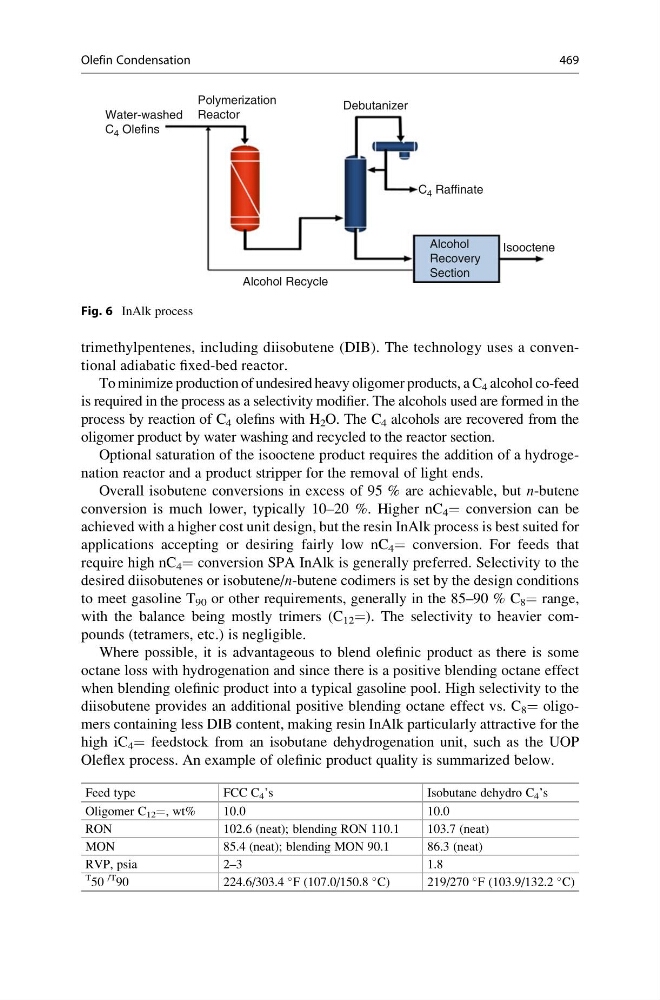
Fig. 6 InAlk process
Olefin Condensation
469
To minimize production of undesired heavy oligomer products, a C 4 alcohol co-feed
is required in the process as a selectivity modifier. The alcohols used are formed in the
process by reaction of C 4 olefins with H 2 O. The C 4 alcohols are recovered from the
oligomer product by water washing and recycled to the reactor section.
Optional saturation of the isooctene product requires the addition of a hydrogenation reactor and a product stripper for the removal of light ends.
Overall isobutene conversions in excess of 95 % are achievable, but n-butene
conversion is much lower, typically 10–20 %. Higher nC 4 = conversion can be
achieved with a higher cost unit design, but the resin InAlk process is best suited for
applications accepting or desiring fairly low nC 4 = conversion. For feeds that
require high nC 4 = conversion SPA InAlk is generally preferred. Selectivity to the
desired diisobutenes or isobutene/n-butene codimers is set by the design conditions
to meet gasoline T 90 or other requirements, generally in the 85–90 % C 8 = range,
with the balance being mostly trimers (C 12 =). The selectivity to heavier compounds (tetramers, etc.) is negligible.
Where possible, it is advantageous to blend olefinic product as there is some
octane loss with hydrogenation and since there is a positive blending octane effect
when blending olefinic product into a typical gasoline pool. High selectivity to the
diisobutene provides an additional positive blending octane effect vs. C 8 = oligomers containing less DIB content, making resin InAlk particularly attractive for the
high iC 4 = feedstock from an isobutane dehydrogenation unit, such as the UOP
Oleflex process. An example of olefinic product quality is summarized below.
Feed type
FCC C 4 ’s
Isobutane dehydro C 4 ’s
Oligomer C 12 =, wt%
10.0
10.0
RON
102.6 (neat); blending RON 110.1
103.7 (neat)
MON
85.4 (neat); blending MON 90.1
86.3 (neat)
RVP, psia
2–3
1.8
T 50
/T
90
224.6/303.4
F (107.0/150.8
C)
219/270
F (103.9/132.2
C)
Water-washed
C 4 Olefins
Debutanizer
C 4 Raffinate
Alcohol
Recovery
Section
Polymerization
Reactor
Alcohol Recycle
Isooctene
Fig. 6 InAlk process
Olefin Condensation
469