

Reaction
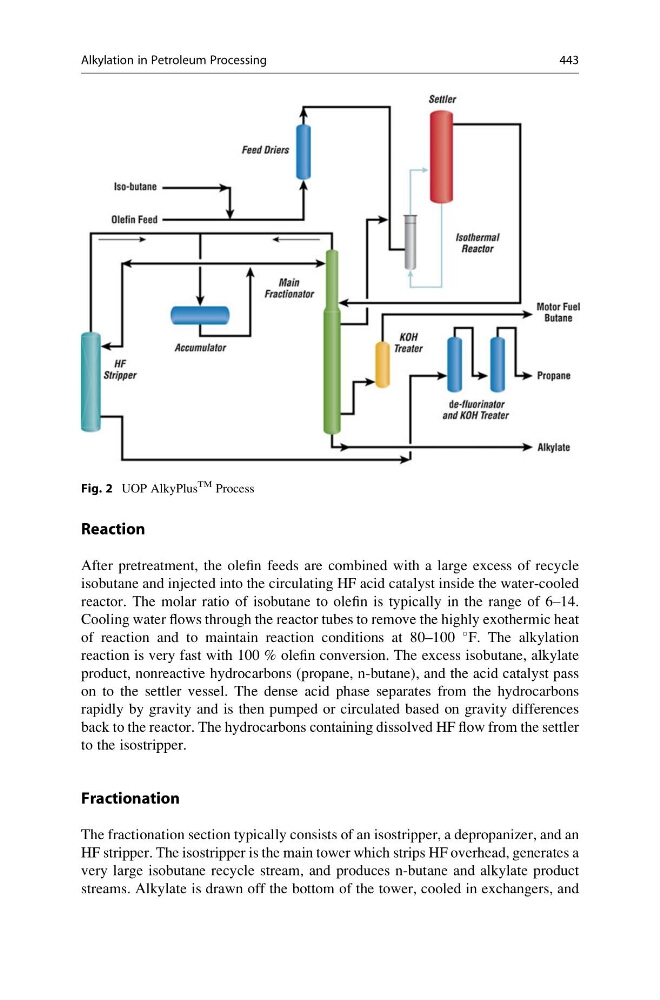
After pretreatment, the olefin feeds are combined with a large excess of recycle
isobutane and injected into the circulating HF acid catalyst inside the water-cooled
reactor. The molar ratio of isobutane to olefin is typically in the range of 6–14.
Cooling water flows through the reactor tubes to remove the highly exothermic heat
of reaction and to maintain reaction conditions at 80–100
F. The alkylation
reaction is very fast with 100 % olefin conversion. The excess isobutane, alkylate
product, nonreactive hydrocarbons (propane, n-butane), and the acid catalyst pass
on to the settler vessel. The dense acid phase separates from the hydrocarbons
rapidly by gravity and is then pumped or circulated based on gravity differences
back to the reactor. The hydrocarbons containing dissolved HF flow from the settler
to the isostripper.
Fractionation
The fractionation section typically consists of an isostripper, a depropanizer, and an
HF stripper. The isostripper is the main tower which strips HF overhead, generates a
very large isobutane recycle stream, and produces n-butane and alkylate product
streams. Alkylate is drawn off the bottom of the tower, cooled in exchangers, and
Fig. 2 UOP AlkyPlus
TM Process
Alkylation in Petroleum Processing
443
After pretreatment, the olefin feeds are combined with a large excess of recycle
isobutane and injected into the circulating HF acid catalyst inside the water-cooled
reactor. The molar ratio of isobutane to olefin is typically in the range of 6–14.
Cooling water flows through the reactor tubes to remove the highly exothermic heat
of reaction and to maintain reaction conditions at 80–100
F. The alkylation
reaction is very fast with 100 % olefin conversion. The excess isobutane, alkylate
product, nonreactive hydrocarbons (propane, n-butane), and the acid catalyst pass
on to the settler vessel. The dense acid phase separates from the hydrocarbons
rapidly by gravity and is then pumped or circulated based on gravity differences
back to the reactor. The hydrocarbons containing dissolved HF flow from the settler
to the isostripper.
Fractionation
The fractionation section typically consists of an isostripper, a depropanizer, and an
HF stripper. The isostripper is the main tower which strips HF overhead, generates a
very large isobutane recycle stream, and produces n-butane and alkylate product
streams. Alkylate is drawn off the bottom of the tower, cooled in exchangers, and
Fig. 2 UOP AlkyPlus
TM Process
Alkylation in Petroleum Processing
443