

sent to product storage. The next product draw up the tower is the n-butane side
draw and above that is a large isobutane recycle draw. On most UOP units, the
isobutane draw is located below the feed tray to minimize HF in the isobutane
recycle.
The isostripper overhead vapor is a propane-enriched isobutane stream that
contains HF, and this stream is condensed and separated in a settling drum. The
heavier HF phase is returned to the reactor section. The hydrocarbon phase is
charged to the depropanizer.
The depropanizer and its associated HF stripper produce a propane product
stream and recover the isobutane and HF to be recycled to the reactor. The
depropanizer bottom stream is returned to the reactors as part of the recycle
isobutane. The depropanizer overhead contains propane product and HF. The
overhead vapor is condensed and the two liquid phases are separated in the
overhead receiver. The heavier acid phase is returned to the reactor section, and
the acid-saturated hydrocarbon phase is fed to the HF stripper column where the HF
is stripped overhead and joins the depropanizer overhead vapor where the HF can
be recovered. The HF stripper bottoms is an acid-free propane product which is
treated with hot alumina to remove organic fluorides, cooled, and treated over a bed
of granular KOH to remove traces of HF and water.
Acid Regeneration
A key advantage of HF alkylation over sulfuric alkylation is the ability to recover
the acid from the by-product polymer, water, and other contaminants. A small
stream of circulating acid is stripped with superheated isobutane in a small Monel
tower called the acid regenerator or acid rerun tower. The regenerator overhead is
HF and isobutane that are recycled to the reactor; the regenerator bottom is polymer
and the HF-water azeotrope, which are neutralized with aqueous NaOH or KOH.
The neutralized polymer has good fuel value. The amount of polymer produced is
generally only 1–2 barrels per 1,000 barrels of alkylate product.
KOH Regeneration
Chemical costs and chemical waste products can be reduced by regenerating the
KOH used to treat products and all relief and vent gasses. This KOH regeneration is
accomplished using lime. As the lime is mixed into the KOH, regeneration of the
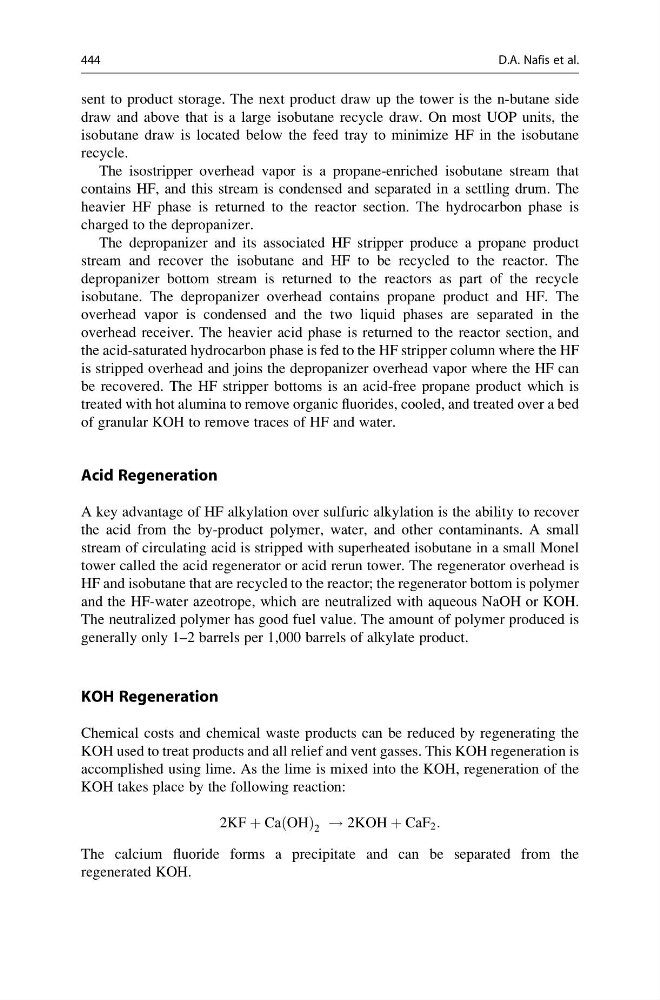
KOH takes place by the following reaction:
2KF þ Ca OH
ð Þ 2 ! 2KOH þ CaF 2 :
The calcium fluoride forms a precipitate and can be separated from the
regenerated KOH.
444
D.A. Nafis et al.
draw and above that is a large isobutane recycle draw. On most UOP units, the
isobutane draw is located below the feed tray to minimize HF in the isobutane
recycle.
The isostripper overhead vapor is a propane-enriched isobutane stream that
contains HF, and this stream is condensed and separated in a settling drum. The
heavier HF phase is returned to the reactor section. The hydrocarbon phase is
charged to the depropanizer.
The depropanizer and its associated HF stripper produce a propane product
stream and recover the isobutane and HF to be recycled to the reactor. The
depropanizer bottom stream is returned to the reactors as part of the recycle
isobutane. The depropanizer overhead contains propane product and HF. The
overhead vapor is condensed and the two liquid phases are separated in the
overhead receiver. The heavier acid phase is returned to the reactor section, and
the acid-saturated hydrocarbon phase is fed to the HF stripper column where the HF
is stripped overhead and joins the depropanizer overhead vapor where the HF can
be recovered. The HF stripper bottoms is an acid-free propane product which is
treated with hot alumina to remove organic fluorides, cooled, and treated over a bed
of granular KOH to remove traces of HF and water.
Acid Regeneration
A key advantage of HF alkylation over sulfuric alkylation is the ability to recover
the acid from the by-product polymer, water, and other contaminants. A small
stream of circulating acid is stripped with superheated isobutane in a small Monel
tower called the acid regenerator or acid rerun tower. The regenerator overhead is
HF and isobutane that are recycled to the reactor; the regenerator bottom is polymer
and the HF-water azeotrope, which are neutralized with aqueous NaOH or KOH.
The neutralized polymer has good fuel value. The amount of polymer produced is
generally only 1–2 barrels per 1,000 barrels of alkylate product.
KOH Regeneration
Chemical costs and chemical waste products can be reduced by regenerating the
KOH used to treat products and all relief and vent gasses. This KOH regeneration is
accomplished using lime. As the lime is mixed into the KOH, regeneration of the
KOH takes place by the following reaction:
2KF þ Ca OH
ð Þ 2 ! 2KOH þ CaF 2 :
The calcium fluoride forms a precipitate and can be separated from the
regenerated KOH.
444
D.A. Nafis et al.