

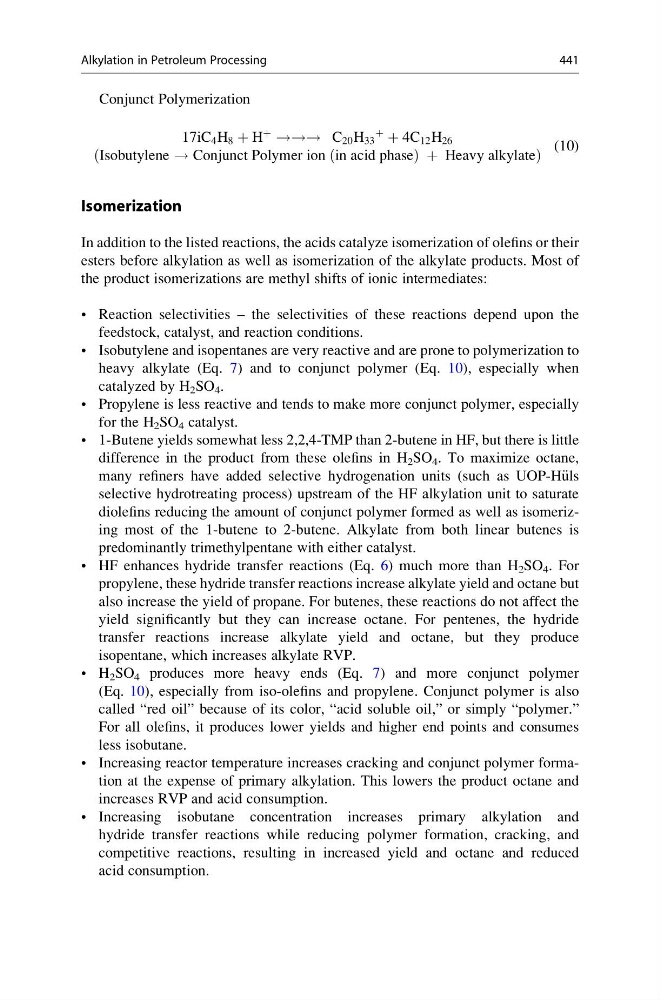
Conjunct Polymerization
17iC 4 H 8 þ H
þ
!!! C 20 H 33
þ
þ 4C 12 H 26
Isobutylene ! Conjunct Polymer ion in acid phase
ð
ÞþHeavy alkylate
ð
Þ
(10)
Isomerization
In addition to the listed reactions, the acids catalyze isomerization of olefins or their
esters before alkylation as well as isomerization of the alkylate products. Most of
the product isomerizations are methyl shifts of ionic intermediates:
• Reaction selectivities – the selectivities of these reactions depend upon the
feedstock, catalyst, and reaction conditions.
• Isobutylene and isopentanes are very reactive and are prone to polymerization to
heavy alkylate (Eq. 7) and to conjunct polymer (Eq. 10), especially when
catalyzed by H 2 SO 4 .
• Propylene is less reactive and tends to make more conjunct polymer, especially
for the H 2 SO 4 catalyst.
• 1-Butene yields somewhat less 2,2,4-TMP than 2-butene in HF, but there is little
difference in the product from these olefins in H 2 SO 4 . To maximize octane,
many refiners have added selective hydrogenation units (such as UOP-H€ uls
selective hydrotreating process) upstream of the HF alkylation unit to saturate
diolefins reducing the amount of conjunct polymer formed as well as isomerizing most of the 1-butene to 2-butene. Alkylate from both linear butenes is
predominantly trimethylpentane with either catalyst.
• HF enhances hydride transfer reactions (Eq. 6) much more than H 2 SO 4 . For
propylene, these hydride transfer reactions increase alkylate yield and octane but
also increase the yield of propane. For butenes, these reactions do not affect the
yield significantly but they can increase octane. For pentenes, the hydride
transfer reactions increase alkylate yield and octane, but they produce
isopentane, which increases alkylate RVP.
• H 2 SO 4 produces more heavy ends (Eq. 7) and more conjunct polymer
(Eq. 10), especially from iso-olefins and propylene. Conjunct polymer is also
called “red oil” because of its color, “acid soluble oil,” or simply “polymer.”
For all olefins, it produces lower yields and higher end points and consumes
less isobutane.
• Increasing reactor temperature increases cracking and conjunct polymer formation at the expense of primary alkylation. This lowers the product octane and
increases RVP and acid consumption.
• Increasing isobutane concentration increases primary alkylation and
hydride transfer reactions while reducing polymer formation, cracking, and
competitive reactions, resulting in increased yield and octane and reduced
acid consumption.
Alkylation in Petroleum Processing
441
17iC 4 H 8 þ H
þ
!!! C 20 H 33
þ
þ 4C 12 H 26
Isobutylene ! Conjunct Polymer ion in acid phase
ð
ÞþHeavy alkylate
ð
Þ
(10)
Isomerization
In addition to the listed reactions, the acids catalyze isomerization of olefins or their
esters before alkylation as well as isomerization of the alkylate products. Most of
the product isomerizations are methyl shifts of ionic intermediates:
• Reaction selectivities – the selectivities of these reactions depend upon the
feedstock, catalyst, and reaction conditions.
• Isobutylene and isopentanes are very reactive and are prone to polymerization to
heavy alkylate (Eq. 7) and to conjunct polymer (Eq. 10), especially when
catalyzed by H 2 SO 4 .
• Propylene is less reactive and tends to make more conjunct polymer, especially
for the H 2 SO 4 catalyst.
• 1-Butene yields somewhat less 2,2,4-TMP than 2-butene in HF, but there is little
difference in the product from these olefins in H 2 SO 4 . To maximize octane,
many refiners have added selective hydrogenation units (such as UOP-H€ uls
selective hydrotreating process) upstream of the HF alkylation unit to saturate
diolefins reducing the amount of conjunct polymer formed as well as isomerizing most of the 1-butene to 2-butene. Alkylate from both linear butenes is
predominantly trimethylpentane with either catalyst.
• HF enhances hydride transfer reactions (Eq. 6) much more than H 2 SO 4 . For
propylene, these hydride transfer reactions increase alkylate yield and octane but
also increase the yield of propane. For butenes, these reactions do not affect the
yield significantly but they can increase octane. For pentenes, the hydride
transfer reactions increase alkylate yield and octane, but they produce
isopentane, which increases alkylate RVP.
• H 2 SO 4 produces more heavy ends (Eq. 7) and more conjunct polymer
(Eq. 10), especially from iso-olefins and propylene. Conjunct polymer is also
called “red oil” because of its color, “acid soluble oil,” or simply “polymer.”
For all olefins, it produces lower yields and higher end points and consumes
less isobutane.
• Increasing reactor temperature increases cracking and conjunct polymer formation at the expense of primary alkylation. This lowers the product octane and
increases RVP and acid consumption.
• Increasing isobutane concentration increases primary alkylation and
hydride transfer reactions while reducing polymer formation, cracking, and
competitive reactions, resulting in increased yield and octane and reduced
acid consumption.
Alkylation in Petroleum Processing
441