

should be avoided since they will tend to reduce the useful life of the catalyst. An
increase in the charge rate will require higher reactor temperature to achieve a
constant desulfurization (or denitrogenation) as well as higher recycle gas rate to
maintain a constant ratio of H 2 to hydrocarbon. The increased reactor temperatures
will lead to a faster rate of coke formation that will reduce the cycle length.
A reduced feed rate may lead to bad flow distribution through the catalyst, such
that higher temperatures will be required to obtain good product quality. A feed’s
distillation range and API gravity best indicate the type of feed being processed. An
increase in the end point of the feed will make sulfur and nitrogen removal more
difficult, thus requiring higher reactor temperatures which, in turn, accelerate coke
formation. Coke deposition is also accelerated by the fact that heavier feed contains
more of the precursors that favor coke formation. In addition to the above, high
boiling fractions also contain increased quantities of metals which lead not only to
higher reactor pressure drop but to rapid catalyst deactivation as well. A reduction
in the API gravity of the feed for the same boiling range is an indication of higher
unsaturates content. This type of feed will result in increased hydrogen consumption and higher temperature rise across the catalyst bed. It also contains more of the
materials that easily condense to form coke in the reactor and associated equipment.
Hydrogen Partial Pressure
The hydrogen partial pressure is calculated by multiplying the H 2 purity of the
recycle gas times the pressure of the product separator. The hydrogen partial
pressure required for the operation of a unit is chosen based on the degree of sulfur
(or nitrogen, or aromatic saturation) removal that must be achieved and is generally
an economic optimum that balances capital cost and operating costs against catalyst
life. Hydrogen partial pressure is also a critical design parameter for achieving the
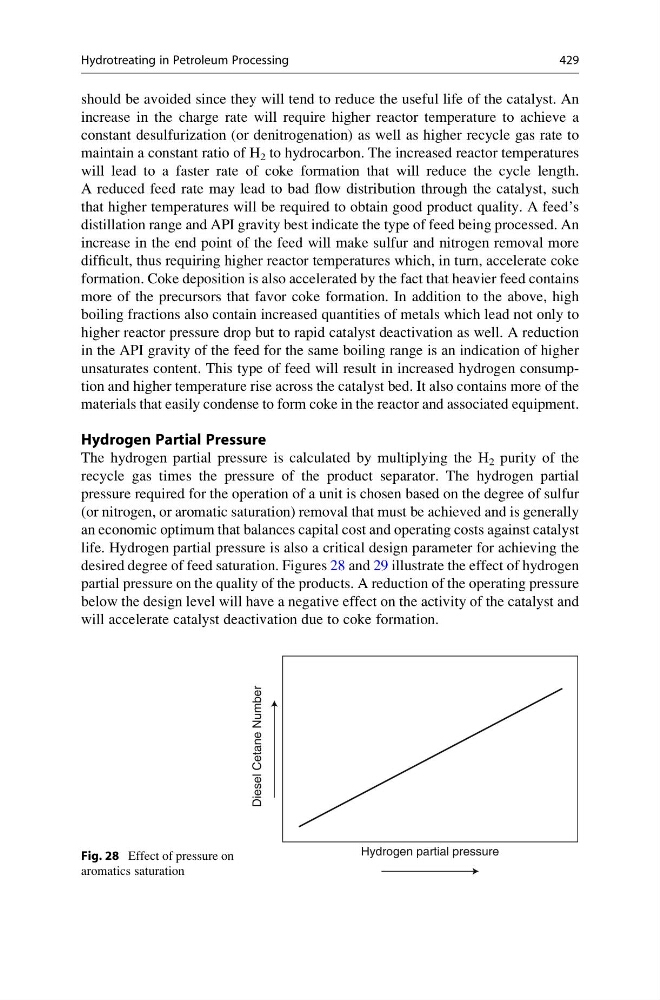
desired degree of feed saturation. Figures 28 and 29 illustrate the effect of hydrogen
partial pressure on the quality of the products. A reduction of the operating pressure
below the design level will have a negative effect on the activity of the catalyst and
will accelerate catalyst deactivation due to coke formation.
Hydrogen partial pressure
Diesel Cetane Number
Fig. 28 Effect of pressure on
aromatics saturation
Hydrotreating in Petroleum Processing
429
increase in the charge rate will require higher reactor temperature to achieve a
constant desulfurization (or denitrogenation) as well as higher recycle gas rate to
maintain a constant ratio of H 2 to hydrocarbon. The increased reactor temperatures
will lead to a faster rate of coke formation that will reduce the cycle length.
A reduced feed rate may lead to bad flow distribution through the catalyst, such
that higher temperatures will be required to obtain good product quality. A feed’s
distillation range and API gravity best indicate the type of feed being processed. An
increase in the end point of the feed will make sulfur and nitrogen removal more
difficult, thus requiring higher reactor temperatures which, in turn, accelerate coke
formation. Coke deposition is also accelerated by the fact that heavier feed contains
more of the precursors that favor coke formation. In addition to the above, high
boiling fractions also contain increased quantities of metals which lead not only to
higher reactor pressure drop but to rapid catalyst deactivation as well. A reduction
in the API gravity of the feed for the same boiling range is an indication of higher
unsaturates content. This type of feed will result in increased hydrogen consumption and higher temperature rise across the catalyst bed. It also contains more of the
materials that easily condense to form coke in the reactor and associated equipment.
Hydrogen Partial Pressure
The hydrogen partial pressure is calculated by multiplying the H 2 purity of the
recycle gas times the pressure of the product separator. The hydrogen partial
pressure required for the operation of a unit is chosen based on the degree of sulfur
(or nitrogen, or aromatic saturation) removal that must be achieved and is generally
an economic optimum that balances capital cost and operating costs against catalyst
life. Hydrogen partial pressure is also a critical design parameter for achieving the
desired degree of feed saturation. Figures 28 and 29 illustrate the effect of hydrogen
partial pressure on the quality of the products. A reduction of the operating pressure
below the design level will have a negative effect on the activity of the catalyst and
will accelerate catalyst deactivation due to coke formation.
Hydrogen partial pressure
Diesel Cetane Number
Fig. 28 Effect of pressure on
aromatics saturation
Hydrotreating in Petroleum Processing
429